

More news on this day
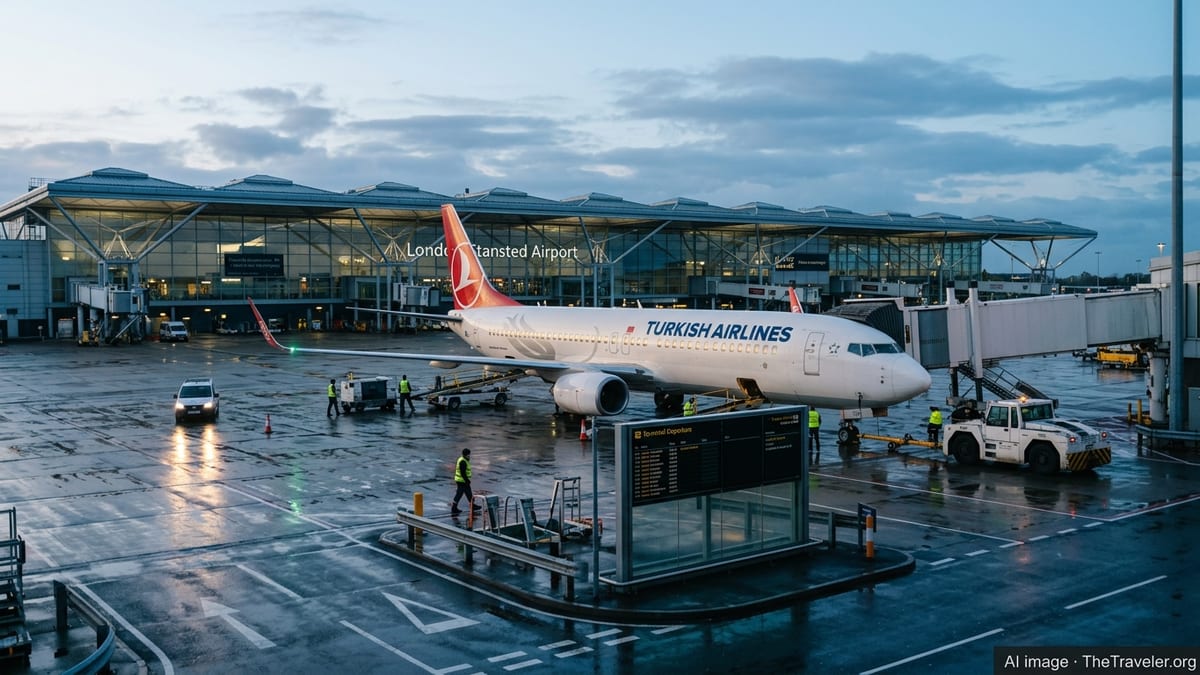
Turkish Airlines is set to deepen its footprint in the UK with a new nonstop service between Istanbul Airport and London Stansted from March 18, 2026, a move expected to reshape travel flows between London, the East of England and Türkiye.
Get the latest news straight to your inbox!
A Third London Gateway for Türkiye’s Flag Carrier
Publicly available information shows that London Stansted will become Turkish Airlines’ third London airport, joining its established operations at Heathrow and Gatwick. The addition underlines how important the UK market has become for the carrier, which has steadily increased flights from Istanbul to major British and Irish cities in recent seasons.
According to published coverage, flights between Istanbul Airport and London Stansted are scheduled to begin on March 18, 2026, with 14 weekly frequencies. This twice‑daily pattern positions the route as a core part of the airline’s UK network rather than a niche add‑on, indicating confidence in sustained demand from both leisure and business travelers.
Stansted’s role as a fast‑growing base for both low‑cost and full‑service airlines provides Turkish Airlines with a different demographic mix from Heathrow’s premium‑heavy traffic and Gatwick’s strong long‑haul leisure segment. Industry reports indicate that the carrier is targeting passengers across North and East London, the East of England, and surrounding counties who currently face longer surface journeys to reach Heathrow or Gatwick.
Airport planning documents and local authority papers referencing the new service suggest that Stansted’s growth strategy is explicitly tied to attracting more full‑service, network airlines. Turkish Airlines’ arrival fits that ambition, bringing a global hub connection to an airport that has historically been dominated by point‑to‑point low‑cost carriers.
New Options for UK Leisure and Business Travelers
The Istanbul–Stansted route is expected to appeal strongly to UK holidaymakers heading to Türkiye’s coastal resorts and cultural destinations. While Stansted already offers significant capacity to Turkish leisure markets through low‑cost operators, the new service introduces a full‑service alternative with through‑ticketing, checked‑through baggage and connection guarantees via Istanbul.
For business travelers and internationally mobile professionals based in the growing corridor from Cambridge to the north and east of London, Stansted’s new link to Turkish Airlines’ hub creates a one‑stop option to a wide range of cities across the Middle East, Africa, Asia and beyond. Published network maps show that Istanbul already functions as a major transfer point between Europe and destinations such as the Gulf, South Asia and Southeast Asia, giving Stansted passengers one‑stop access to markets previously more easily reached via Heathrow.
The route is also likely to support visiting‑friends‑and‑relatives traffic between the UK and Türkiye, which continues to grow alongside student and professional mobility. Travel industry analyses point out that the Turkish diaspora in Britain is concentrated in London and surrounding regions, making an additional, conveniently located London gateway particularly attractive.
For travelers, the availability of three distinct London airports served by the same carrier can translate into more flexibility on timing and fares. Passengers may choose Heathrow for premium connections, Gatwick for certain long‑haul pairings, or Stansted for easier access from the East of England, depending on their origin and itinerary.
Strengthening Türkiye’s Position as a Global Transit Hub
The new Istanbul–Stansted route also strengthens Türkiye’s strategic role as a connecting hub between Europe and the rest of the world. Istanbul Airport has been developed with large‑scale transfer traffic in mind, and Turkish Airlines has steadily built a network that links secondary European cities to long‑haul destinations through coordinated schedules.
Recent network developments, including frequency increases on routes to key international markets, show that the airline is continuing to use Istanbul as a platform for growth. Adding Stansted to the UK portfolio extends that strategy into one of Europe’s most competitive aviation markets, and offers UK travelers another alternative to traditional Western European hubs.
Analysts note that demand for one‑stop itineraries via Istanbul has benefited from travelers looking for schedule choice and competitive pricing without necessarily routing through the largest Western European airports. By tapping into Stansted’s catchment area, Turkish Airlines gains access to a pool of passengers who may previously have connected through Amsterdam, Paris, Frankfurt or London Heathrow for their long‑haul journeys.
For Türkiye, the move reinforces the country’s broader ambition to position Istanbul Airport as a leading global transfer node. Each additional spoke, such as Stansted, adds density to the network, improving connectivity and feeding traffic into long‑haul services that rely on a mix of local and connecting passengers.
Implications for Stansted and UK Aviation Strategy
From a UK aviation perspective, the announcement aligns with broader efforts to distribute long‑haul and connecting traffic more evenly across the southeast of England’s airports. Stansted has long argued that it has capacity to absorb additional growth without the infrastructure pressures faced by Heathrow, and attracting a major network carrier like Turkish Airlines supports that narrative.
Airport statements and planning materials indicate that new long‑haul and hub‑connecting services are central to Stansted’s long‑term vision. Turkish Airlines’ entry not only diversifies the airport’s airline mix but also enhances its resilience by reducing reliance on a small number of large low‑cost operators.
For regional economies in the East of England, improved global connectivity can support trade, investment and tourism. Businesses in sectors such as technology, life sciences and education, which are prominent in the Cambridge–Stansted corridor, gain a more convenient route to partners and markets across Türkiye and further afield.
At the same time, competition among carriers serving UK–Türkiye routes is likely to intensify. Existing operators from Stansted and other London airports may respond with pricing adjustments or schedule changes, giving travelers more choice but also increasing pressure on airlines to differentiate through service and network quality.
A Competitive Edge in a Crowded Market
Industry observers view the Istanbul–Stansted launch as part of Turkish Airlines’ wider European growth strategy, in which the UK has emerged as a central pillar. Recent schedule changes have added capacity across multiple British and Irish airports, signaling confidence in demand and a willingness to compete in a market where low‑cost carriers have a strong presence.
By combining a full‑service product with the convenience of a local London airport for many travelers, Turkish Airlines aims to carve out a distinct niche at Stansted. The airline’s extensive onward network, inclusive services and stopover or layover programs in Istanbul may help attract passengers who value a more traditional network‑carrier experience but live closer to Stansted than to Heathrow or Gatwick.
Travel analysts note that the timing of the launch, just ahead of the peak 2026 summer season, is designed to capture both leisure and business traffic. With 14 weekly flights scheduled from the outset, the route opens at a scale that allows for meaningful competition and schedule choice, rather than tentative, low‑frequency testing of the market.
As tickets become available and schedules firm up, passenger response will determine how quickly the route matures and whether further capacity increases follow. For now, the decision to add London Stansted to the Istanbul network underscores the growing importance of the UK for Türkiye’s flag carrier and signals a new phase in the aviation relationship between the two countries.