

More news on this day
Turkish Airlines has joined a growing list of major international carriers reducing or suspending flights across West Asia, as escalating conflict, rolling airspace closures and fast-changing security restrictions disrupt some of the world’s busiest long-haul corridors.
Get the latest news straight to your inbox!
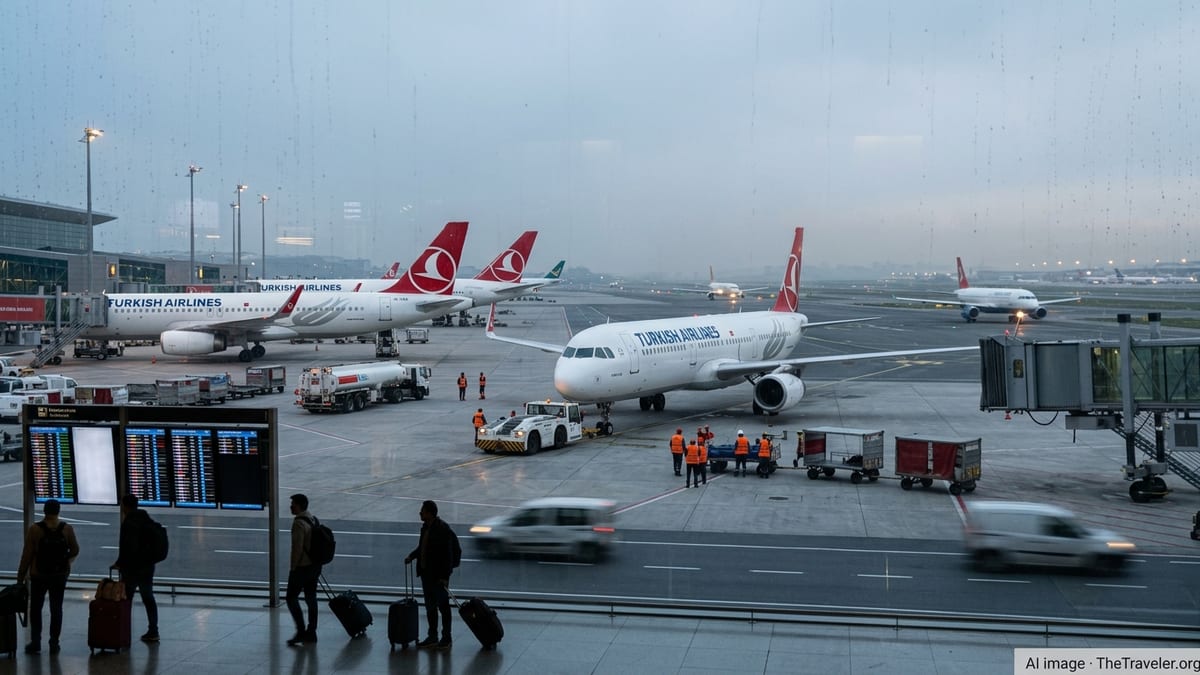
Turkish Airlines Scales Back as Conflict Redraws Regional Skies
Publicly available flight information shows that Turkish Airlines has been progressively trimming services across West Asia following a wave of airspace closures linked to the war involving Iran, Israel and several Gulf states. Routes touching Iranian, Iraqi and Israeli airspace have faced particular disruption, with schedules adjusted at short notice and some services withdrawn entirely on certain days.
Industry trackers indicate that Turkey’s flag carrier has focused on consolidating operations through Istanbul, reducing frequencies on selected routes into the Gulf and Levant and rerouting others around closed or restricted air corridors. These adjustments are adding flying time and fuel burn on east–west services that previously relied on relatively direct tracks over Iran and neighboring states.
While Turkish Airlines continues to serve many key destinations in the wider region, its decision to pare back flights places it in the same camp as a number of global peers that have concluded current conditions in parts of West Asia are too unstable to support normal operations. The changes underscore how quickly regional tension can ripple into airline network planning and traveler confidence.
For passengers, the impact ranges from outright cancellations to more subtle schedule shifts and aircraft swaps. Travel agents report that connecting itineraries through Istanbul now require closer scrutiny, as minimum connection times can be eroded by longer routings around restricted airspace and by knock-on delays elsewhere in the network.
United, Air France, JAL, Vietnam Airlines, Finnair and airBaltic Adjust Plans
Turkish Airlines’ move is part of a broader retrenchment by global carriers that traditionally rely on Middle Eastern airspace as a bridge between Europe, Asia, Africa and Oceania. United Airlines has issued a series of “Middle East unrest” waivers for customers, allowing fee-free changes on itineraries touching the region as it pares schedules and re-times flights between North America, the eastern Mediterranean and South Asia.
European carrier Air France has been rerouting and periodically suspending services that would typically cross Iranian or Iraqi airspace, instead operating longer northerly or southerly tracks when conditions and traffic rights permit. According to published route data, this has added significant block time on some flights to the Indian subcontinent and further into Asia, tightening aircraft utilization and increasing operating costs.
In Asia, Japan Airlines and Vietnam Airlines have reworked flight plans on routes to Europe and the Middle East, in several cases avoiding direct overflight of the most volatile areas. Public schedules indicate that some departures have disappeared from timetables or had booking halted for selected travel dates as planners seek operational flexibility. Finnair and airBaltic, both heavily exposed to changing overflight restrictions in Europe and Eurasia, have also trimmed capacity on select services that would normally take advantage of Middle Eastern corridors.
The combined effect is a patchwork of service reductions that does not always show up as a headline cancellation. Some airlines are quietly downgrading aircraft size, consolidating frequencies or shifting flights to less risky nighttime or early-morning slots, leaving travelers to piece together alternatives across multiple carriers and hubs.
Airspace Closures, Notams and Security Rules Drive Network Turmoil
The latest turmoil stems from a cascade of airspace notices to air missions, or NOTAMs, issued since late February across Iran, Israel, Iraq, Qatar, Kuwait, Bahrain and parts of the United Arab Emirates and Saudi Arabia. Travel advisories and aviation bulletins describe partial or full closures, altitude restrictions and corridor limits that have forced airlines to abandon traditional high-traffic routes over the heart of the Middle East.
Some hubs, such as Doha and airports in the UAE, have gradually reopened to limited traffic, but capacity remains far below pre-crisis levels. Industry briefings note that controllers are managing crowded detour routes on the periphery of the conflict zone, often over Turkey, the Caucasus, Central Asia and the eastern Mediterranean, increasing congestion in airspace that was already busy.
The situation is compounded by overlapping disruptions elsewhere, including restrictions that have periodically affected Pakistani airspace and heightened security scrutiny at airports in Europe, North America and Asia for flights transiting to or from the conflict region. For airlines, each new NOTAM or security advisory can trigger rapid revisions to flight plans, with knock-on effects across widebody fleets and crewing rosters.
Operational bulletins circulated to corporate travel clients highlight that many of these restrictions are described as temporary but are repeatedly extended, leaving planners reliant on short-term workarounds rather than stable, long-range schedules. This uncertainty has become a defining feature of long-haul travel planning for West Asia in early 2026.
Longer Routes, Higher Costs and Itineraries in Disarray
With direct corridors over Iran, Iraq and adjacent states heavily restricted, long-haul flights between Europe and South or Southeast Asia are in many cases detouring via northern or southern arcs that add hundreds of nautical miles to a typical journey. Analysts note that additional flying time of 60 to 120 minutes on a single sector is becoming common on some detoured routes.
These longer routings mean higher fuel consumption at a time of already elevated energy prices, squeezing airline margins and, in some cases, prompting capacity cuts on marginal routes. Cargo operators are also affected, with logistics updates describing delays and reduced uplift on key lanes connecting Asia, the Middle East, Europe and Africa.
For travelers, the disruption is highly uneven. Some passengers find their flights canceled outright with offers of rerouting days later, while others experience multiple rebookings in the same trip as airlines adjust to shifting airspace access. Reports from airports in South Asia, Africa and Europe describe pockets of stranded travelers when services to Middle Eastern hubs are suspended with limited notice.
Travel management companies are advising clients to allow greater buffers between connecting flights, to monitor bookings closely in the days before departure and to consider alternative routings that avoid the most volatile airspace, even if that means backtracking or additional stops. Flexible ticket rules introduced by many airlines provide some relief, but do not fully offset the inconvenience of disrupted journeys.
What the Shake-Up Means for Future West Asia Travel
As Turkish Airlines and its global peers navigate this extended period of instability, the traditional role of West Asian hubs as seamless bridges between continents is under acute pressure. Analysts point out that carriers in Europe, North America and Asia are reassessing how much of their long-haul strategy can rely on airspace and infrastructure that can be curtailed overnight by geopolitical events.
Some aviation commentators suggest that, depending on how long restrictions persist, airlines may rebalance capacity toward more northerly transcontinental routes or deepen partnerships that allow them to switch connecting points quickly when a particular corridor is closed. For travelers, this could mean a longer-term shift in the default pathways between Europe, Asia, Africa and Oceania.
For now, Turkish Airlines’ decision to join United, Air France, Japan Airlines, Vietnam Airlines, Finnair, airBaltic and others in curbing operations through the most affected parts of West Asia captures the scale of the challenge. The region remains a vital crossroads, but its skies have become a complex maze of restrictions, detours and evolving risks that airlines must navigate flight by flight.
Until the conflict landscape stabilizes and airspace authorities relax the tight web of limitations now in place, passengers planning trips through or near West Asia are likely to face a higher risk of last-minute changes, longer journeys and a continuing sense of uncertainty around a part of the world that once prided itself on unrivaled connectivity.