

More news on this day
London Stansted’s fast‑growing route map has taken a strategic leap with the launch of Turkish Airlines flights to Istanbul, positioning the airport alongside Europe’s leading carriers and opening up hundreds of new one‑stop connections worldwide.
Get the latest news straight to your inbox!
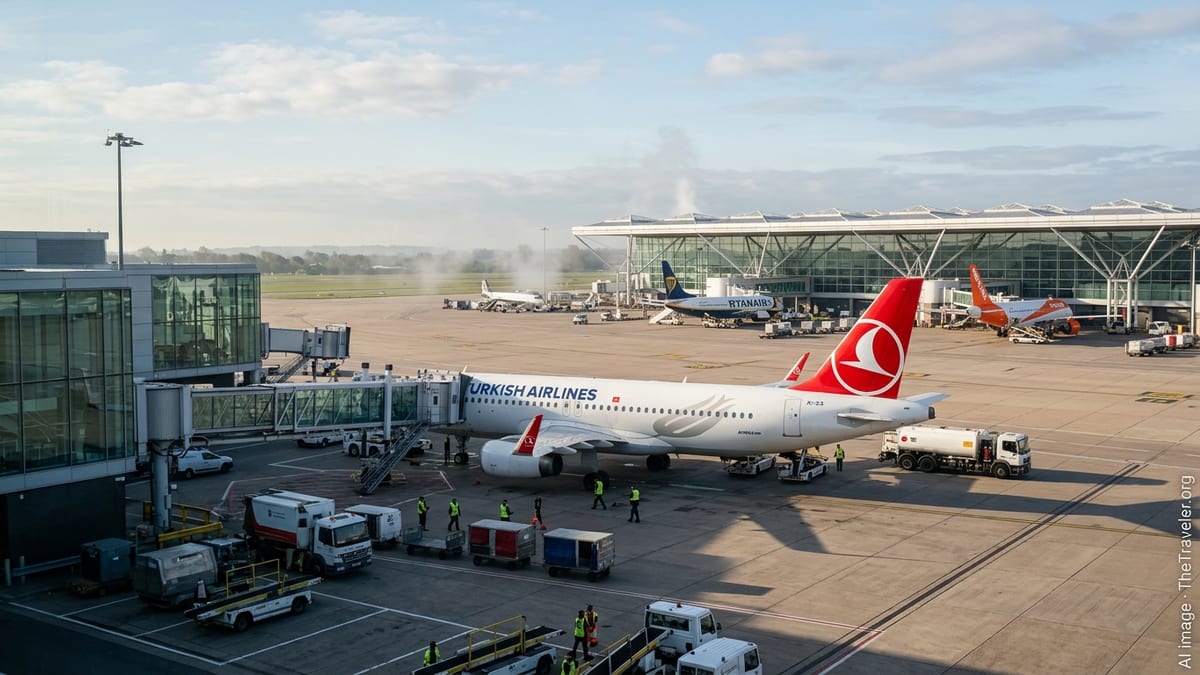
A New Flag Carrier Joins Stansted’s Low-Cost Powerhouse
Turkish Airlines has officially added London Stansted to its UK network, introducing direct flights to Istanbul Airport and giving the East of England a full-service global carrier alongside established low-cost operators such as easyJet and Ryanair. Publicly available information indicates that flights began operating in March 2026, following months of preparation and schedule loading by the airline and the airport.
The move elevates Stansted’s profile beyond its traditional focus on European short-haul routes. While Ryanair, easyJet, Jet2.com and other leisure-focused airlines account for a large share of the airport’s traffic, the arrival of Turkey’s national carrier brings long-haul reach through Istanbul’s role as a major intercontinental hub. Industry coverage highlights that Turkish Airlines already serves Heathrow, Gatwick, Manchester, Birmingham and Edinburgh, making Stansted its sixth UK gateway.
For Stansted, the partnership supports a broader strategy to diversify its airline mix and strengthen its appeal to business travellers and long-haul leisure passengers. Airport planning documents and outreach material describe ambitions to grow passenger numbers further over the next two decades, with new network partnerships seen as central to that plan.
For Turkish Airlines, adding Stansted extends the carrier’s access to the London market into a catchment area stretching across the East of England, north and east London, and parts of the Midlands, where road and rail links to Heathrow or Gatwick can be significantly less convenient.
Route Details: Frequency, Schedule and Network Reach
Timetable data and airline announcements show that Turkish Airlines has structured the Istanbul–Stansted route with multiple daily departures designed to connect into its global bank of flights at Istanbul Airport. Initial plans called for 10 weekly rotations from mid-March 2026, ramping up to 14 per week with the switch to the northern summer schedule, providing double-daily service on most days.
Published schedules indicate that flights are spread across morning, afternoon and evening departure waves, improving onward connection options. Typical timings include a morning departure from Istanbul that arrives at Stansted before midday, an afternoon service that reaches London in the late afternoon, and an evening departure timed to land late at night. Return services from Stansted are arranged to feed into onward flights to Asia, Africa, the Middle East and beyond the following day.
From a connectivity standpoint, the new route is less about point-to-point London–Istanbul demand, which is already served from other London airports, and more about the one-stop links it offers. Through Istanbul, passengers from Stansted gain access to destinations across Southeast Asia, the Indian subcontinent, the Gulf, East and West Africa, as well as North and South America, often with coordinated minimum connection times and through-checked baggage.
Travel industry analysis notes that this routing can be especially attractive for travellers in the airport’s catchment who previously needed to backtrack across London to reach a long-haul hub, or who relied on indirect connections through European low-cost and hybrid carriers with less integrated transfer products.
Stansted’s 2026 Growth Story: From Regional Gateway to Global Node
The Turkish Airlines launch comes amid a broader wave of capacity and route growth at London Stansted in 2026. Trade and tourism publications outline a series of new and expanded services from airlines including Ryanair, easyJet, Jet2.com, TUI and BA CityFlyer, adding frequencies and destinations across Europe, North Africa and the eastern Mediterranean.
Airport strategy documents describe an ambition to raise Stansted’s annual passenger cap over the coming years, backed by infrastructure upgrades and terminal enhancements. The addition of a full-service network carrier operating into a global hub is seen as a key milestone in this evolution, broadening the airport’s appeal beyond price-sensitive holiday traffic to include premium and connecting passengers.
Reports on the local economy suggest that improved connectivity is particularly important for export-focused businesses in the East of England, many of which rely on rapid access to overseas clients and supply chains. Turkish Airlines’ extensive network into emerging markets in Africa, Central Asia and the Middle East aligns closely with these trade flows, potentially shortening travel times and reducing the need for surface journeys to more distant London airports.
Tourism bodies also point to potential inbound gains. The new Istanbul route provides an additional entry point for visitors from Asia and the Middle East who may be combining London and wider UK itineraries, with Stansted offering convenient access to destinations such as Cambridge, Norwich and coastal areas of Essex and Suffolk.
What Travellers Should Know Now
For passengers considering the new service, several practical points emerge from currently available schedules and airport guidance. Turkish Airlines is operating the Istanbul–Stansted route with narrowbody aircraft configured for both economy and business class, offering a different onboard product to the all-economy layouts common on many of Stansted’s low-cost routes.
The schedule typically supports same-day connections across much of the Turkish Airlines network, but travellers are advised, based on general industry practice, to review minimum connection times and any visa or transit requirements that may apply when passing through Istanbul. Published airline information notes that some passengers on longer layovers may be eligible for stopover or transit hotel programs, although these schemes carry specific terms and conditions and are subject to change.
From a ground-access perspective, Stansted remains linked to London by dedicated express rail services and a range of coach and bus routes. For travellers starting their journey in the East of England, this can significantly reduce surface travel compared with journeys to Heathrow or Gatwick, which often involve cross-London transfers or longer motorway drives.
Fare data and early booking trends reported in trade media suggest that pricing on the Stansted route is being positioned competitively against both other London–Istanbul services and rival one-stop options via continental hubs. However, as with most network airlines, yields can vary considerably depending on season, booking window and cabin selected, so advance comparison remains important.
Competitive Landscape and Outlook for Demand
Turkish Airlines’ arrival places Stansted more firmly in the competitive race among Europe’s major airports vying for long-haul and connecting traffic. Low-cost carriers such as Ryanair and easyJet continue to dominate the airport’s seat capacity, but the presence of a global network carrier strengthens Stansted’s hand in attracting both leisure and corporate travellers seeking integrated itineraries beyond Europe.
Analysts note that the Istanbul hub adds an alternative to connections via Frankfurt, Amsterdam, Paris or the Gulf, often appealing to passengers on eastbound routes thanks to its geography and the breadth of the Turkish Airlines network. This diversification may also increase resilience for travellers when disruption affects particular regions or alliances.
Looking ahead, industry commentary suggests that success on the Stansted route could pave the way for further capacity or additional destinations from the airport, particularly if long-haul demand from the East of England continues to rise. Airport planning material highlights long-term interest in securing more widebody services and expanding links to North America and Asia, with the Turkish Airlines partnership seen as a proof point for Stansted’s viability as a global node.
For now, the new Istanbul service marks a significant shift in Stansted’s profile. With Turkish Airlines joining easyJet, Ryanair and other leading European carriers at the airport, travellers in the region gain broader choice and a more direct pathway into an extensive worldwide network, underscoring how secondary airports are increasingly central to Europe’s evolving air connectivity landscape.