

More news on this day
Turkish Airlines has reported an operating profit of 2.2 billion dollars for 2025, underscoring the carrier’s rise as one of global aviation’s most profitable and strategically influential airlines even as the industry continues to grapple with cost pressures and geopolitical uncertainty.
Get the latest news straight to your inbox!
Solid 2025 Results Build on Consecutive Years of Profit
Publicly available financial disclosures for 2025 indicate that Turkish Airlines generated an operating profit of approximately 2.2 billion dollars, slightly lower than the previous year but still among the strongest results in the airline’s history. Revenue rose to around 24.1 billion dollars, supported by sustained demand for both long haul and regional travel across the carrier’s extensive network.
Reports on the airline’s 2024 performance showed net profit in the range of 2.4 to nearly 3 billion dollars, depending on methodology and exchange rate assumptions, positioning 2025 as another highly profitable year despite margin pressures. Industry analysts note that while operating profit in 2025 declined by high single digits compared with 2024, the company maintained a healthy double digit margin that many competitors are still struggling to reach.
Observers point to the carrier’s multi year track record of profitability as evidence of a business model that is withstanding volatile fuel prices, supply chain constraints and shifting demand patterns. Turkish Airlines’ ability to sustain multi billion dollar profit from main operations puts it in a small group of network carriers that have fully moved beyond the pandemic era downturn and are using their financial strength to accelerate growth.
Istanbul Hub Strategy Strengthens Global Connectivity
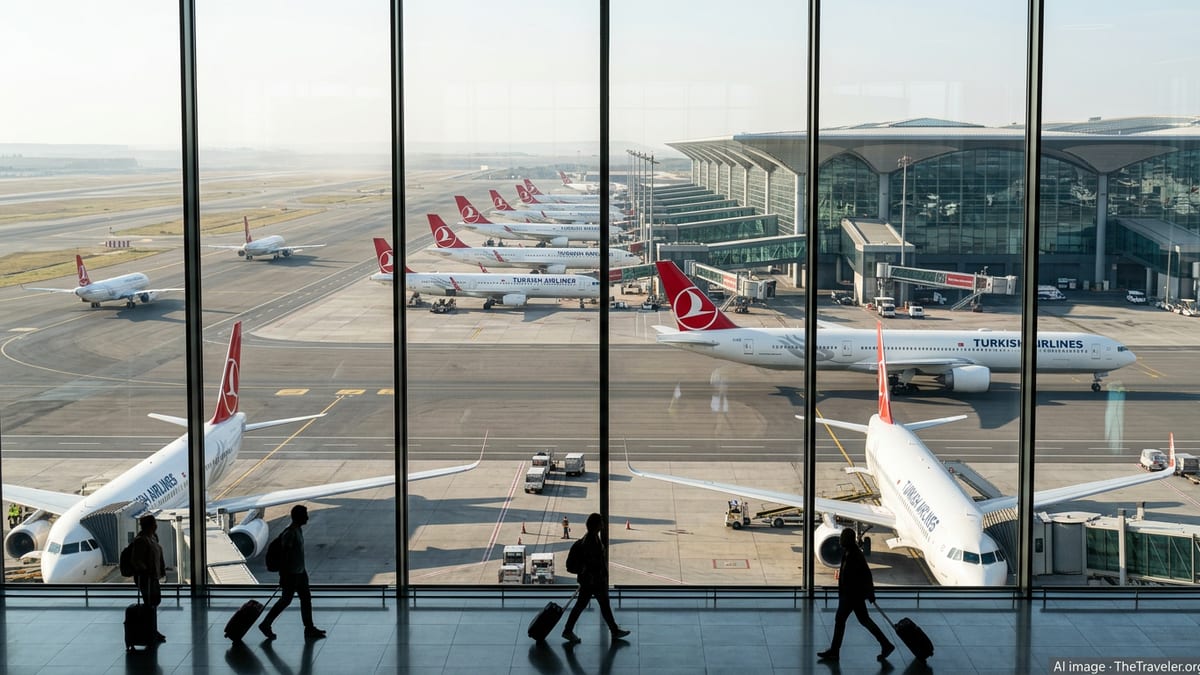
Central to the 2025 performance is Turkish Airlines’ continued leveraging of Istanbul as a global super hub linking Europe, Asia, Africa and the Americas. Traffic data and airline communications show that the carrier now flies to more countries than any other airline, with a network that spans more than 300 destinations and over 100 countries.
The expansion of Istanbul Airport and the airline’s growing widebody fleet have enabled increased capacity on high demand routes, particularly to North America, the Middle East and key African gateways. Capacity, measured in available seat kilometres, rose by mid single digits in 2025, while passenger revenue grew at a similar pace, indicating that the airline was able to add seats without materially diluting yields.
Analysts highlight that Turkish Airlines’ model focuses on funnelling connecting traffic through Istanbul rather than relying primarily on point to point origin and destination markets. This hub and spoke approach allows the carrier to serve thinner city pairs with competitive one stop itineraries, capturing demand that might otherwise flow through Gulf or European hubs. The 2025 profit figures suggest that this strategy continues to deliver scale benefits that support strong operating margins.
Cargo, Ancillary Revenue and Cost Discipline Support Margins
Beyond its core passenger business, Turkish Airlines continues to benefit from a diversified revenue mix that includes a fast growing cargo division and a broad portfolio of ancillary services. Previous years’ reports showed Turkish Cargo ranking among the world’s top airfreight operators, and 2025 performance commentary indicates that cargo remained an important contributor to overall profitability, even as global freight yields normalised from earlier peaks.
Ancillary revenues from services such as extra baggage, seat selection, and loyalty programme partnerships have also become a more meaningful share of total income. Aviation sector analysis notes that these non ticket revenues help buffer the impact of competitive fares and promotional activity, particularly on routes where low cost and regional rivals are active.
On the cost side, inflationary pressures in Türkiye, higher labour expenses and continued maintenance costs on an expanding fleet weighed on results. However, financial filings for 2025 show that unit cost discipline and fuel efficiency gains, supported by newer generation aircraft, helped offset a portion of these increases. The resulting 2.2 billion dollar operating profit, achieved in a year marked by volatile fuel markets and currency movements, is viewed by many industry watchers as evidence of effective cost management.
Fleet Expansion and Strategic Partnerships Reshape Competition
The 2025 results arrive as Turkish Airlines presses ahead with an ambitious fleet and network expansion plan. Industry publications and investment reports point to a growing orderbook for new widebody and narrowbody aircraft intended to support growth through the end of the decade. The airline’s fleet has surpassed 500 aircraft, with projections indicating further increases as new deliveries arrive.
Strategic partnerships also continue to support the carrier’s reach. Turkish Airlines’ membership in a major global alliance, along with a series of bilateral codeshare agreements, extends its effective network well beyond its own operated destinations. This partnership strategy has been particularly important in North America and parts of Asia Pacific, where collaborative scheduling and reciprocal frequent flyer benefits make the airline more competitive against established incumbents.
Industry analysts suggest that the combination of a growing fleet, deep alliance ties and increasingly dense connectivity through Istanbul is reshaping competitive dynamics on several long haul corridors. Routes linking secondary European cities to Asia and Africa, which were once dominated by a small set of Gulf and European airlines, now see Turkish Airlines as a leading player, supported by the profitability reflected in its 2025 financials.
Implications for Travelers and the Global Airline Landscape
The strong 2025 profit performance has implications beyond corporate balance sheets, particularly for travellers who use Istanbul as a connecting hub. With robust cash generation from operations, Turkish Airlines has continued to invest in cabin upgrades, digital services and premium products at its main hub. Travel industry reports note improvements in lounge offerings, onboard connectivity and long haul business class seating, as the airline targets higher yielding segments while still marketing competitive economy fares.
For the wider industry, the 2.2 billion dollar operating profit underscores a shift in global aviation power centres. Turkish Airlines’ sustained profitability and network growth position it alongside the largest European and Gulf carriers as a key connector between continents. As other airlines continue to rebuild balance sheets, Turkish Airlines enters the second half of the decade with the financial resources to pursue additional expansion, aircraft investment and product enhancements.
Looking ahead, analysts caution that the airline still faces risks from geopolitical tensions, regulatory changes and economic volatility in its home market and beyond. Nevertheless, the 2025 results, highlighted by a 2.2 billion dollar profit from main operations and rising revenues, reinforce the view that Turkish Airlines has become one of the travel industry’s most influential and resilient players, with Istanbul firmly established as a central node in global air travel.