

More news on this day
Venezuela is set to regain a crucial long-haul air link this March as Turkish Airlines resumes direct flights between Istanbul and Caracas, a move expected to revive tourism, business travel and long-stalled trade ties after months of disrupted connectivity.
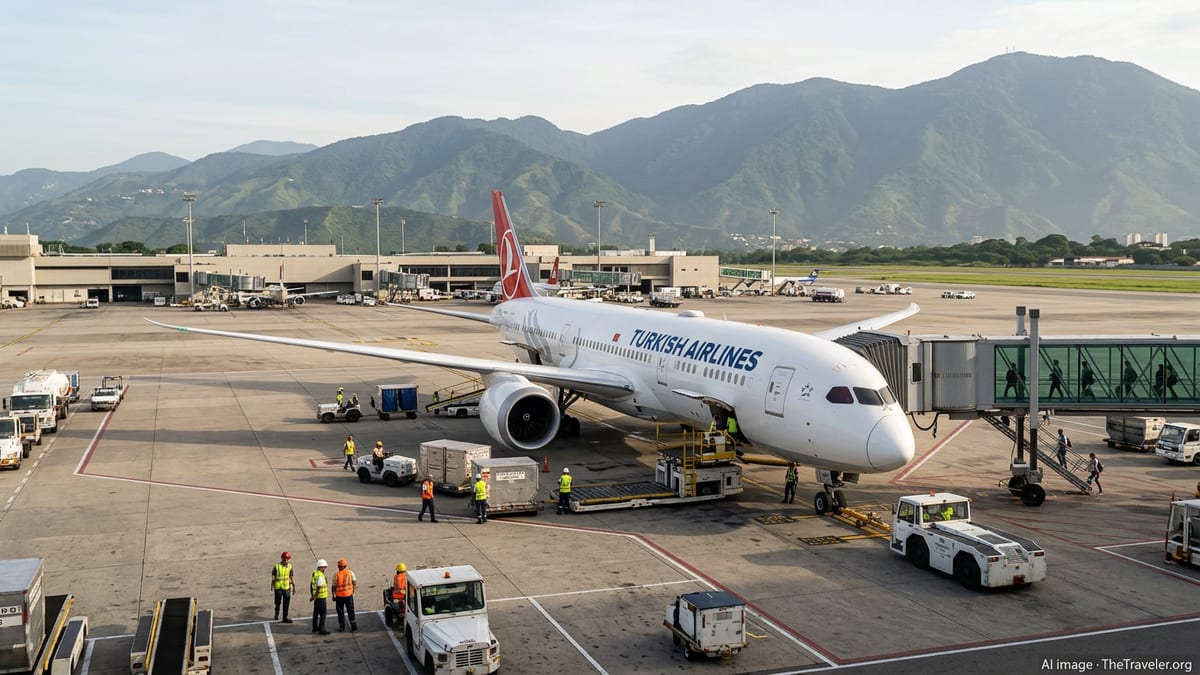
Direct Istanbul–Caracas Service Returns in March
Turkish Airlines has confirmed that nonstop commercial flights between Istanbul Airport and Caracas’ Simón Bolívar International Airport will restart on March 3, 2026, after a suspension triggered in late 2025 by airspace security concerns and regulatory tensions. The restored service will initially operate three times per week, providing one of the few direct links between Venezuela and a major Eurasian hub.
According to schedule filings and statements shared with travel agencies, the carrier plans to run flights with Boeing 787-9 Dreamliner aircraft, offering a modern long-haul product with lie-flat business class and upgraded economy cabins. The itinerary has been reworked to better serve both leisure and corporate travelers, with late-evening departures from Caracas connecting into Turkish Airlines’ extensive morning bank of flights out of Istanbul toward Europe, the Middle East, Asia and Africa.
The restart follows the partial lifting of restrictions that had sharply curtailed international operations to Venezuela from November 2025, when several global airlines temporarily halted services citing security advisories. Officials and industry groups in Caracas spent early 2026 negotiating phased returns with carriers, culminating in a wave of resumptions that is now restoring Venezuela’s long-frayed global air network.
For Venezuela, the Istanbul–Caracas route is more than a city-pair. It is a strategic corridor linking the South American nation with markets far beyond Europe, as Turkish Airlines promotes one-stop itineraries from Caracas to destinations from Dubai and Doha to Mumbai, Beijing and Nairobi.
Boost for Tourism After Years of Volatility
The return of direct Turkish Airlines flights is being greeted with optimism by tour operators and hotel executives in Venezuela, who see Istanbul as a powerful gateway for European, Middle Eastern and Asian vacationers. Before the suspension, the route had quietly become an important entry point for travelers seeking multi-stop itineraries that combined Turkey with Caribbean and Andean destinations.
Venezuelan travel agencies report a noticeable rebound in inquiries for international leisure travel since announcements that multiple foreign carriers, including Turkish Airlines, would be back in the market between February and April 2026. The ability to sell a single-ticket journey from cities such as Paris, Rome, Dubai or Singapore into Caracas via Istanbul is seen as critical to rebuilding confidence among long-haul tourists, who often favor global network airlines for reliability and through-checked baggage.
Within Venezuela, tourism officials are using the impending resumption to relaunch marketing campaigns around destinations like Los Roques, Canaima, Margarita Island and the colonial city of Coro. Packages are being designed that connect incoming Turkish Airlines passengers through domestic carriers from Caracas to beach, jungle and cultural circuits. Industry groups argue that a stable, predictable long-haul schedule can encourage new investment in hotels, ecolodges and tour operations that had stalled during years of uncertainty.
For Istanbul, the revived Caracas link also enhances the city’s growing profile as a cosmopolitan stopover destination. Turkish Airlines’ stopover and city-break programs, which offer hotel stays or short sightseeing options for eligible passengers, are expected to feature more prominently in itineraries that combine a few days in Turkey with longer holidays in Venezuela.
Reopening a Trade and Investment Corridor
Beyond tourism, the Istanbul–Caracas connection is regarded by business leaders in both countries as a key plank in efforts to deepen bilateral trade. Turkey has emerged over the past decade as an increasingly important commercial partner for Venezuela, with exchanges in sectors such as food products, household goods, machinery, textiles and construction materials.
Direct belly-hold cargo capacity on passenger flights is particularly prized by exporters and importers who have struggled with infrequent and costly freight options during the period of reduced connectivity. The Boeing 787-9’s combination of range, fuel efficiency and freight space allows for regular shipment of high-value and time-sensitive goods, from pharmaceuticals and electronics to specialty foods.
Chambers of commerce in Caracas and Istanbul have already begun promoting upcoming trade missions timed to coincide with the flight resumption. Business forums are being planned in both cities to explore opportunities in infrastructure, energy services, tourism development and aviation-related investment. Executives note that the psychological impact of a reliable direct flight can be as significant as its economic value, signaling a willingness by both governments to support more stable commercial ties.
The route also plays a symbolic role in Venezuela’s broader push to diversify its international partnerships. By anchoring a direct connection to a major Eurasian hub outside the traditional North American and Western European circuits, the country aims to tap into new sources of capital, technology and visitors while hedging against geopolitical volatility.
Diaspora, Family Travel and Connectivity Across Regions
For many Venezuelans, particularly those with relatives in Europe and the Middle East, the restored Turkish Airlines route offers a more straightforward way to maintain family and cultural ties. During the suspension, travelers often faced complex multi-stop journeys through Latin American hubs, with longer travel times and higher fares.
The Istanbul hub allows Venezuelan passengers to reach a wide range of destinations where sizable diaspora communities now reside, including Spain, Italy, Germany and the Netherlands, as well as growing Venezuelan and Latin American communities in cities like Istanbul itself. It also provides a convenient bridge for travelers from the Middle East and North Africa heading to Venezuela for business, tourism or family visits.
Travel agents say demand is especially strong among passengers combining business trips with family visits, as well as students and professionals relocating between continents. The ability to book through tickets with coordinated connections and baggage handling is expected to be a significant draw for these travelers, many of whom had postponed or rerouted journeys during the months of disruption.
Regional connectivity within Latin America may also benefit. As other airlines restore links between Caracas and cities such as Bogotá and São Paulo, Turkish Airlines’ flights will slot into a growing web of one-stop itineraries that connect Venezuela via Istanbul to secondary markets across Europe and Asia, potentially lowering fares through increased competition and capacity.
Airspace Security, Regulatory Hurdles and the Road Ahead
The return of Turkish Airlines to Venezuela comes only after a tense period in which international regulators, including United States authorities, issued warnings about heightened security risks in the country’s airspace. Those advisories prompted a wave of temporary suspensions by multiple carriers in late 2025, shrinking Venezuela’s global connectivity almost overnight.
Since then, Venezuelan officials have worked to reassure partners by highlighting enhanced coordination with air traffic control, military authorities and airline safety teams. Industry sources say carriers demanded clear protocols and contingency planning before agreeing to return, while governments and regulators pursued a calibrated easing of restrictions tied to ongoing risk assessments.
Even with flights resuming, operational and financial challenges remain. Currency controls, complex payment repatriation rules and evolving aviation regulations in Venezuela have long been sticking points for foreign airlines. Executives will be watching closely to ensure they can sustainably manage revenue, maintenance and crew logistics on the reinstated Istanbul–Caracas route.
For now, however, the scheduled restart in March 2026 marks a rare piece of positive news for Venezuela’s aviation and tourism sectors. If the operation proves stable and demand holds, industry analysts expect Turkish Airlines to consider adding frequencies on the route, turning the restored link into a long-term pillar of the country’s reemerging international air network.