

More news on this day
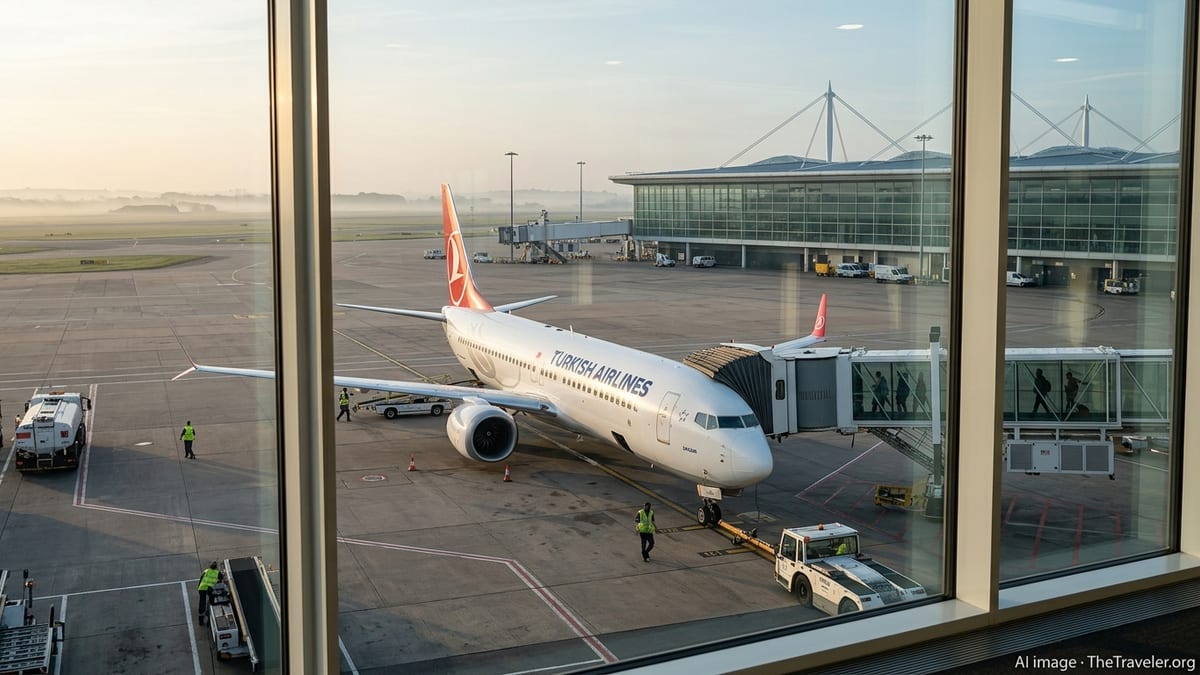
London Stansted is set to step onto the global long-haul stage in March 2026 as Turkish Airlines launches new services to Istanbul, positioning the Essex airport as a powerful new gateway to hundreds of destinations worldwide.
Get the latest news straight to your inbox!
New Istanbul Link Marks a Strategic Shift for Stansted
Publicly available information shows that from March 18, 2026, Turkish Airlines will begin flying between London Stansted and its main hub at Istanbul Airport, adding the carrier’s third London gateway alongside Heathrow and Gatwick. Reports indicate that the airline plans a high-frequency schedule across the week, aimed at capturing both business and leisure demand from London and the wider East of England.
The move represents a strategic shift for Stansted, traditionally known for European short-haul and low-cost operations. By plugging directly into Turkish Airlines’ intercontinental network, the airport moves closer to the role played by Heathrow and Gatwick as a springboard to Africa, Asia, the Middle East and beyond.
Airport communications describe the Istanbul route as a way to deliver “greater choice, value and convenience” to passengers across its catchment, which stretches deep into north and east London, Hertfordshire, Essex and Cambridgeshire. With the airport already handling tens of millions of passengers a year, the addition of a full-service global carrier strengthens its position in the competitive London aviation market.
The new service also reinforces Istanbul’s role as one of Europe’s key connecting hubs. As travel demand continues to recover and diversify, the link is expected to appeal to travellers who value a single-connection journey to secondary cities and emerging destinations that are not served nonstop from the UK.
357 Destinations Within One Stop of Essex
According to published coverage and Turkish Airlines’ own network information, the new Stansted route will feed into a global map of more than 350 onward destinations across six continents via Istanbul Airport. That reach stretches from major capitals such as Singapore, Tokyo and Johannesburg to smaller cities in Central Asia, the Caucasus and East Africa that typically require multiple changes when travelling from the UK.
The Istanbul hub model allows passengers from Stansted to connect within a single itinerary, often with coordinated transfer times and baggage checked through to the final destination. This is expected to be particularly attractive for travellers heading to destinations such as Pakistan, India, the Gulf states, Southeast Asia and sub-Saharan Africa, where Turkish Airlines has built dense coverage.
Industry analyses note that the carrier’s network breadth has become one of its defining features, positioning Istanbul as an alternative to Gulf and Western European hubs for passengers originating in the UK. For Stansted-based travellers, that translates into one-stop options that previously required a journey across London to Heathrow or Gatwick, or a connection via another European city.
The airline’s ongoing fleet expansion, detailed in recent corporate disclosures about large aircraft orders, suggests further room for growth on long-haul sectors from Istanbul over the coming years. That, in turn, could increase the range and frequency of destinations realistically reachable from Stansted with a single connection.
What the Expansion Means for London’s Aviation Landscape
The arrival of Turkish Airlines at Stansted underlines an evolving balance between London’s airports. Heathrow remains the capital’s primary long-haul hub, but capacity constraints and slot scarcity continue to encourage full-service carriers to look to secondary airports for growth. Gatwick has already established itself as a significant long-haul player; Stansted now appears to be moving in a similar direction, albeit from a different starting point.
Analysts point out that Stansted offers airlines access to a large and relatively affluent catchment without the operational and cost pressures of Heathrow. For Turkish Airlines, serving three London airports creates a broader footprint across the metropolitan area, reducing surface travel times for many passengers and giving more flexibility in schedule planning.
The move may also intensify competition on connecting traffic between London and destinations historically dominated by carriers at Heathrow or Gulf hubs. With additional capacity flowing through Istanbul, fare and schedule competition is likely to sharpen on routes to South and Southeast Asia in particular.
For Stansted, attracting a global network carrier is widely seen as a validation of its long-term growth strategy. Airport development plans in recent years have focused on terminal upgrades and operational efficiency, creating the infrastructure needed to support more full-service and long-haul operations alongside the dominant low-cost segment.
Boost for Regional Connectivity and Local Economy
Local business and travel reports highlight the potential economic benefits of the new Istanbul service for communities around Stansted and across the East of England. Easier access to a worldwide network can support trade, inward investment and tourism, particularly for sectors that rely on fast links to markets in Asia, the Middle East and Africa.
Smaller companies based outside central London often face longer and more complex journeys to reach global hubs. Having a major international connector on their doorstep reduces travel time and can help make the region more attractive as a base for export-oriented firms, universities and research institutions with global partnerships.
The route is also expected to appeal strongly to visiting friends and relatives traffic, especially among communities in the East of England with ties to Turkey, South Asia and the broader Middle East. For these travellers, schedule choice and reduced surface travel to the departure airport can be as important as onboard product or loyalty schemes.
Tourism bodies in both the UK and Turkey are likely to benefit as well. Istanbul itself remains a major city-break and cultural destination for British travellers, and easier access from Stansted could stimulate additional short trips, especially during off-peak seasons when competitive fares are typically available.
Passengers Gain New Choices Across London’s Six-Airport System
The addition of Turkish Airlines at Stansted gives London-area passengers another variable to weigh when choosing how to start an international itinerary. The capital’s six-airport system already offers a mix of low-cost, leisure and full-service options; by bringing a major network carrier to Stansted, the range of one-stop global choices from the city’s north and east expands significantly.
Air travel guides note that passengers are increasingly willing to trade a longer transfer time in the air for a shorter and more predictable journey to the airport on the ground. For travellers living in counties such as Essex, Suffolk or Cambridgeshire, Stansted’s direct rail and road links can make it a more practical gateway than Heathrow, even when the total flying time is similar.
The broader trend suggests that long-haul connectivity is no longer the exclusive domain of a single London hub. Instead, a more distributed model is emerging, with airlines using multiple airports to reach different segments of the market. Turkish Airlines’ arrival at Stansted from March 2026 is the latest example of that shift, and one that could reshape travel habits well beyond the airport’s traditional low-cost core.
As booking systems continue to load the new services and schedules solidify for the 2026 season, passengers across the region will gain a clearer view of how Stansted can function not just as a gateway to Europe, but as a practical starting point for journeys across nearly every corner of the globe.