

More news on this day
Türkiye’s airlines are lining up a wave of new 2026 routes that will redraw leisure and business travel maps, as Turkish Airlines, Pegasus and SunExpress leverage Istanbul and coastal hubs to plug fresh nonstops into Europe, Asia and beyond.
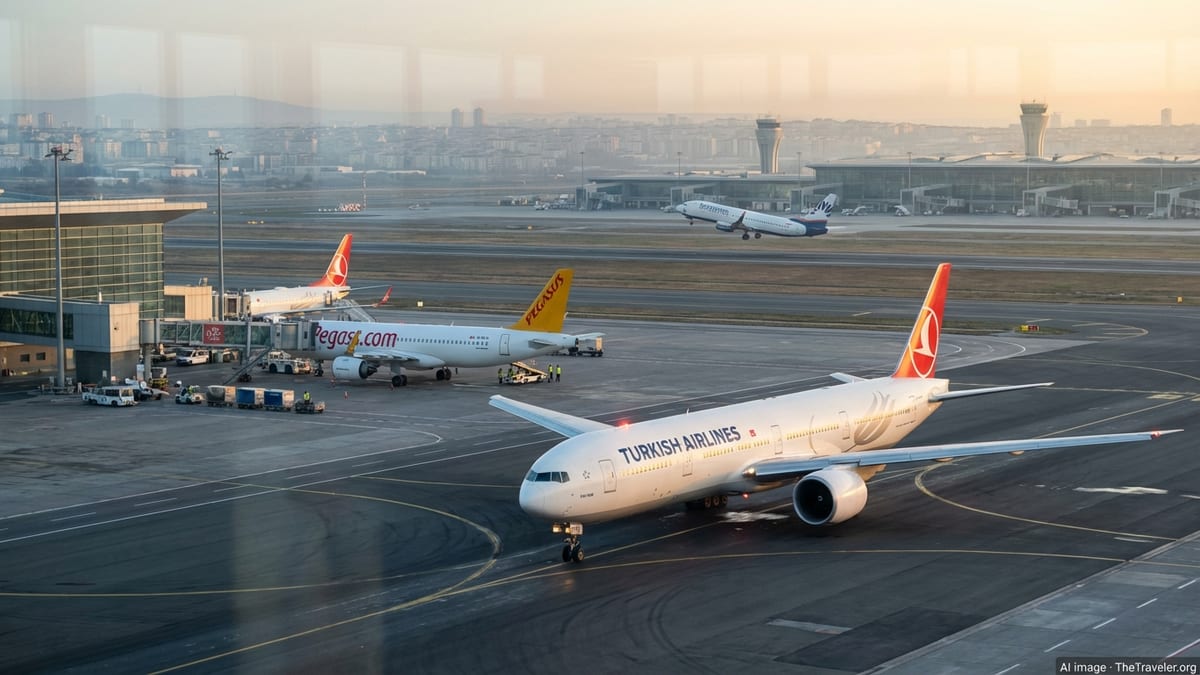
Turkish Airlines Targets New Gateways and Global Feed in 2026
Fresh from Skytrax recognition as one of Europe’s leading carriers, Turkish Airlines is using 2026 to deepen its role as a bridge between continents with a mix of new city pairs and capacity shifts through its Istanbul megahub. Central to that strategy is its planned debut at London Stansted, where the airline will launch 14 weekly flights to Istanbul on 18 March 2026, opening a new nonstop option into its global network of more than 350 destinations for passengers across northeast London and the wider East of England.
The Stansted move effectively gives Turkish Airlines a third London gateway alongside Heathrow and Gatwick and responds to sustained demand from UK travellers heading for Southeast Asia, the Indian subcontinent, Africa and Australia via Istanbul. Aviation analysts say the high frequency from day one positions the service as a business and leisure workhorse rather than a niche add-on, signalling confidence in long-term demand on the corridor.
Beyond the UK, Turkish Airlines is also focusing on new markets in both Europe and Asia to reinforce Istanbul as a one-stop option between emerging economies. In Southeast Asia, its new link to Phnom Penh, launched in late 2025 via Bangkok, is scheduled to mature through 2026 as a feeder for trade, tourism and student flows between Cambodia and key European and North American cities. In the Caucasus, the airline is preparing for a new daily schedule between Istanbul and Yerevan from March 2026, ramping up to double-daily frequencies during the summer peak, a move widely seen as a vote of confidence in improving regional ties.
Combined, the new services further concentrate long-haul traffic over Istanbul, reinforcing Turkish Airlines’ strategy of serving secondary cities in Europe and Asia with wide onward connectivity, rather than relying solely on mega-capitals. For travellers, that translates into shorter total journey times and more one-stop options from regional airports that previously required complex connections.
SunExpress Scales Up UK and European Holiday Links
SunExpress, the leisure specialist jointly owned by Turkish Airlines and Lufthansa, is preparing one of its largest network expansions yet for the northern summer 2026 season, centred on the Mediterranean resort of Antalya and the Aegean hotspot of Bodrum. The airline will add East Midlands in England’s Midlands region to its map with new flights to Antalya, launching at the end of March 2026 and building to three weekly services in the peak season, giving millions of potential passengers a direct link to Türkiye’s most popular beach destination.
The Midlands addition is part of a wider push that will see SunExpress offer around 196 weekly flights on 30 routes from 14 airports in the UK and Ireland in summer 2026, with more than 2.1 million seats on sale, an estimated 10 percent increase year on year. New routes from London Gatwick and Manchester to Bodrum will operate twice weekly, while additional services from Cork to Antalya and Dublin to Dalaman are designed to tap fast-rising demand from Ireland for affordable sunshine breaks on Türkiye’s Turquoise Coast.
On the continent, SunExpress is simultaneously knitting together a web of new point-to-point routes from its Turkish bases to secondary European cities. From Antalya, it plans new services to Cork, East Midlands, Memmingen, Bratislava and Ostrava across the summer 2026 schedule, while its Bodrum hub gains seasonal links to Pristina and Tirana. Ankara will be connected directly to Rotterdam, and Izmir will see an extended summer operation on the Porto route as well as new flights to Sofia.
The strategy reflects SunExpress’s ambition to dominate leisure traffic between Europe and Türkiye by combining dense coverage of German-speaking markets with rapid growth in the UK, Ireland and the Balkans. For local tourism boards and hoteliers along Türkiye’s south and west coasts, the expanded network promises longer peak seasons and broader demand, especially from travellers flying in on low-cost or hybrid fares and assembling their own package stays.
Pegasus Builds Muscle at Sabiha Gökçen to Support New Routes
While Pegasus Airlines has yet to publish a full slate of new routes for 2026, the low-cost carrier is laying the groundwork for accelerated network expansion from its Istanbul Sabiha Gökçen base with a major investment in technical infrastructure. In February 2026, Pegasus inaugurated a new aircraft maintenance centre at the airport, a 40 million dollar project that adds two large maintenance hangars and a dedicated paint hangar capable of handling five narrow-body jets simultaneously.
The carrier says the facility, underpinned by digitalisation and efficiency-focused processes, will reduce maintenance-related downtime and improve on-time performance across its growing fleet of Airbus A320neo family aircraft and Boeing 737s. That operational cushion is key as Pegasus eyes additional medium-haul opportunities into Europe, North Africa and Central Asia from Sabiha Gökçen, Istanbul’s secondary airport on the Asian side, which is popular with cost-conscious travellers and increasingly with connecting passengers.
Industry observers expect Pegasus to leverage the maintenance upgrade to sustain higher utilisation rates and support denser schedules on high-demand routes, while selectively opening thinner new markets that require tight cost control to succeed. In practice, that could mean more nonstops from Sabiha Gökçen to emerging city pairs in Central and Eastern Europe, the Gulf and the Caucasus, where the airline’s low-fare model has already proved competitive against both full-service rivals and other budget carriers.
For the wider Turkish aviation ecosystem, Pegasus’s investment underscores the country’s ambition to be not only a passenger hub but also a regional centre for aviation services. As more of its maintenance capacity is brought in-house, the airline gains flexibility to rotate aircraft across its network and respond quickly to demand spikes, including on future 2026 routes that have yet to be formally announced.
Türkiye’s Airports Poised as Powerhouse Hubs
The combined 2026 plans of Turkish Airlines, SunExpress and Pegasus highlight how Türkiye’s airport system is evolving into a multilayered global gateway. Istanbul Airport anchors long-haul and full-service transfers, Sabiha Gökçen serves as a cost-conscious alternative for point-to-point and hybrid traffic, while coastal airports such as Antalya, Bodrum, Dalaman and Izmir are increasingly functioning as mini-hubs for sun-and-sea tourism and regional connectivity.
By stitching new nonstops between UK, Irish and European regional airports and these Turkish gateways, the country’s carriers are capturing travellers who might otherwise route via traditional western European hubs. The result is a growing share of northbound and southbound leisure traffic being channelled through Türkiye, with downstream benefits for hotels, tour operators and local economies that depend heavily on visitor spending.
For passengers, the 2026 shake-up translates into more choice of departure airports, more direct services to holiday regions and a broader menu of one-stop long-haul options, often at competitive fares. For the airlines, it is a calculated bet that demand for cross-border travel will continue to rise, and that Türkiye’s geographic position and investment in airport infrastructure can sustain another year of aggressive route growth.
As schedules for summer and winter 2026 are progressively loaded over the coming months, travellers in the UK, Europe, the Middle East and Asia can expect more announcements from Turkish Airlines, Pegasus and SunExpress. All three are positioning themselves to ensure that when demand surges, they are ready with aircraft, crews and, crucially, new nonstop routes into the heart of one of the world’s most dynamic aviation markets.