

More news on this day
Türkiye is moving to reassure global travelers and industry partners that its key airports will remain fully operational throughout the 2026 tourism season, positioning the country as a stable aviation hub despite shifting regional geopolitics and airspace disruptions linked to the wider Middle East crisis.
Get the latest news straight to your inbox!
Airport Network Positioned as Regional Stabilizer
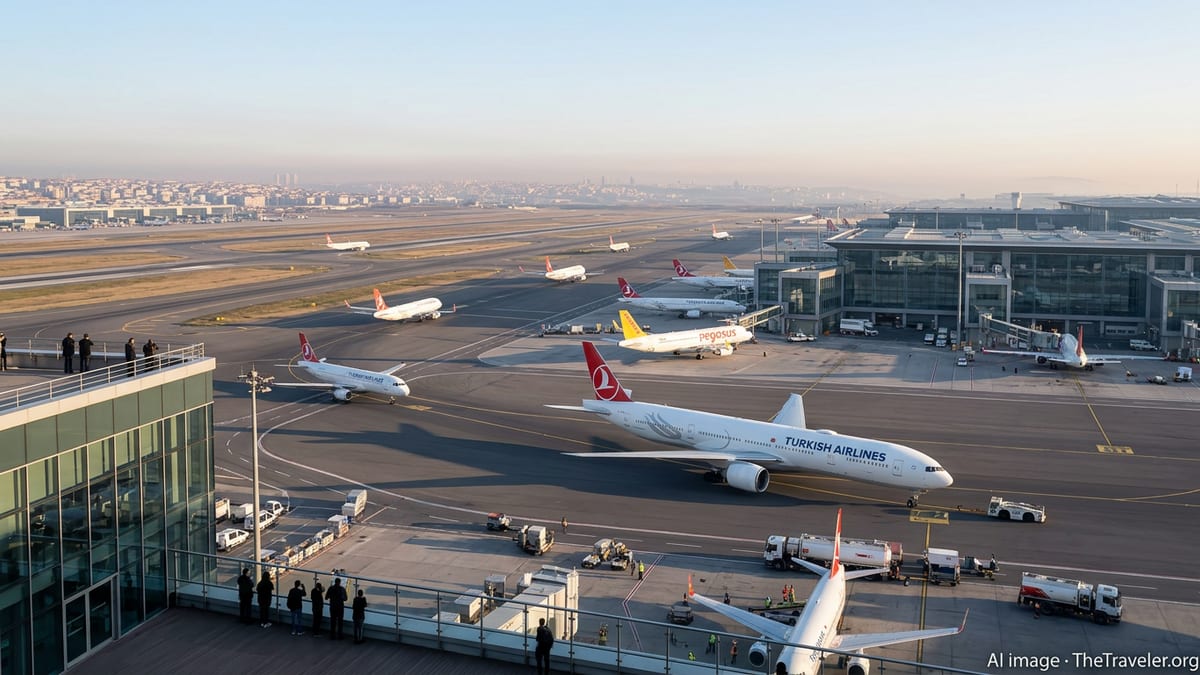
Publicly available data on passenger volumes and investment plans indicate that Türkiye is treating uninterrupted airport operations as a strategic priority for 2026. The country’s main gateways, led by Istanbul Airport, Antalya and the growing network of regional airports, are being framed as reliable corridors at a time when neighboring airspaces are subject to periodic closures and rerouting.
Recent economic planning documents highlight that Türkiye’s airports handled more than 200 million passengers in 2025, with forecasts pointing to further growth in 2026, underpinned by tourism demand and transfer traffic between Europe, the Middle East and Asia. Istanbul Airport alone continues to rank among the world’s busiest international hubs, with daily movements exceeding 1,600 flights on peak days according to official statistics. These volumes underline the scale of the infrastructure that authorities intend to keep fully functioning through the coming high season.
Industry commentary portrays Türkiye’s hub strategy as a key buffer against the turbulence hitting regional aviation. As temporary restrictions affect airspace over parts of the Gulf and Iran, long-haul itineraries are being recalibrated, and routing through Turkish hubs is emerging as one of the more resilient options. This backdrop gives added significance to the country’s message of continuity ahead of the summer 2026 surge.
At the same time, analysis by tourism and aviation consultancies stresses that operational continuity is not only a question of air traffic control and runway capacity. It also depends on maintaining ground services, security procedures and passenger processing at a level that can absorb diverted flights and irregular operations without causing cascading disruption, an area where Türkiye has invested heavily in recent years.
Tourism Growth Targets Meet Geopolitical Tensions
Türkiye’s commitment to full airport operations comes as the wider region experiences one of its most volatile periods in years. A series of military escalations involving Iran has led to warnings from tourism analysts that Middle Eastern destinations could collectively forgo tens of billions of dollars in visitor revenue by the end of 2026 as travelers reconsider itineraries. In this environment, the ability of individual countries to keep aviation corridors open is becoming a central competitive factor.
Domestic tourism projections for Türkiye nonetheless remain broadly positive. Trade press coverage and sector surveys suggest that the country expects visitor numbers in 2026 to edge above record 2025 levels, after welcoming more than 60 million international tourists last year. Analysts point to strong demand from European and Russian markets, a diversified product mix spanning coastal resorts and city breaks, and a relatively favorable pricing environment compared with some eurozone destinations.
However, regional risk perception is affecting booking patterns. Travel advisories for parts of the Eastern Mediterranean and the Levant have shifted in recent weeks, and reports from tour operators describe a more cautious approach among long-haul travelers when it comes to itineraries that transit conflict-adjacent airspace. In that context, the emphasis on uninterrupted airport operations for the 2026 season is being interpreted as a signal aimed at airlines, cruise lines, and large tour wholesalers that rely on predictable connectivity.
Market commentary also notes that Türkiye’s tourism strategy increasingly focuses on spreading demand across the calendar year and beyond the classic resort areas. Keeping domestic and secondary airports fully functional throughout 2026 is therefore tied not only to peak summer traffic but also to winter sports, cultural travel and congress tourism, which depend on consistent schedules to retain international business.
Major Hubs Strengthen Capacity and Resilience
On the ground, Türkiye’s largest airports are entering the 2026 season with expanded capacity and a sharpened focus on resilience. Istanbul Airport continues to develop its multi-runway system and terminal facilities, preparing to host high-profile industry gatherings such as the ACI World Airport Experience Summit scheduled for late summer 2026. Organizers describe the airport as a showcase for digital transformation and passenger experience, underlining its role as a flagship hub.
Antalya Airport, the main gateway for Mediterranean resort tourism, is also scaling up. Recent promotional material for international events hosted in the city describes Antalya as Türkiye’s third-largest airport, with traffic projected to push into the low-40-million passenger range in 2026. Concession documentation and operator reports signal ongoing investments in terminals and apron space designed to handle dense waves of charter and low-cost flights during peak holiday months.
New and upgraded regional facilities are adding redundancy to the system. The formal opening of Çukurova International Airport in 2024 has provided an additional modern gateway for the southern region, supporting both leisure tourism and cargo flows. Other regional airports that have been rehabilitated or expanded in recent years are positioned to absorb more point-to-point traffic from Europe and the Middle East, easing pressure on Istanbul and Antalya at times of disruption.
Financial disclosures from airport operators hint at confidence in sustained demand. One major listed operator reported that passenger numbers across its portfolio of Turkish and international airports rose again in 2025, with guidance for 2026 assuming continued growth and a full year of activity under new concessions. This suggests that the private sector is planning for a 2026 season in which airports remain open and active despite geopolitical crosswinds.
Airspace Rerouting and Operational Challenges
Behind the headline of full operational continuity lies a more complex reality in the air. Tourism and aviation reports point out that partial closures of regional airspace have effectively reshaped flight paths between Europe, the Gulf, and South and East Asia. As certain routes over or near Iran and neighboring states are suspended or restricted, remaining safe corridors have become more congested, with Türkiye and Egypt frequently cited as primary alternatives.
For airlines, this rerouting translates into longer flight times, higher fuel burn and the need to adjust schedules to meet crew duty regulations. Turkish carriers and international partners using Turkish hubs are adapting by tweaking departure banks, increasing block times and, in some cases, upgauging aircraft to consolidate capacity. Publicly accessible timetables and traveler reports from early 2026 indicate that, while some frequencies to conflict-adjacent markets have been suspended, core trunk routes linking Türkiye with major European, North American and Asian cities continue to operate.
Operational continuity at airports themselves has, so far, remained largely intact. Social media posts and traveler accounts from Istanbul in recent days describe normal activity levels, with no widespread cancellations linked directly to incidents near Türkiye’s borders. The main visible impact for passengers transiting the country is more frequent schedule changes and longer connection buffers on certain long-haul itineraries as airlines build in extra time for potential rerouting.
Regulatory notices and airline advisories also show a focus on passenger handling obligations, such as rebooking support and welfare provisions, in cases where regional developments force last-minute changes. While these measures do not eliminate the inconvenience caused by geopolitical shocks, they contribute to the perception that Turkish airports can remain open and functional even as the broader airspace map is redrawn.
Strategic Tourism Vision Anchored in Connectivity
Türkiye’s broader tourism vision for 2026 reinforces the centrality of airports to its economic outlook. Policy documents outlined by the Ministry of Culture and Tourism describe aviation connectivity as a foundation for goals that include higher per-visitor spending, growth in experience-based tourism, and a push into new source markets beyond Europe and Russia. The emphasis on full airport operations is therefore closely linked to ambitions that extend well beyond a single season.
Analysts observing the sector note that Türkiye is attempting to convert geopolitical risk into an argument for reliability. By presenting its airport network as a stable platform surrounded by more fragile corridors, the country aims to reassure tour operators planning charter programs, global distribution systems modeling flight options, and independent travelers weighing alternative hubs for multi-country trips.
At the same time, expert commentary stresses that this strategy carries its own pressures. Maintaining 2026 operations at scale will require continued coordination between civil aviation authorities, airport operators and airlines as the regional security picture evolves. Any prolonged spillover of conflict closer to Turkish airspace, or a significant escalation in travel advisories, could test the resilience that has been carefully cultivated over the past decade.
For now, however, Türkiye enters the 2026 tourism season with a clear message: its airports are open, its runways are busy, and its role as a bridge between continents remains intact, even as the geopolitical landscape around it continues to shift.