

More news on this day
Turks and Caicos has dramatically scaled back its 500 million dollar airport expansion dream, canceling a flagship redevelopment plan for Providenciales while promising a leaner, phased approach to keep pace with booming tourism and new long-haul routes.
Get the latest news straight to your inbox!
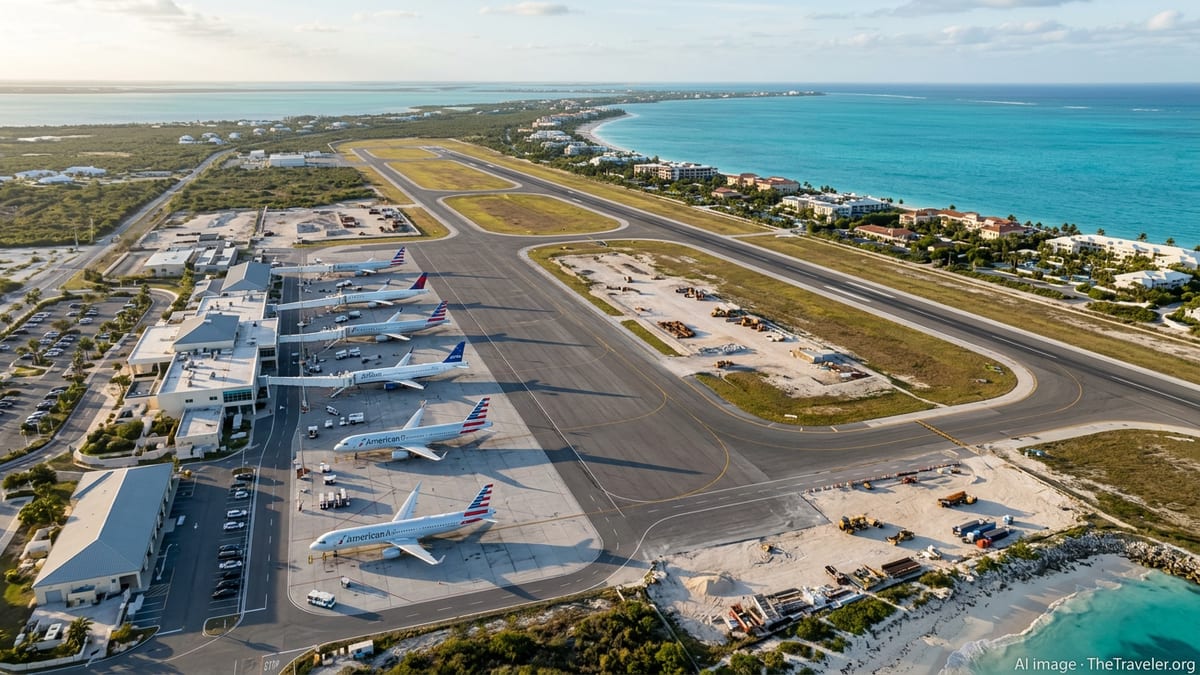
From Mega-Terminal Vision to Sudden Policy Shift
The redevelopment of Howard Hamilton International Airport on Providenciales was conceived as a transformative, roughly half-billion dollar project to deliver a brand-new, state-of-the-art terminal and expanded airside infrastructure. Positioned as the country’s most important piece of tourism-related infrastructure, the scheme was being advanced through a public-private partnership model, with international investors courted to help finance and operate the enlarged gateway.
Momentum built through 2023 and 2024 as passenger volumes rebounded beyond pre-pandemic levels and the Turks and Caicos Islands Government secured key consents. Aviation planners envisioned a modern terminal capable of handling rising US leisure traffic, as well as premium long-haul links from Europe and South America. For many in the local hospitality sector, the redevelopment became synonymous with the territory’s broader growth ambitions.
That trajectory shifted abruptly at the turn of the year. In late December 2025, Cabinet decided to terminate the competitive procurement for the public-private partnership, effectively scrapping the mega-terminal concept in its current form. A joint statement from the Ministry of Physical Planning and Infrastructure Development and the Turks and Caicos Islands Airports Authority cast the move as a change in policy direction rather than a retreat from redevelopment itself.
Officials have been careful to stress that the decision does not mean an end to airport improvements. Instead, the government is signaling a pivot away from a single, high-risk, 500 million dollar-style project toward more modular works that can be delivered within tighter financial and operational parameters.
Passenger Growth Meets Infrastructure Bottlenecks
The policy rethink comes as Howard Hamilton International struggles to keep pace with demand. Turks and Caicos has emerged as one of the Caribbean’s post-pandemic success stories, with scheduled seat capacity climbing above 2019 levels and visitor arrivals outpacing regional competitors. At peak times, the compact terminal at Providenciales is stretched, with arriving passengers frequently encountering long queues, congested baggage belts and bottlenecks at immigration and security.
These pressures have intensified as airlines add new routes into the territory. Recent announcements from U.S. carriers such as Frontier, Delta and American have strengthened connectivity from major hubs, increasing the flow of leisure travelers bound for Providenciales’ resorts. Aviation planners and the Airports Authority have also been pursuing premium long-haul links that would put the islands more directly on the map for European and South American travelers.
Without additional processing space and upgraded airside facilities, however, that growth risks bumping up against hard capacity limits. Industry analysts warn that constrained terminal infrastructure could eventually dampen the appetite of airlines to add frequencies or new markets, particularly if on-the-ground delays begin to erode the guest experience that underpins the island’s high-end tourism brand.
Against this backdrop, the decision to step back from a single, large-scale redevelopment is being watched closely by hoteliers and tour operators. Many accept the need for financial prudence but are looking for concrete timelines and clearly phased works that will relieve the most acute pain points for travelers as soon as possible.
A Shift Toward Phased, Self-Financed Expansion
In place of the abandoned public-private partnership, the Turks and Caicos Islands Airports Authority is moving toward a more incremental, self-financed expansion strategy across multiple airports. Budget documents for the current fiscal cycle outline capital allocations for architectural and construction management services, signaling that planning work for future upgrades is still advancing, even if the overall price tag is now well below the once-touted 500 million dollar horizon.
Officials have indicated that immediate priorities at Howard Hamilton International include a new or expanded arrivals hall, additional check-in and security lanes, and reconfigured passenger flows to reduce congestion at peak weekend departure banks. Smaller, discrete projects are seen as more manageable from both a funding and delivery perspective, allowing the authority to sequence works around high season travel without massively disrupting operations.
The Airports Authority is also using newly updated traffic and revenue forecasts to recalibrate what the system can afford. With passenger growth strong but not unlimited, planners are focusing on right-sizing the next wave of investment to actual demand rather than a speculative mega-hub model. That recalibration dovetails with a broader regional trend, as Caribbean governments look for ways to modernize strategic airports without taking on unsustainable levels of debt.
For investors who had been eyeing a long-term concession at Providenciales, the shift represents a cooling of one of the Caribbean’s headline infrastructure opportunities. For local stakeholders, however, a measured expansion program that can be funded largely from airport-generated revenues may be more politically palatable and less exposed to global financing shocks.
Island Connectivity and Tourism Strategy Rebalanced
The changes in Providenciales have implications beyond a single airport. Turks and Caicos has been quietly upgrading and rebranding several out-island gateways, including the Norman B. Saunders Sr. International Airport on South Caicos, which recently secured its first direct international flights from Miami. These moves are part of a wider push to diversify tourism beyond Providenciales and spread visitor spend across the archipelago.
A more modest capital program at Howard Hamilton International could free up resources and political attention for upgrades at smaller airports, including runway works, safety improvements and modest terminal enhancements. While these projects are far from the scale of the abandoned mega-terminal, they are critical for supporting boutique resorts, fishing lodges and eco-tourism ventures that depend on reliable air links.
Tourism leaders say that a balanced approach to airport investment is now essential. Providenciales must remain a dependable primary gateway with an efficient, modern terminal, but the long-term health of the destination also hinges on making it easier for travelers to continue onward to lesser-known islands. That goal requires coordinated planning between the Airports Authority, civil aviation regulators and carriers that operate regional services.
At the same time, the government is under pressure to ensure that any new infrastructure is resilient to climate-related risks and tailored to the islands’ fragile coastal environment. Even scaled-back works are expected to integrate stronger storm protection, improved drainage and more energy-efficient systems, in line with evolving international standards.
What Travelers Can Expect in the Near Term
For visitors flying into Turks and Caicos in the coming seasons, the most immediate change will not be an eye-catching new terminal but a gradual series of smaller improvements. Authorities are preparing for works that may temporarily affect traffic flows at Howard Hamilton International, from reconfigured queuing areas to construction screens around expanded processing zones.
Industry sources suggest that these phased interventions are designed to tackle peak-time congestion first, particularly at weekend changeovers when resort occupancies turn over and multiple large jets arrive within tight windows. Travelers may see additional temporary staff during those periods, more visible wayfinding signage and, over time, new lanes dedicated to families or passengers requiring assistance.
Airlines serving Providenciales are monitoring the situation closely, building extra buffer time into schedules where possible and working with ground handlers to smooth boarding and turnaround processes. While some growing pains are inevitable, the goal is to avoid the kind of systemic delays that would dent Turks and Caicos’ reputation as a convenient luxury escape compared with rival Caribbean destinations.
For now, the half-billion dollar airport of earlier visions is off the table. In its place is a more cautious, adaptive blueprint that seeks to deliver targeted capacity increases while preserving financial flexibility. How successfully that blueprint is executed will help determine whether Turks and Caicos can sustain its tourism momentum in the decade ahead.