

More news on this day
Turks and Caicos is entering 2026 on a tourism high, with record visitor numbers and a slate of new luxury resorts positioning the archipelago as one of the Caribbean’s most closely watched high-end destinations.
Get the latest news straight to your inbox!
Record Visitor Growth Fuels Demand for High-End Stays
Recent tourism data and industry analyses indicate that Turks and Caicos has posted back-to-back years of record-breaking arrivals, edging close to 2 million visitors in 2024 across air and cruise segments. Air arrivals alone have climbed by double digits compared with pre-pandemic levels, while cruise traffic through Grand Turk has expanded even faster. Publicly available figures from tourism and airport authorities show that the destination has outpaced many regional peers, with growth underpinned by strong demand from North American travelers.
Published coverage notes that more than 730,000 visitors arrived by air in 2024, representing year-over-year growth of around 10 to 11 percent, while cruise passenger volumes surpassed 1.2 million. Industry observers say this performance cements Turks and Caicos as a premier Caribbean luxury market rather than a volume-driven mass tourism hub. The islands’ positioning around upscale villa stays, boutique resorts, and premium all-inclusives has attracted higher-spending travelers, helping to offset the challenges of limited land area and environmental sensitivities.
Travel trade reports suggest that this momentum has carried into the 2025 winter and early 2026 high seasons, supported by additional airlift from major U.S. gateways and growing interest in multi-island itineraries that combine Providenciales with out-islands such as South Caicos. With demand rising at the top end of the market, developers and global brands have accelerated resort projects aimed at capturing affluent leisure travelers, remote professionals, and second-home owners.
The result is a feedback loop: elevated demand is encouraging new luxury development, while news of upcoming openings is drawing fresh attention from travel advisors and consumers planning trips into late 2026 and 2027. Industry analysts say the tourism surge is no longer a post-pandemic rebound story but a structural shift in how Turks and Caicos competes within the Caribbean.
New Luxury Openings Redefine Grace Bay in 2026
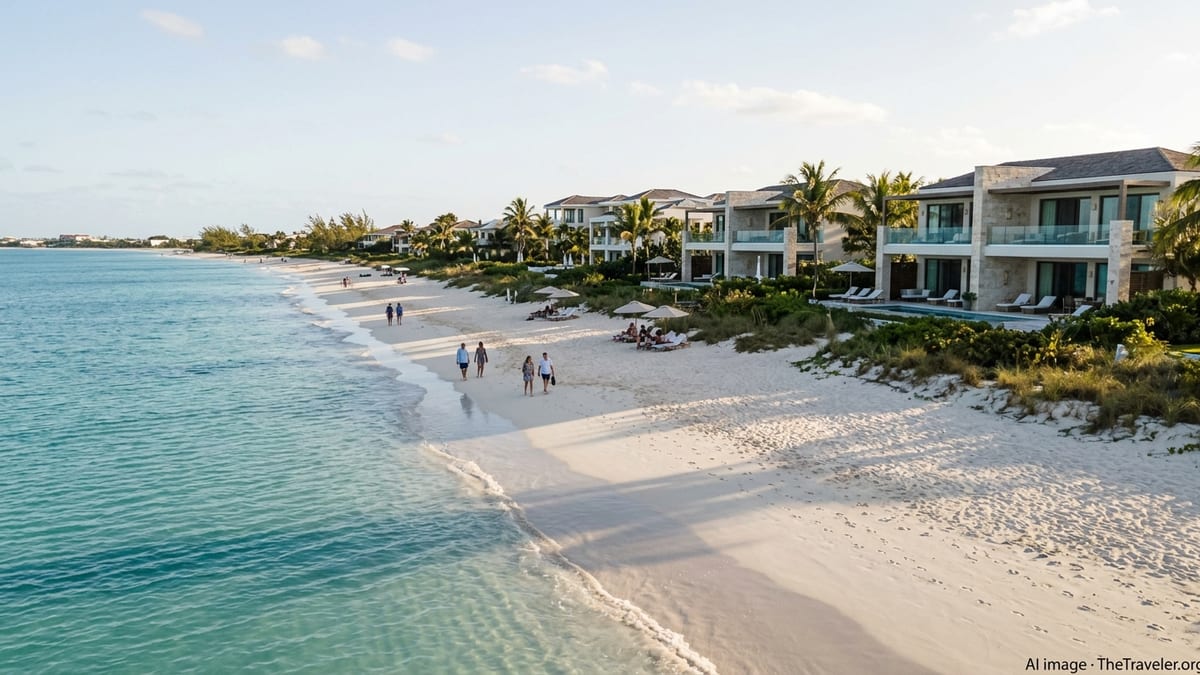
Grace Bay Beach on Providenciales, long regarded as one of the Caribbean’s marquee stretches of sand, is at the center of the current development wave. Among the most closely watched projects is Andaz Turks & Caicos at Grace Bay, part of Hyatt’s luxury and lifestyle portfolio. Hyatt’s recent development updates describe the property as the brand’s first Andaz in the Caribbean, with studios, suites, and branded residences oriented toward design-forward travelers seeking a boutique alternative to traditional beachfront resorts.
Project communications and real estate marketing materials indicate that Andaz Turks & Caicos is targeting a grand opening in spring 2026, following several years of construction along Grace Bay. The resort is expected to offer fewer than 60 resort keys but a substantial residential component, reflecting a broader trend in Turks and Caicos toward mixed-use luxury communities that blend hotel operations with for-sale condos and villas. Observers note that this model aligns with visitor preferences for more spacious, apartment-style accommodations and long-stay flexibility.
Grace Bay is also seeing activity from established all-inclusive players. Travel industry coverage highlights a significant expansion at Beaches Turks & Caicos, where a new village concept with additional suites is slated to open in 2026. The project will add more high-category family accommodations, including multi-bedroom concierge and butler suites, reinforcing the resort’s appeal to multi-generational groups willing to pay premium rates for comprehensive, beachfront stays.
Together, these developments are reshaping the Grace Bay skyline, adding contemporary architecture and new amenities to an already competitive strip of sand. Travel advisors are watching closely to see how room rates, occupancy patterns, and guest demographics evolve once the new inventory comes online during the 2026-2027 seasons.
Beyond Providenciales: Emerging Luxury Enclaves Across the Islands
While Providenciales remains the main gateway, new projects signal that luxury development in Turks and Caicos is gradually dispersing beyond Grace Bay. Government planning documents and investment reports reference boutique resort and villa concepts on quieter islands, including North and Middle Caicos, as well as small-scale, ultra-private properties that cater to groups seeking full buyouts.
Airport infrastructure is playing a key role in this shift. Publicly available information on South Caicos’ upgraded Norman B. Saunders Sr. International Airport shows that the island secured direct service from Miami in 2024, an important step in making smaller islands more accessible to U.S. travelers. Industry commentary suggests that improved air access is likely to encourage niche luxury projects focused on diving, fishing, and low-density eco-luxury experiences.
In parallel, development reports point to forthcoming high-end properties such as The Loren at Turtle Cove on Providenciales and other resort-residential communities slated for the mid-2020s. These projects generally emphasize waterfront living, full-service marinas, and wellness offerings, broadening the range of settings beyond the classic Grace Bay beachfront strip.
The diversification of luxury product across multiple islands aligns with Turks and Caicos’ stated ambition to become a multi-island, high-value destination. Travel analysts observe that this could help ease pressure on Grace Bay’s limited shoreline while encouraging visitors to stay longer and explore less-trafficked cays and settlements.
Resort Pipelines, Branded Residences, and Rising Real Estate Values
The current tourism surge is closely intertwined with a robust pipeline of branded residences and resort real estate. Developer materials for projects such as Andaz Turks & Caicos underscore that many new builds are being financed and structured through sales of serviced apartments, condos, and villas that participate in hotel rental programs. Buyers are typically high-net-worth individuals from North America and Europe attracted to Turks and Caicos’ stable legal framework, U.S.-dollar economy, and relative proximity to major East Coast cities.
Regional construction and cost reports identify Turks and Caicos as one of the more active Caribbean markets for upper-upscale and luxury projects, despite elevated building costs and supply chain constraints. New phases at established resorts, including expanded suites and upgraded public areas, are proceeding alongside entirely new builds. Industry coverage suggests that this blend of renovations and greenfield projects is refreshing the overall inventory, with newer properties emphasizing sustainability measures, hurricane-resilient design, and energy efficiency.
Real estate agents active in the islands have highlighted steady appreciation in waterfront property values, particularly along Grace Bay and Long Bay. The arrival of global hotel brands, combined with limited oceanfront land, has contributed to competitive pricing for both residential and resort sites. Analysts note that branded residence projects often pre-sell quickly, providing developers with capital and confidence to move ahead on ambitious timelines for 2026 and beyond.
For the tourism sector, the expansion of luxury inventory has implications for airlift, service standards, and workforce needs. With more high-spend guests expected, travel media commentators anticipate heightened demand for private aviation services, yacht charters, and bespoke excursions, further reinforcing Turks and Caicos’ image as a premium destination.
Opportunities and Pressures for a Small-Island Destination
The rapid rise in visitor numbers and luxury development is generating debate about capacity and sustainability in a small-island environment. Policy documents and airport master plans emphasize the need to expand infrastructure, including terminal facilities at Providenciales International Airport, to handle growing passenger volumes while maintaining service quality. At the same time, environmental groups and some tourism stakeholders have raised questions about coastal erosion, reef health, and the long-term impact of construction along prized beaches.
Publicly available planning filings show that new resort proposals increasingly must address shoreline management, setbacks, and wastewater treatment, reflecting tighter regulatory scrutiny. Some properties are marketing investments in renewable energy, water conservation, and reef-friendly practices as key differentiators in a competitive market, recognizing that high-end travelers are paying closer attention to sustainability credentials.
Despite these pressures, travel industry commentary remains broadly optimistic about Turks and Caicos’ trajectory into 2026. The combination of strong airlift, recognizable brand names, and enduring natural appeal has positioned the islands as a preferred alternative to more densely built Caribbean destinations. As new luxury resorts open their doors over the next year, the performance of these properties will be closely watched as an indicator of how much further the market can grow without compromising the intimate atmosphere that first drew travelers to Turks and Caicos.