

More news on this day
U.S. airline leaders are issuing increasingly urgent warnings that a prolonged federal government shutdown, layered onto already strained air traffic control staffing, could push the nation’s air travel system toward severe disruption just as peak travel seasons approach.
Get the latest news straight to your inbox!
Airline CEOs Raise Alarm Over Shutdown and System Strain
Major airline chiefs and industry trade groups have stepped up public pressure on Washington in recent months, warning that the combination of a record-length federal shutdown, frozen modernization funding, and chronic staffing shortages is pushing the aviation system toward what some describe as a breaking point. Published coverage shows airline executives cautioning that passengers could face worsening delays, cancellations, and shrinking schedules if the political standoff drags on without a funding deal for key transportation agencies.
Reports from outlets including Fortune and other business publications indicate that leaders at large carriers such as American and United have linked softer booking trends and higher operating risks to the shutdown’s fallout. Trade association Airlines for America has circulated open letters and public statements arguing that air traffic control infrastructure is already outdated and that extended funding gaps are undermining safety margins and reliability.
Industry analysts note that while airlines themselves are not directly shut down by the budget impasse, they rely on federal partners at the Federal Aviation Administration and the Department of Homeland Security to keep aircraft flowing safely through the system. Any prolonged degradation in those services, executives argue, can quickly ripple into missed connections, stranded crews, and ultimately fewer options for travelers.
Flight Cuts and Possible Airspace Closures Put Travelers on Edge
Publicly available FAA and Transportation Department information shows that officials have already taken the rare step of ordering broad flight reductions at some of the country’s busiest airports during the ongoing shutdown, cutting scheduled operations by up to 10 percent across 40 high volume markets. News reports from late 2025 describe these measures as unprecedented in scope, reflecting both strained controller staffing and the need to preserve safety in crowded airspace.
Coverage from national outlets such as the Associated Press, Time, and Axios details how these cuts have translated into thousands of delayed and canceled flights nationwide, with knock-on effects for days at major hubs from Los Angeles and Chicago to Atlanta and New York. Transportation Department leaders have publicly warned that, if funding is not restored, further steps could eventually include partial airspace closures in some regions, language that has intensified concern about the prospect of more serious disruption.
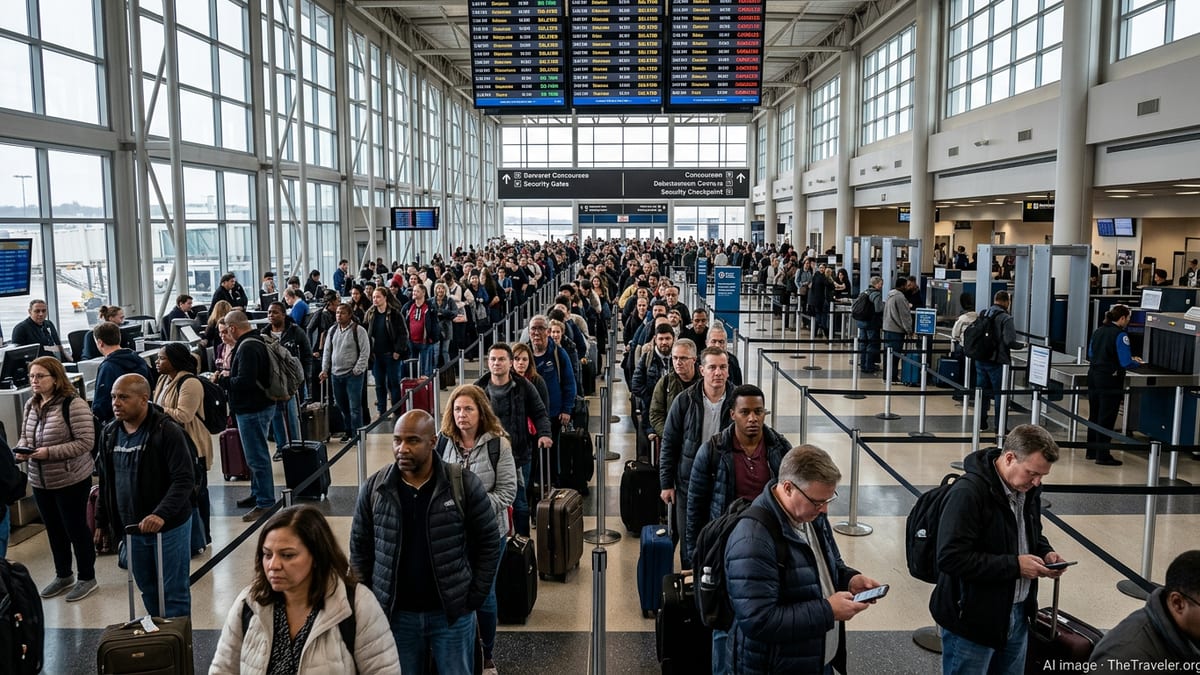
For travelers, the practical impact is already evident in longer lines and tighter capacity at key hubs. Reduced schedules mean fewer alternative flights when weather or mechanical issues arise, making it harder to rebook stranded passengers. Analysts caution that even if only a fraction of national airspace were temporarily restricted, rerouted traffic would likely create congestion and delays far beyond the immediately affected areas.
Air Traffic Control Staffing and Modernization Efforts Under Pressure
Even before the latest funding standoff, federal watchdogs and aviation experts were warning about long term strains inside the air traffic control workforce. Recent reports from the Government Accountability Office and other oversight bodies highlight persistent staffing shortfalls at many critical facilities and an aging controller population nearing retirement, raising concerns about fatigue and burnout.
Congress approved a multibillion dollar package in 2025 to modernize air traffic control technology, including upgrades to radar, communications, and traffic management tools. However, travel industry coverage indicates that much of that investment has been frozen by the shutdown, slowing projects that were meant to ease congestion and reduce delays over the long term. Observers say that each month of halted work deepens the backlog and pushes key upgrades further into the future.
At the same time, unions representing controllers and technical personnel have drawn attention to the impact of unpaid work and mass federal layoffs on morale and retention. Public statements from labor groups describe a system where new controller training is delayed, support staff have been cut, and experienced personnel are being asked to work longer hours to cover gaps. Taken together, airline executives argue, these pressures leave less flexibility to absorb surges in traffic when holiday or summer peaks arrive.
Security Bottlenecks and Rural Air Service Risks
The shutdown’s effects are not limited to the towers and control centers that manage aircraft in flight. Reports from recent weeks describe hourslong waits at some U.S. airports as Transportation Security Administration officers continue screening passengers without pay, while some employees call in sick or seek other work. Travelers at large airports, including hubs in Texas and the Southeast, have been advised through airport statements and local media coverage to arrive four to five hours before departure to clear security.
Beyond the major gateways, communities that rely on subsidized commercial service face a different threat. The Department of Transportation’s Essential Air Service program, which helps keep flights operating to more than one hundred small and rural airports, has been repeatedly flagged in public filings as being at risk of running out of money during the shutdown. Officials at the department have announced temporary funding patches to extend the program for a few extra weeks, but have also warned that without a long term budget agreement, airlines could eventually be released from their contracts to serve those destinations.
Abrupt cuts to rural routes would force many travelers to drive hours to reach the nearest large airport, potentially undermining local economies that depend on reliable air links for business, tourism, and medical travel. Industry observers note that once airlines pull back from thinly served markets, it can be difficult and costly to restore that connectivity, even after federal funding is eventually restored.
What Travelers Can Do Now to Limit Disruption
While the underlying budget dispute is beyond passengers’ control, travel experts and airline operations managers are offering practical guidance aimed at reducing the personal fallout from a system under stress. Publicly available advisories from carriers and airports emphasize the importance of building in more time at every stage of a trip, from check in and security to connections at busy hubs where reduced schedules leave fewer backup options.
Airlines are updating their waiver and rebooking policies to offer more flexibility for travelers whose flights are affected by government related flight reductions. Many carriers have urged customers through email alerts and app notifications to monitor their itineraries closely in the days leading up to departure, as schedules may be adjusted repeatedly while the FAA manages capacity at constrained airports.
Industry analysts suggest that travelers who can adjust their plans may wish to avoid peak travel days and late evening departures, when disruptions are more likely to cascade and leave fewer remaining options. They also recommend booking longer connection times than usual, particularly when routing through one of the 40 airports subject to official capacity cuts, to reduce the risk of missed onward flights if security or departure lines move slowly.
For now, U.S. airspace remains open and most flights continue to operate, but the combination of airline warnings, federal capacity limits, and unresolved funding fights has injected an unusual level of uncertainty into upcoming travel periods. With little clarity on how long the shutdown will last, both airlines and passengers are bracing for a turbulent stretch ahead.