

More news on this day
A sweeping wave of cartel violence across Mexico following the killing of drug kingpin Nemesio “El Mencho” Oseguera Cervantes has prompted heightened travel alerts and shelter-in-place warnings from both the United States and Canada, disrupting flights, closing schools and raising fresh questions about safety in some of the country’s most popular tourist destinations.
Cartel Kingpin’s Death Triggers Nationwide Unrest
Mexican authorities confirmed that Nemesio Rubén Oseguera Cervantes, widely known as “El Mencho” and long considered Mexico’s most wanted drug lord, was killed on February 22, 2026, during a military operation in Tapalpa, a mountainous town in the western state of Jalisco. Oseguera, alleged leader of the Jalisco New Generation Cartel, had been the focus of years of joint U.S.-Mexican investigations and carried a multimillion-dollar reward for information leading to his capture.
The operation, led by the Mexican army and backed by intelligence support from U.S. agencies, reportedly unfolded as security forces moved to detain Oseguera and his associates. Officials said the cartel boss was gravely wounded during clashes and died while being transported to Mexico City. Several cartel members were also killed or arrested, and authorities displayed a cache of seized weapons that included high-caliber rifles, explosives and rocket launchers.
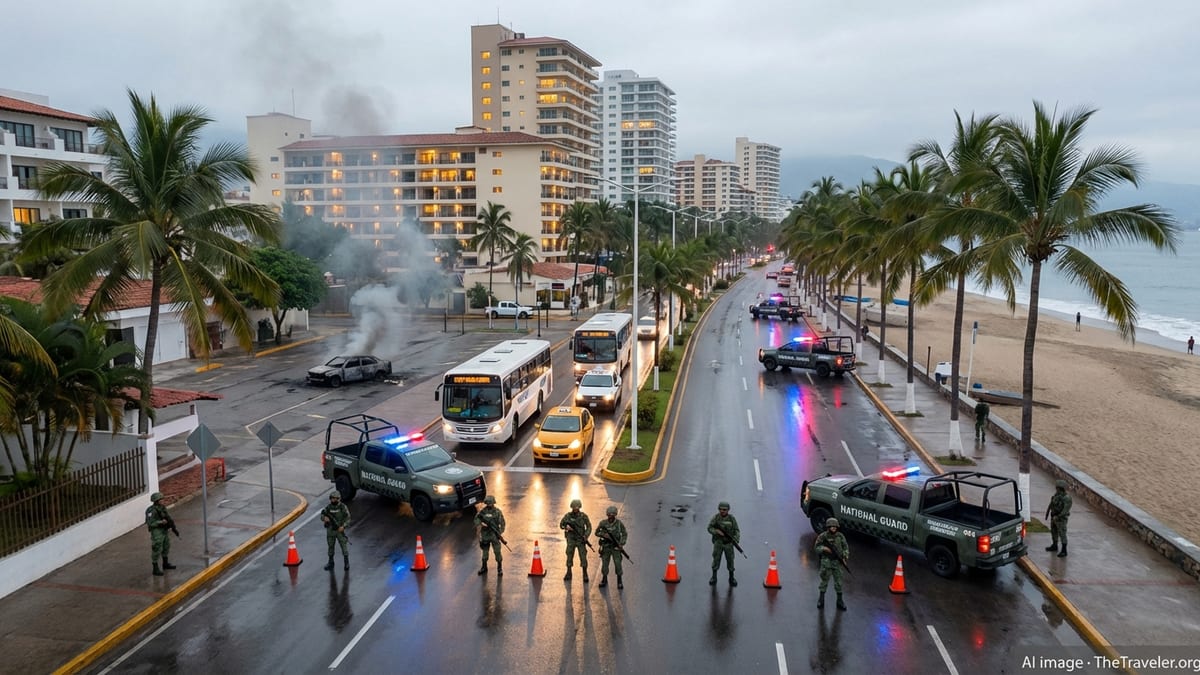
Within hours of the announcement, violence rippled far beyond the operation’s epicenter. Authorities and eyewitnesses described convoys of gunmen setting vehicles ablaze, erecting roadblocks and attacking security forces in multiple states. In Jalisco’s capital, Guadalajara, residents reported smoke plumes rising from burning buses, the thrum of helicopters and bursts of gunfire echoing through parts of the city as officials urged people to stay indoors.
The unrest quickly morphed into a broader security emergency. Public transportation was suspended in some areas, schools canceled in-person classes and large public events were postponed or scrapped. Analysts warned that the killing of such a powerful figure in Mexico’s criminal underworld was likely to trigger a volatile power struggle within the cartel and with rival groups, with potential implications for security in key tourist corridors.
U.S. Issues Shelter-in-Place Warnings in Tourist Hotspots
In response to the rapidly deteriorating situation, the U.S. Embassy in Mexico City issued an urgent security alert late on February 22, advising American citizens in several states to shelter in place. The warning specifically named Jalisco, Tamaulipas, Michoacán, Guerrero and Nuevo León, and highlighted the resort city of Puerto Vallarta, the lakeside town of Chapala and the metropolis of Guadalajara as areas of particular concern.
The alert cited “ongoing security operations and related road blockages and criminal activity,” urging U.S. citizens to avoid travel on major highways, steer clear of areas where law enforcement activity was under way and refrain from joining crowds or protests. Americans already in affected regions were told to remain indoors, secure their accommodations and minimize nonessential movements until conditions stabilize.
As images of burning vehicles and armed convoys circulated on social media, consular officials reinforced existing long-standing State Department advisories that already warn against travel to some Mexican states or recommend reconsidering nonessential trips. The latest alert, however, marked a more immediate, incident-driven response focused on specific cities and corridors where violence appeared directly linked to the fallout from Oseguera’s death.
U.S. officials emphasized that the guidance was precautionary and that many parts of Mexico, including major resort areas, continued to operate normally. Nonetheless, the shelter-in-place language signaled a rare level of concern about short-term risk, particularly for travelers who might inadvertently encounter roadblocks, confrontations or sudden airport closures.
Canada Raises Advisory Level and Urges Caution
Canadian authorities also moved quickly to adjust their travel advice. Ottawa updated its guidance for Mexico to highlight the spike in violence and the potential for sudden disruptions to transportation and public services in Jalisco and surrounding states. The advisory warned Canadians to exercise “a high degree of caution” and to avoid demonstrations, police operations and any areas where roadblocks had been reported.
Canada’s alert echoed many of the same concerns raised by U.S. officials, citing burning vehicles, armed clashes and temporary shutdowns around major urban centers. Canadian citizens already in Mexico were urged to register with consular services, monitor local news broadcasts and follow the instructions of local authorities, who have been imposing curfews in some municipalities and temporarily suspending public events.
The Canadian government highlighted disruptions at Puerto Vallarta and other key gateways used by Canadian snowbirds and winter holidaymakers. Officials noted that airlines could delay or reroute flights at short notice, leaving travelers stranded or facing long waits in crowded terminals. The advisory urged passengers to check their flight status frequently, remain in secure areas of airports and make contingency plans in case of overnight delays.
While the overall risk level for Mexico remained varied by region, the updated Canadian guidance underscored that the current turbulence was directly linked to the cartel leader’s killing and that the potential for localized flare-ups would likely continue in the days ahead.
Flight Cancellations Snarl Cross-Border Travel
The security crisis quickly spilled over into air travel, straining connections between Mexican resort hubs and major cities in the United States and Canada. Airlines suspended or curtailed flights to Puerto Vallarta and Guadalajara in particular, citing safety concerns for passengers and crew as well as uncertainty over access routes to airports.
United Airlines, among the largest U.S. carriers in the Mexico market, canceled all scheduled flights to and from Puerto Vallarta and Guadalajara on Sunday and into Monday, affecting travelers at airports such as San Francisco International. Other carriers adjusted schedules, merged flights or substituted larger aircraft in an effort to accommodate stranded passengers once operations could safely resume.
Canadian travelers were similarly affected. Air Canada temporarily halted its Puerto Vallarta operations after reporting that the security situation around the airport made it difficult for passengers and staff to reach the terminal safely. Additional cancellations were reported by other North American carriers serving the Pacific coast and central Mexico, intensifying pressure on airport authorities already grappling with heightened security measures and nervous travelers.
Inside affected terminals, travelers described scenes of confusion as departure boards filled with delays and cancellations and airport announcements struggled to keep pace with rapid operational changes. Some passengers, eager to leave areas where reports of gunfire or roadblocks had surfaced, found themselves lining up for hours at airline counters, seeking rebookings or alternate routes home.
On the Ground in Mexico’s Tourist Corridors
In many of Mexico’s best-known tourist destinations, the impact of the unrest has been uneven but palpable. In Puerto Vallarta, a Pacific beach city heavily reliant on foreign visitors, hotels reported an immediate wave of questions and cancellation requests from international guests. While the city’s oceanfront promenade remained mostly calm, local businesses described a sharp drop in evening foot traffic as residents and tourists alike heeded warnings to stay indoors.
Inland, around Guadalajara and the Lake Chapala region, residents contended with intermittent road closures, the sight of armored vehicles on major thoroughfares and a heavy presence of military and National Guard patrols. Local authorities temporarily suspended in-person classes and some cultural events, including concerts and sports fixtures, in hopes of limiting crowds and reducing the risk of civilians getting caught in crossfire or confrontations.
Elsewhere in the country, including in states such as Guanajuato, Michoacán and Guerrero, reports surfaced of burned vehicles and ad hoc checkpoints possibly linked to the Jalisco New Generation Cartel’s reaction to its leader’s death. In some communities, intercity buses were halted and passengers told to disembark amid competing instructions from gunmen and security forces.
Despite the alarming images, many neighborhoods and resort districts continued to function relatively normally, highlighting the patchwork nature of Mexico’s security landscape. Travel experts cautioned against overgeneralizing conditions across such a large and diverse country, while still acknowledging that the current spike in violence underscored the long-running risks in areas where powerful criminal groups maintain a presence.
What Travelers Are Being Told to Do Now
For travelers currently in Mexico, both U.S. and Canadian officials have issued similar core messages: stay informed, stay flexible and prioritize personal safety over rigid itineraries. Tourists are being advised to monitor official government alerts, sign up for security updates, and keep in close contact with their airlines, hotels and tour operators as conditions evolve.
Authorities suggest that visitors in affected states should identify safe shelter locations, keep mobile phones charged, ensure they have local emergency numbers saved and travel with copies of key identification documents. They also stress the importance of avoiding attempts to drive through roadblocks or confront armed groups and of steering clear of social media rumors that can exaggerate or misrepresent events on the ground.
Travel advisers recommend that anyone planning an imminent trip to the most affected areas speak with their airline and accommodation provider before departure to assess whether postponement may be advisable. Those who decide to proceed are encouraged to build in additional time for airport transfers, expect increased security screenings and be prepared for last-minute changes to flight schedules.
Consular officials, meanwhile, have reminded citizens that local authorities in Mexico may respond swiftly to perceived threats, including by imposing temporary curfews, closing highways or restricting access to certain neighborhoods with little advance notice. Travelers are urged to comply with local instructions, carry identification at all times and maintain a low profile in public spaces.
Impact on Mexico’s Tourism Image and Economy
The latest wave of cartel-related violence poses a serious reputational challenge for Mexico’s tourism industry, which has become a vital pillar of the country’s economy. Destinations such as Puerto Vallarta, Cancun, Los Cabos and Mexico City collectively welcome millions of visitors each year, generating crucial revenue and employment in regions that have few comparable sources of income.
While crime and security concerns have long shadowed Mexico’s international image, the vivid footage of burning buses, deserted highways and heavily armed patrols arriving on the heels of the cartel kingpin’s killing risks reinforcing foreign perceptions of instability. Travel agents in North America reported a spike in inquiries from nervous clients over the weekend, with some opting to shift bookings to other sun destinations in the Caribbean or the United States.
Industry leaders in Mexico have responded by stressing that the violence remains localized and that the country’s main resort corridors are working closely with federal and state security forces to protect visitors. Hotel associations and tourism boards have encouraged travelers to seek detailed, region-specific information rather than cancel trips based on sensational images alone.
Nonetheless, economists warn that even a short-term dip in arrivals can ripple through local economies, affecting everyone from hotel staff and tour guides to taxi drivers and market vendors. The longer the current unrest persists, the more difficult it may become for authorities and private operators to reassure travelers that Mexico’s beaches, colonial cities and cultural attractions remain safe and accessible.
Uncertain Path Ahead as Security Forces Dig In
As Mexico’s government hails the killing of Nemesio “El Mencho” Oseguera as a major victory, security specialists caution that dismantling the Jalisco New Generation Cartel’s powerful networks will be far more complex than removing a single leader. The group has embedded itself deeply in multiple regions, forged alliances with local gangs and diversified its criminal portfolio beyond drug trafficking into extortion, fuel theft and illegal mining.
Analysts say that in the short term, the most likely scenario is a period of heightened volatility, with possible retaliatory attacks, internal succession battles and opportunistic moves by rival criminal organizations seeking to exploit any perceived weakness. That turbulence could lead to shifting patterns of violence, with some areas seeing an easing of pressure and others suddenly becoming flashpoints.
For foreign governments, including the United States and Canada, the challenge will be to calibrate travel guidance to rapidly changing realities without unduly alarming citizens or undermining the tourism lifeline that sustains many Mexican communities. Officials in both countries have signaled that they are closely monitoring events and will adjust their alerts as more information emerges.
For now, travelers, airlines and tourism operators are all navigating a landscape defined by both risk and resilience. The coming days will test Mexico’s ability to contain the fallout from one of the most significant blows to organized crime in its recent history, and to convince the world that its beaches, cities and cultural treasures remain open, welcoming and secure.