

More news on this day
Tens of thousands of airline passengers across the United States have been stranded or severely delayed in recent days as a wave of spring storms, heavy Easter travel demand and a tightly stretched airline system combine to create widespread gridlock across the national flight network.
Get the latest news straight to your inbox!
Storm Systems Collide With Holiday Crowds
The latest turmoil has built steadily since the start of April, when a series of storm fronts swept across large sections of the country just as Easter-period travel peaked. Flight-tracking data cited in recent media coverage indicates that between April 2 and April 6, U.S. airports recorded many thousands of delays and several thousand cancellations, with some days seeing more than 6,000 delayed departures nationwide.
Major hubs from New York and Boston to Chicago, Atlanta and Dallas have reported repeated waves of disruption as thunderstorms, high winds, fog and low cloud forced temporary ground stops and reduced runway capacity. At New York’s LaGuardia Airport, published analyses note that early-morning fog and embedded storms on April 5 triggered a rolling ground stop during the busiest departure window, causing a backlog that continued to ripple through schedules for days afterward.
Passenger-rights organizations tracking the period estimate that more than 100,000 travelers were directly affected over the Easter weekend alone, either stranded overnight, forced to rebook onto later flights or facing missed connections on domestic and international itineraries. With aircraft operating at high load factors, space to re-accommodate disrupted passengers has been limited, leaving many with extended waits in crowded terminals.
Network Strain Turns Local Weather Into Nationwide Gridlock
Industry data and recent travel reporting suggest that the scale of the disruption cannot be explained by weather alone. Airlines entered the busy spring period with schedules already running near full capacity, meaning that relatively routine storms have had an outsized impact as there are fewer spare aircraft and crews available to absorb delays.
According to summaries of airline performance published by aviation analytics firms, once storms forced temporary shutdowns or slowdowns at key hubs, knock-on effects spread quickly through the network. Late-arriving aircraft missed connection banks, crew duty-time limits were reached before flights could depart, and maintenance tasks were pushed back, creating additional cancellations even after skies cleared.
Recent analyses of U.S. on-time performance trends highlight how dependent the system is on a handful of giant hubs and complex, banked schedules. When a storm or congestion episode hits one of these nodes, the result is often a cascade of missed connections and stranded passengers hundreds or even thousands of miles away, as aircraft and crews end up out of position for subsequent flights.
Staffing Gaps and Infrastructure Limits Add to Delays
Reports from travel-industry outlets point to persistent staffing challenges as another factor turning heavy weather into full-blown gridlock. In several regions, airlines and contractors are still working to rebuild flight crews, ground teams and customer-service staffing to match the surge in demand, while air-traffic control centers and security screening checkpoints have also faced tight staffing in recent weeks.
Publicly available guidance from passenger-advocacy groups notes that even small gaps in staffing can amplify delays when flight schedules are dense. If one crew times out or a set of ground handlers is short-staffed, an aircraft can miss its departure slot, sparking a chain reaction that affects multiple onward flights. At already busy airports, this can further congest taxiways and gates, lengthening turnaround times and forcing additional ground holds.
Infrastructure constraints, including runway and taxiway work at several major airports and occasional IT or reservation-system issues at individual carriers, have also been cited in recent coverage as contributing factors. While these problems may be relatively minor in isolation, they add friction to an already stressed network and leave less margin to recover when severe weather sweeps through.
Travelers Face Long Lines, Limited Options
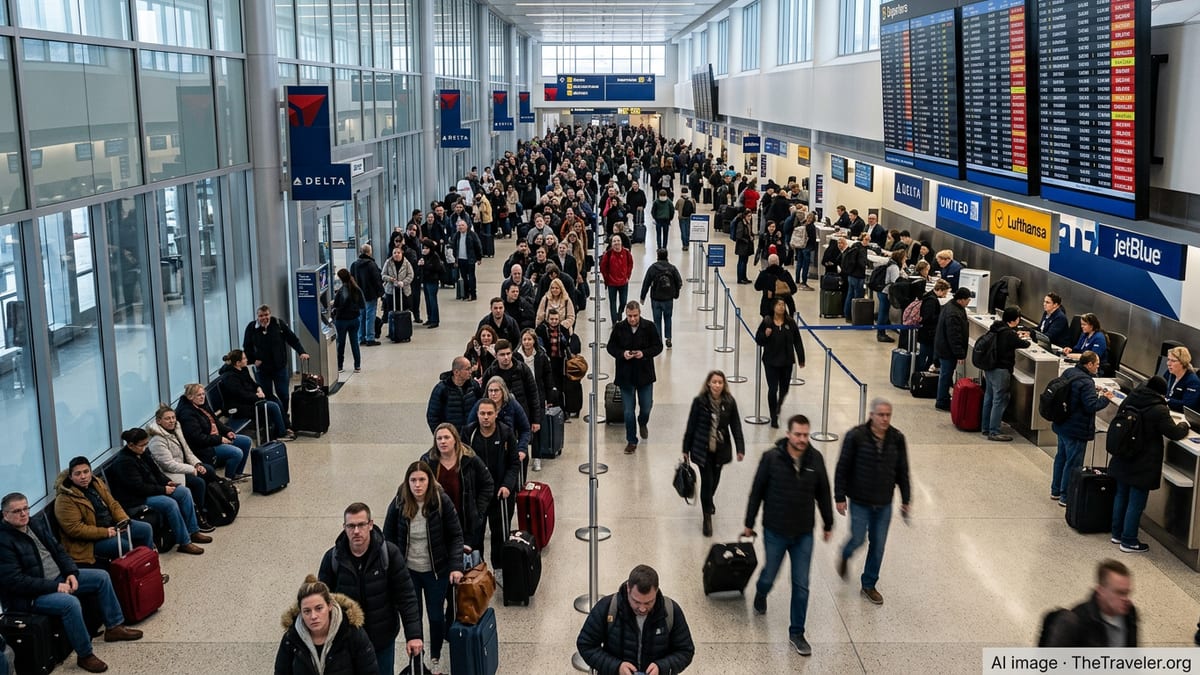
For travelers, the convergence of storms, staffing pressures and infrastructure limits has translated into long lines, disrupted plans and, in many cases, overnight stays at or near airports. Images and accounts shared across social media and in local news coverage describe packed concourses, extended waits at customer-service desks and difficulty securing hotel rooms near some of the hardest-hit hubs.
Consumer-rights organizations and travel publications advise that, during wide-scale gridlock, rebooking options can be limited for days, especially on popular routes and during peak travel windows. With many flights already close to full, displaced passengers are often split among multiple later departures, and some end up rerouted through less direct connections in order to reach their destinations.
Guides aimed at affected passengers stress the importance of using airline mobile apps and online tools to monitor flight status and manage rebooking, rather than relying solely on in-person service counters. Travelers are also being encouraged to keep essential items in carry-on bags, build extra time into itineraries and be prepared for last-minute gate changes or aircraft swaps as airlines attempt to reset their operations.
Gridlock Renews Questions About System Resilience
The latest episode of nationwide gridlock comes on the heels of several major weather and operational disruptions earlier in 2026, including winter storms that produced thousands of cancellations and widespread power outages across multiple states. Travel analysts note that each new wave of chaos has revived debate about the resilience of the U.S. aviation system and how quickly it can recover when multiple stressors collide.
Research into long-term delay patterns across U.S. airlines has found that a growing share of disruptions are linked not just to direct weather impacts, but to what are known as reactionary delays, in which earlier problems cascade through the network. With airlines seeking to maximize aircraft use and meet strong demand, there is limited slack in schedules, making it more difficult to absorb these reactionary effects when storms or bottlenecks develop.
Policy discussions highlighted in recent coverage have focused on potential responses ranging from targeted investments in airport and air-traffic infrastructure to updated crew-scheduling practices and stronger consumer protections for passengers caught up in mass cancellations. As tens of thousands of travelers wait for the current wave of disruptions to ease, pressure is likely to build for measures that can better insulate the system from similar gridlock episodes in future peak travel periods.