

More news on this day
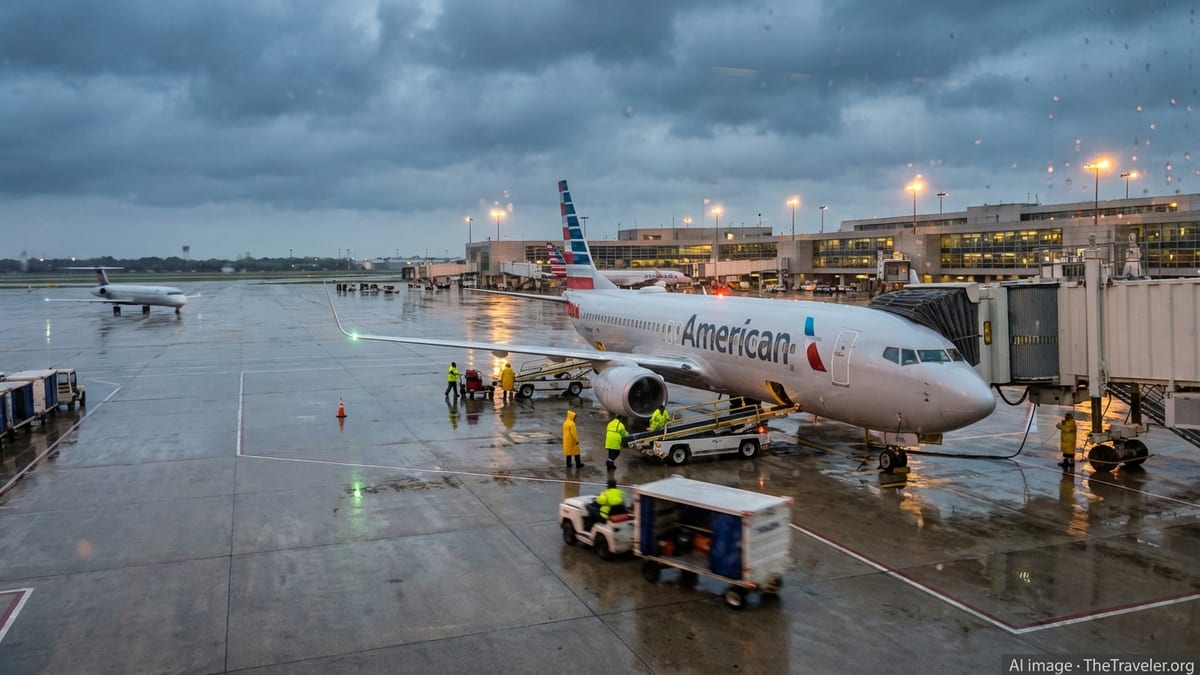
An American Airlines Boeing 737 preparing to depart Dallas Fort Worth International Airport for Las Vegas taxied back to the gate this weekend, a routine operational decision that has taken on outsized symbolism as regulators in Washington and Mexico City spar over airspace access, safety oversight and competitive balance across North American skies.
A Routine Return to Gate in an Unusual Moment
According to people familiar with the operation, the American Airlines jet had begun taxiing from its gate at Dallas Fort Worth on Saturday during a period of heavy rain and widespread disruptions across the carrier’s Texas hub. Within minutes, the crew requested to return, citing an operational concern that required attention before takeoff. Passengers were instructed to remain seated as the aircraft made its way back to the terminal.
Dallas Fort Worth was among the most affected U.S. airports over the weekend, with hundreds of delays and cancellations as storms soaked North Texas and forced airlines to slow departures. American Airlines, the dominant carrier at the airport, saw more than 450 departure delays and over 100 cancellations on Saturday alone, amplifying the impact of even minor schedule disruptions at its primary connecting hub.
Ordinarily, a taxi-out and return to gate is a non-event in commercial aviation, often triggered by a maintenance indicator, weight-and-balance recalculation, weather hold or a passenger issue. In this case, there were no reports of an emergency declaration, evacuation or injuries. Yet the incident unfolded against a backdrop of heightened sensitivity around U.S. airspace near Mexico and an increasingly public feud between regulators in Washington and Mexico City, magnifying what might otherwise have remained an anonymous delay.
For travelers on board, the episode translated into inconvenience rather than danger. Several passengers described a long but orderly wait in the cabin as ground crews and gate agents coordinated next steps. Once back at the gate, customers were updated on their options, with some rebooked onto later flights amid ongoing weather-related constraints at the airport.
Weather Disruptions Layered on Operational Strain
The return to gate at Dallas Fort Worth came during one of American Airlines’ most challenging weather days so far this year. Torrential rain across North Texas slowed ground handling, reduced visibility for pilots and forced the stretching of separation between departures and arrivals. Ramp crews navigated slick concrete and lightning alerts, conditions that routinely ripple through tightly timed hub schedules.
Data from flight-tracking and disruption-monitoring services showed American absorbing the brunt of the impact. At its Dallas Fort Worth hub, hundreds of arriving and departing flights recorded significant delays, as the airline struggled to move aircraft and crews into position. When a jet that has already pushed back must return to the gate, it can strand a departure slot, pushing subsequent flights further into the evening and adding stress to already stretched resources.
Operational experts note that in adverse weather, airline dispatchers and pilots often adopt a lower tolerance for even minor anomalies. A system alert that might be managed with extra monitoring in ideal conditions can prompt a preemptive return to the gate when thunderstorms loom and runway braking conditions are deteriorating. In that context, the choice to bring a Boeing 737 back for further checks at Dallas Fort Worth fits squarely within a conservative, safety-first operating philosophy.
The weekend storms also overlapped with a partial U.S. government shutdown that has raised concerns about staffing and wait times at federal checkpoints. While the security situation is administratively separate from airline operations, the combined effect of longer queues, weather delays and aircraft swaps has made major hubs like Dallas Fort Worth feel more strained to passengers and frontline workers alike.
Border Airspace Jitters After El Paso Shutdown
The Dallas Fort Worth disruption occurred just days after a highly unusual partial shutdown of airspace around El Paso, a major Texas city along the U.S.–Mexico border. Late on February 10, the Federal Aviation Administration abruptly halted most flights in and out of El Paso International Airport, initially indicating that the restriction could last up to 10 days for unspecified security reasons before quickly scaling back the order.
The closure, which was reversed within hours, stranded travelers and forced diversions, sparking confusion among airlines and local officials. Subsequent statements from federal agencies and unnamed industry sources pointed alternately to suspected cross-border cartel drones and to confusion surrounding U.S. military testing of counter-drone technology in the region. The lack of a clear and consistent explanation has deepened unease among aviation stakeholders on both sides of the border.
Mexican officials, including President Claudia Sheinbaum, pushed back on claims of cartel drone incursions, stating that Mexican authorities had not seen corroborating evidence. They called on U.S. agencies to share concrete information through formal diplomatic and security channels rather than through anonymously sourced media briefings and unilateral airspace decisions that have immediate consequences for commercial passengers and cargo flows.
For airlines like American, which serve both domestic hubs such as Dallas Fort Worth and cross-border markets, the El Paso episode underscored how quickly security decisions at the border can ripple through broader operations. While the returned Boeing 737 at Dallas Fort Worth was not linked to a security threat, the incident played into a broader public sense that the skies over the U.S.–Mexico frontier are entering a more volatile and politically charged phase.
Regulatory Dispute Strains U.S.–Mexico Aviation Ties
Beyond border security, the United States and Mexico are embroiled in a simmering regulatory confrontation that has transformed what was once a showcase of cross-border aviation liberalization into a high-stakes standoff. In recent months, the U.S. Department of Transportation has moved to revoke approvals for numerous current and planned routes by Mexican carriers into American cities, citing what it describes as Mexico’s persistent noncompliance with the 2015 bilateral air transport agreement.
Transportation Secretary Sean P. Duffy has framed the crackdown in populist terms, accusing Mexican authorities of freezing U.S. carrier growth at key Mexican airports while granting domestic airlines favored access. The department has disapproved a roster of existing and proposed schedules for major Mexican carriers and has imposed a broad freeze on future expansion from the Mexico City area into the United States, effectively weaponizing route authority to force policy changes south of the border.
Mexico, for its part, has pushed back on the U.S. narrative, arguing that domestic infrastructure constraints and safety reforms at Mexico City’s main and secondary airports require tighter slot management for all airlines. Officials in Mexico City insist they have sought to preserve reciprocal opportunities and maintain a level playing field, even as critics in Washington contend that American and other U.S. carriers have been shut out of growth opportunities while Mexican airlines pursue new city pairs north of the border.
The result is a climate of uncertainty for airlines and passengers, with the possibility that route cancellations and frequency caps could escalate if the two governments fail to bridge their differences. In that environment, even routine operational choices at large U.S. hubs, such as returning a Boeing 737 to the gate in Dallas, can become fodder for larger political narratives about whose skies are safer, fairer and more open.
American Airlines Under the Microscope on Safety and Reliability
American Airlines, already under scrutiny following several high-profile operational incidents in recent years, has been working to convince regulators and passengers that its safety culture is not being compromised by aggressive cost controls or the pressures of operating the world’s largest fleet. Investigations into previous events, including a runway overrun by a Boeing 737 at Dallas Fort Worth tied to maintenance missteps and an engine fire that prompted an evacuation in Denver, have highlighted the need for rigorous oversight of procedures and contractor work.
The carrier has responded by revising maintenance manuals, tightening quality checks and increasing training for both its own staff and third-party providers. Executives have emphasized that American’s overall safety record remains strong, noting that the U.S. commercial aviation system has not seen a major fatal jetliner crash in more than a decade. They also point out that the decision to return aircraft to the gate rather than press ahead in the face of any unresolved anomaly is a visible expression of that safety-first mindset.
Yet American’s reliability metrics, particularly during severe weather or air traffic control constraints, have at times lagged those of certain competitors. Passengers at Dallas Fort Worth routinely share stories of cascading delays when storms linger over North Texas, with missed connections reverberating across the network. The weekend that saw the Las Vegas-bound Boeing 737 return to its gate was no exception, as disrupted crew assignments and aircraft rotations forced rebookings well into the following day.
Industry analysts say the airline’s heavy reliance on Dallas Fort Worth as a central hub magnifies the impact of any disruption there, whether driven by thunderstorms, a sudden airspace restriction elsewhere on the border or political decisions that affect cross-border flying rights. The tension between operating an efficient megahub and maintaining enough slack to absorb surprises remains one of American’s central strategic challenges.
Travelers Caught Between Policy Fights and Practical Realities
For passengers, the unfolding friction between U.S. and Mexican aviation authorities is experienced less as a matter of treaties and more as a patchwork of disruptions, sudden schedule changes and confusing explanations. A traveler whose flight from Dallas Fort Worth to Las Vegas returns to the gate may never hear more than a brief reference to an “operational issue,” even as that same traveler later discovers that a separate trip to Mexico City or Cancun has been rescheduled or rerouted due to regulatory disputes beyond any airline’s direct control.
Consumer advocates argue that airlines and regulators alike need to communicate more clearly about the root causes of disruptions, particularly when they stem from political or security decisions rather than mechanical or weather events. While acknowledging that sensitive law enforcement and defense details cannot always be shared, they say the El Paso airspace shutdown and the escalating route revocations for Mexican carriers show how opaque the decision-making process can appear to the flying public.
In the meantime, travel advisers are encouraging cross-border passengers to build more connection time into itineraries, especially when connecting through hubs that are vulnerable to summer storms or winter ice, and to monitor flights closely in the days leading up to departure. Flexible tickets and travel insurance tailored to airline-caused disruptions rather than just weather may offer some additional protection, though coverage details vary widely among providers.
For leisure travelers bound for Mexico or U.S. desert destinations like Las Vegas, the combination of regulatory uncertainty and operational volatility suggests that careful planning and up-to-date information will be increasingly important. What once felt like a straightforward two-hour hop from Dallas Fort Worth can quickly become a multi-hour ordeal when a jet is forced back to the gate and adverse conditions block the path forward.
What the Incident Reveals About North American Air Travel
In isolation, the American Airlines Boeing 737’s return to the gate before departure from Dallas Fort Worth to Las Vegas is a textbook example of the safety conservatism that underpins modern commercial aviation. Crews are trained to err on the side of caution, dispatchers have wide latitude to call aircraft back when conditions change, and airlines are expected to bear the financial cost of delays rather than expose passengers to unnecessary risk.
Placed within the broader context of U.S.–Mexico tensions over airspace security, market access and regulatory enforcement, however, the event becomes a small but telling detail in a larger narrative. It illustrates how closely intertwined domestic U.S. operations are with developments along the border and in foreign capitals, and how quickly technical terms like temporary flight restrictions, slot disapprovals and joint venture terminations can translate into missed weddings, lost business deals and frayed tempers at crowded gates.
As Washington and Mexico City navigate their disputes over drones, military testing, airport slot management and reciprocal access for airlines, major U.S. hubs such as Dallas Fort Worth will remain frontline arenas where policy decisions are felt in real time. Each decision to hold a departure on the taxiway or bring a jet back to the gate is shaped not only by the weather outside the cockpit window, but also by the evolving political and regulatory winds blowing across North America.
For now, the returned Boeing 737 at Dallas Fort Worth stands as a reminder that in a complex, interconnected air transport system, no flight operates in a vacuum. Even a routine delay can offer a glimpse into the fault lines that define the future of travel between the United States and Mexico, and into the delicate balance between safety, sovereignty and convenience that underpins every takeoff and landing.