

More news on this day
WASHINGTON, D.C. — The U.S. government is rushing to assemble evacuation flights for Americans stranded across the Middle East, as expanding conflict and widespread airspace closures leave tens of thousands of citizens struggling to find a way out.
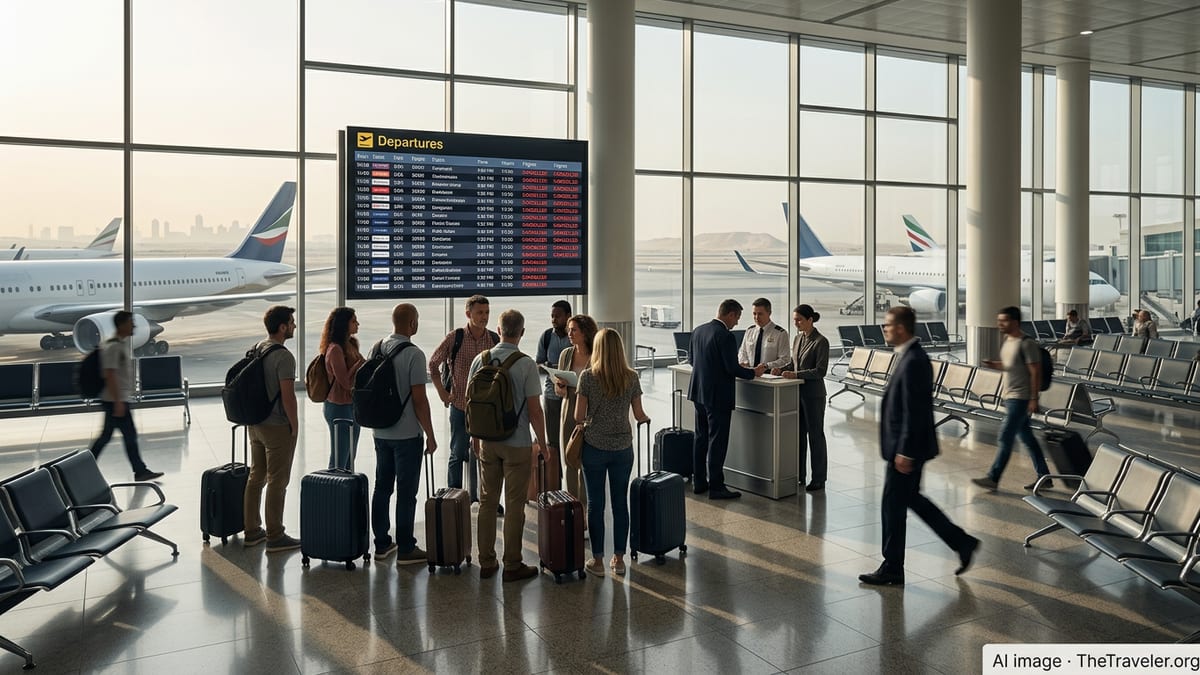
From “Depart Now” Warning to Organized Evacuations
The scramble to secure evacuation flights follows an urgent U.S. State Department advisory instructing Americans in more than a dozen Middle Eastern countries to leave immediately using any available commercial transport. That message, delivered as hostilities between the United States, Israel and Iran widened, triggered a wave of demand on already strained airline networks and left many travelers with no viable route home.
Officials in Washington acknowledged that the initial directive relied heavily on commercial aviation at a time when major carriers were suspending services and several states had moved to fully or partially close their airspace. Aviation tracking data shows thousands of flights to and from the region canceled since the weekend, effectively sealing off key hubs that typically serve as lifelines for long-haul travelers.
As stranded Americans voiced frustration and fear, the State Department confirmed it was shifting from a “commercial first” approach to one centered on government-coordinated evacuations. That includes the use of U.S. military assets and contracted charter aircraft to move citizens out of the most disrupted locations to safer transit points.
Senior consular officials say they are in direct contact with several thousand Americans who have registered their presence in the region, while stressing that the true number of U.S. citizens and dual nationals affected is likely far higher, given the large expatriate communities and peak travel season traffic.
Military and Charter Flights Out of Regional Hubs
In recent days, Washington has quietly expanded a patchwork of evacuation options, focusing first on airports that remain operational and can safely handle large aircraft. Charter flights are now operating or being assembled from countries such as the United Arab Emirates, Saudi Arabia and Jordan, serving as staging points for onward travel to Europe and North America.
State Department officials say more than 9,000 U.S. citizens have already been transported out of the broader region on a mix of government-organized and commercial flights, with numbers expected to rise as additional capacity comes online. In several cases, Americans have been routed to third countries where commercial links remain intact, then assisted in booking connections back to the United States.
In parallel, the Pentagon has been tasked with identifying airlift assets that can be deployed quickly if conditions deteriorate further around key population centers or if commercial options collapse entirely. The use of military transport aircraft is expected to prioritize locations where U.S. embassies and consulates have scaled back or suspended normal operations due to direct security threats.
Unlike earlier evacuation operations that required travelers to sign promissory notes to reimburse the government, officials say Washington has moved to waive statutory repayment requirements for these flights, framing the effort as an emergency measure in an exceptionally volatile security environment.
Stranded Travelers Face Closed Airspace and Shuttered Embassies
For many Americans in the Middle East, the promise of evacuation support is colliding with the on-the-ground reality of closed airports, damaged infrastructure and fast-moving front lines. Multiple governments in the region have shut their skies to overflights or inbound traffic, and some have restricted access to major terminals to essential personnel only.
Embassy services have also been sharply curtailed. U.S. missions in several countries, including key Gulf states and Lebanon, have either closed temporarily or are operating with skeleton staff after being targeted by drone and missile attacks or caught in nearby strikes. Security alerts issued overnight have urged citizens to stay away from diplomatic compounds and to shelter in place where large gatherings or transport hubs could become targets.
Travelers who managed to leave early describe chaotic scenes in departure halls as airlines canceled flights with little notice and rebooked passengers onto limited remaining services. Others say they were turned away at airport checkpoints when new restrictions came into force, forcing them back to hotels or private residences while they await word on organized departure options.
In countries where airports are still open but airspace restrictions are tightening, local authorities have moved to prioritize outbound flights serving evacuation corridors coordinated with foreign governments. U.S. consular messages in those locations have begun directing citizens to specific flights or check-in windows, stressing that seats are limited and may not be available for all who seek to depart on a given day.
Washington Seeks to Reassure Families as Criticism Mounts
The rapid shift from routine travel advisories to full-scale evacuation planning has sparked pointed criticism on Capitol Hill, where some lawmakers accuse the administration of reacting too slowly to clear warning signs of escalation. They argue that Washington should have pre-positioned airlift resources and contingency plans before issuing its call for Americans to “depart now.”
Officials at the State Department counter that the speed and scope of the conflict’s expansion, coupled with unilateral airspace decisions by regional governments, created an unprecedented level of disruption that complicated early planning. They emphasize that a dedicated task force is now coordinating across agencies to increase the frequency and reach of evacuation flights.
For families in the United States, communication with loved ones in the Middle East has been hampered by intermittent power outages, cellular network disruptions and the closure of some local transportation links. Consular officers are urging Americans abroad to enroll in the Smart Traveler Enrollment Program and to maintain as much contact as possible via secure messaging and email so that they can be notified rapidly when new flight options emerge.
Travel industry analysts say the unfolding evacuation is likely to reshape perceptions of risk for leisure and business travel to the region for months or even years, with tour operators already suspending itineraries and rerouting cruise and air itineraries away from traditional Middle Eastern gateways.
Implications for Future Travel and Crisis Planning
For the wider travel community, the evacuation effort offers a stark reminder of how quickly a popular region can become inaccessible when conflict intersects with airspace closures and diplomatic strain. Within days, major hubs that routinely connect North America, Europe, Asia and Africa were effectively cut off, leaving travelers reliant on emergency corridors and government-organized repatriation efforts.
Risk consultants say the episode is likely to accelerate demand for more robust crisis plans from corporations, universities and tour operators that send Americans to the Middle East. That could include pre-arranged charter contingencies, detailed evacuation routes through neighboring countries, and stricter thresholds for when to suspend travel or require personnel to leave.
For individual travelers, consular officials and security experts alike are reiterating long-standing guidance that can prove critical in fast-moving crises: register travel plans with official channels, carry contingency funds and essential documents, maintain multiple ways to communicate, and monitor both U.S. and local government advisories closely. As the current conflict continues to evolve, those steps may spell the difference between catching an early outbound seat and waiting anxiously for the next evacuation flight to materialize.