

More news on this day
Major Gulf carriers including Gulf Air, Emirates, Qatar Airways and flydubai have canceled or reshaped more than 60 flights in recent days, disrupting links between the United Arab Emirates, Bahrain and wider Middle East and European gateways such as Cairo, Doha, Prague, Budapest, Munich, Oslo, Stockholm and Riyadh as regional airspace restrictions continue into late March 2026.
Get the latest news straight to your inbox!
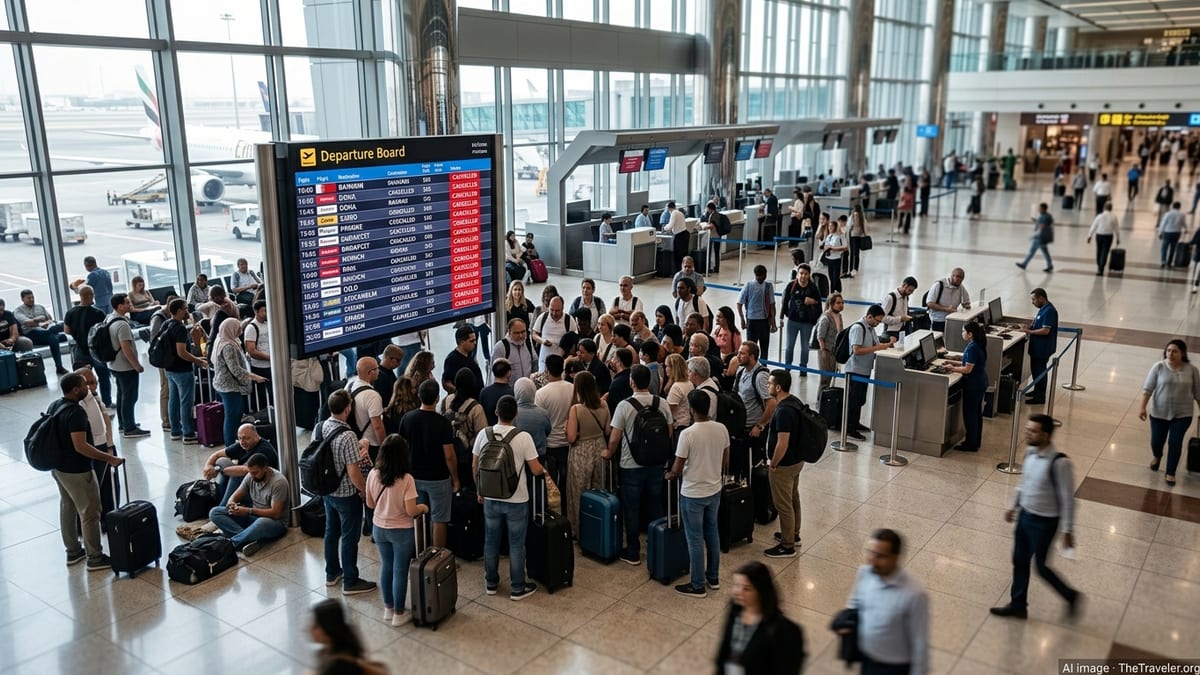
Airspace Restrictions Ripple Across Gulf Hubs
Publicly available advisories show that airspace closures and tight restrictions across parts of the Gulf and wider Middle East, introduced after the escalation of conflict involving Iran earlier in March 2026, remain the primary driver of schedule upheaval. Notices covering the United Arab Emirates, Bahrain, Qatar and neighboring states describe constrained or suspended operations at key hubs that normally act as connective tissue between Europe, Asia and Africa.
Travel management bulletins issued in early March indicated that carriers such as Emirates, Etihad Airways and Qatar Airways temporarily halted most normal services as their home airspace or critical overflight corridors were curtailed. Limited exceptions have been made for selected departures and arrivals, often framed as repatriation or relief flights, while regular commercial schedules are reduced or paused on multiple routes.
As authorities update airspace permissions in stages, Gulf-based airlines have been repeatedly forced to adjust timetables with short notice. The result is a rolling pattern of cancellations and last-minute resumptions, with particular pressure on high-traffic city pairs that funnel passengers through Dubai, Abu Dhabi, Doha and Bahrain on long-haul itineraries.
According to published data sets tracking regional aviation, cancellation rates on intra–Middle East links surged during the first half of March, with some corridors seeing well over half of scheduled services scrubbed on peak disruption days. This backdrop has set the stage for the current wave of route-specific adjustments now affecting travelers bound for cities across the Gulf, North Africa and Europe.
Gulf Air, Emirates and Flydubai Trim Services to Key Cities
Passengers connecting via Bahrain have reported multiple cancellations on Gulf Air services since early March, particularly on itineraries that rely on Bahrain as a bridge between the UAE and onward destinations. Anecdotal accounts shared on public forums describe travelers seeing successive Bahrain-bound flights from Dubai and Abu Dhabi withdrawn, forcing them to reroute through alternative hubs or postpone trips altogether.
Emirates, operating from Dubai International Airport, has restructured its network repeatedly as airspace conditions evolve. Lists of special departure schedules circulated to passengers earlier this month highlighted one-off or short-term flights to European cities including Prague, Budapest, Munich, Oslo and Stockholm, often branded as repatriation or exceptional services. More recently, as fresh restrictions and operational limits bite, a number of those links have again been pared back or canceled outright on selected days.
Routes between Dubai and regional centers such as Cairo and Riyadh have also seen disruption. While Emirates has been able to mount limited services on certain days, public flight-tracking snapshots show gaps in the usual frequency, with multiple rotations canceled within the same 24-hour period. Travelers with bookings on these routes report being moved to later dates or rebooked onto alternative gateways in Europe and Asia when space permits.
Low-cost carrier flydubai, which normally complements Emirates on short and medium-haul segments, has likewise shifted to a reduced and highly dynamic schedule. Advisory summaries shared by travel agents indicate that flydubai has operated only a subset of its normal flights out of Dubai, leaving some regional destinations without service on particular days even when they appear on timetable listings.
Qatar Airways Adjusts Doha Operations Amid Limited Reopenings
Qatar Airways has faced a distinct set of challenges centered on the status of Qatari airspace and the airline’s Doha hub. Early in the disruption, publicly available notices stated that regular services to and from Doha were largely suspended while airspace remained closed or heavily restricted, with the carrier focusing on a small number of relief flights.
Financial and market reports from Qatar in mid-March outline a cautiously expanding interim schedule, with Qatar Airways gradually adding limited connections from Doha to cities such as Cairo and major European and Asian hubs on specific dates. These flights have typically been described as exceptions rather than a full restoration of the pre-crisis timetable, and passengers have been urged via public channels to treat them as subject to change.
Even with this incremental rebuilding, overall capacity through Doha has remained sharply lower than normal. Travelers hoping to use Qatar Airways for itineraries linking the Gulf to European airports such as Munich or to regional destinations like Riyadh and Cairo report frequent schedule changes, including last-minute cancellations or re-timings that can break carefully planned connections.
Recent community discussions among passengers suggest that Qatar Airways is now operating on a rolling limited schedule extending into April, with ongoing adjustments tied to updated clearances from aviation regulators. For many would-be travelers, this means continuing uncertainty over whether flights booked weeks in advance will actually depart as scheduled.
European Links to Prague, Budapest, Munich, Oslo and Stockholm Hit
The disruption is particularly visible on long-haul and connecting routes between the Gulf and secondary European gateways. Publicly shared departure manifests and anecdotal accounts from Dubai-based travelers show that Emirates services to Prague, Budapest and Munich, usually important spokes in the airline’s European network, have operated on an irregular basis throughout March, punctuated by stretches of cancellations.
Flights connecting Dubai with northern European capitals such as Oslo and Stockholm have experienced similar volatility. In some cases, special flights were mounted to carry stranded passengers out of the UAE or back home during temporary easing of restrictions, only for subsequent departures on the same route to be canceled as airspace constraints were tightened again or operational priorities shifted.
The knock-on effect for connecting passengers has been significant. Many itineraries from Asia or Australia to these European cities rely on a single Gulf transfer point. When one leg of that journey is canceled, travelers can find themselves stuck at intermediate hubs like Dubai or forced to accept reroutings via major European airports such as London, Frankfurt or Madrid, often with extended layovers and limited seat availability.
Reports from travel management companies describe a sharp rise in rebooking requests for passengers originally ticketed through Prague, Budapest, Munich, Oslo and Stockholm, as well as a growing number of travel advisories recommending additional buffer time or alternative routings for anyone needing to reach those cities from the Middle East.
Passengers Face Rebookings, Refunds and Ongoing Uncertainty
For individual travelers, the immediate impact of more than 60 cancellations across multiple carriers is a patchwork of disrupted plans. Public posts from affected passengers detail missed business meetings, delayed family visits and extended stays in transit hubs as they wait for available seats on replacement flights.
Airlines across the region have publicly encouraged passengers to monitor their bookings closely and use digital channels to confirm flight status before heading to the airport. In many cases, rebooking onto later dates or alternative routes has been offered without additional fare, although seat scarcity on popular corridors means some travelers are waiting days rather than hours for new itineraries.
Travel advisors note that refund policies and waiver conditions differ by airline and ticket type, adding complexity for those who prefer to cancel rather than navigate uncertain rebooking options. Some passengers holding nonrefundable or heavily restricted fares report being steered toward travel credits, while others on more flexible tickets have been able to secure full refunds after their flights were formally canceled.
With regional airspace restrictions still subject to change and carriers continuing to adjust schedules in response, publicly available guidance from industry bodies and travel management firms emphasizes caution. Prospective travelers are being urged to build flexibility into their plans, consider alternative routings that avoid the most affected corridors, and remain prepared for short-notice changes as Gulf airlines work to balance safety, regulatory requirements and the strong underlying demand for cross-regional travel.