

More news on this day
Major carriers across the Gulf are cutting back services and reshaping fleets as the latest escalation in Middle East tensions disrupts airspace, constrains key hubs in the United Arab Emirates and pushes Qatar Airways to move portions of its Airbus A380 and A350 fleets into long-term storage.
Get the latest news straight to your inbox!
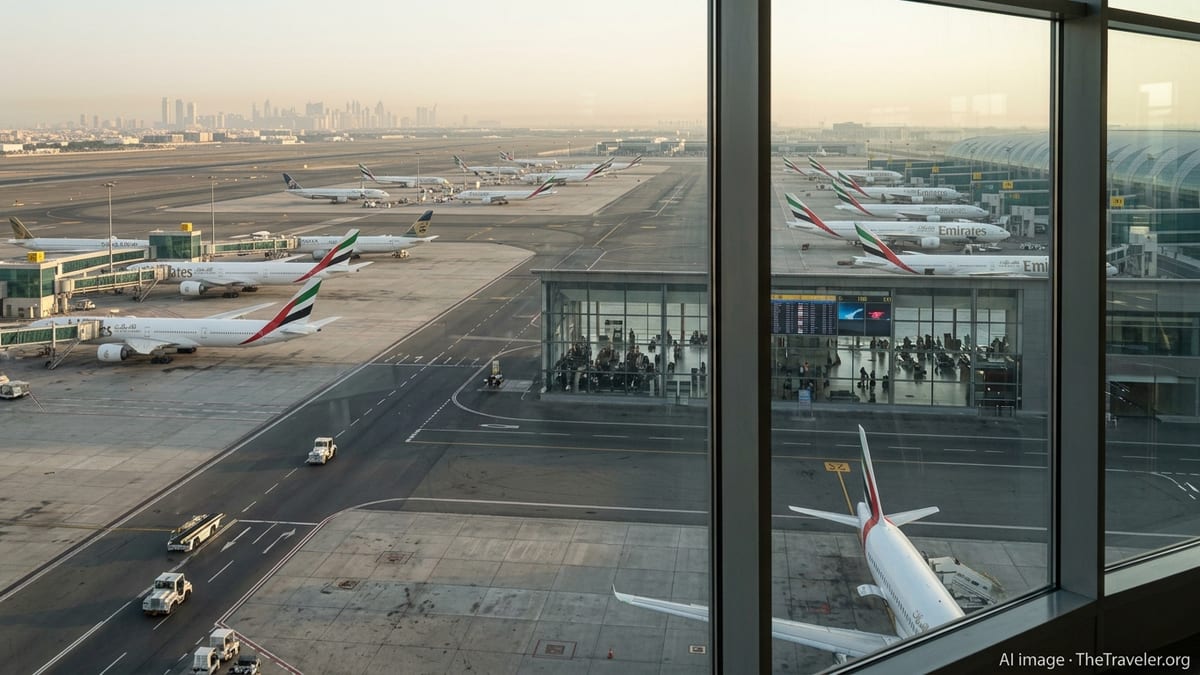
Flight Suspensions Ripple Across UAE Hubs
Airspace closures linked to the conflict involving Iran, Israel and the United States have triggered sweeping schedule cuts at Dubai International, Abu Dhabi International and other airports across the United Arab Emirates. Publicly available data from aviation analytics firms and airline advisories indicate that Emirates, Etihad Airways, flydubai and Air Arabia have all operated on sharply reduced timetables in recent weeks, with many services still suspended or operating only on a limited basis.
Reports from travel industry trackers describe hundreds of cancellations and diversions as airlines navigate restricted corridors over Iran, Iraq, the Gulf and the eastern Mediterranean. In the first days of the latest crisis, departures boards at Dubai and Abu Dhabi thinned dramatically as carriers paused most passenger operations and prioritized evacuation flights and essential cargo movements.
While some services have gradually resumed, schedules remain far from normal. Travel advisories aimed at corporate and leisure passengers note that many routes into and out of the UAE continue to face rolling cancellations, last minute rerouting and extended flight times as aircraft loop around closed or high risk airspace.
Industry observers say the disruption is particularly significant because UAE hubs function as connective tissue between Europe, Africa, Asia and Oceania. Even partial suspensions at these airports reverberate across global networks, affecting travelers who never intended to set foot in the region.
Qatar Airways Turns to Long-Term Storage for A380 and A350 Jets
Against this backdrop, Qatar Airways is adjusting its long haul fleet strategy by placing additional widebody aircraft into long-term storage. Aviation fleet databases and specialist publications tracking aircraft movements show that the carrier has progressively withdrawn several Airbus A380 superjumbos and selected Airbus A350s from scheduled service and relocated them to storage facilities in more remote, lower cost locations.
These moves build on an earlier pattern of cautious deployment of the A380 at the Doha based airline. The aircraft type was already operating on a reduced set of routes compared with pre pandemic levels, and the renewed volatility in regional airspace has undercut demand forecasts on some of the high capacity corridors the superjumbo was designed to serve.
The A350, considered one of the most fuel efficient long haul aircraft, is also being selectively sidelined where demand has softened or where route structures have become less predictable. Analysts note that longer routings around closed airspace erode some of the fuel burn advantages of newer jets, while uncertainty over schedule reliability can reduce the economic case for deploying larger widebodies on particular city pairs.
By mothballing part of its twin aisle fleet, Qatar Airways is preserving asset value and reducing immediate operating costs while retaining the flexibility to reactivate stored aircraft if political conditions improve and long haul demand recovers. The approach mirrors strategies used during earlier shocks, but is unfolding in a context where geopolitical risk rather than purely health or economic concerns is the primary driver.
Capacity Cuts and Network Realignments for UAE Carriers
UAE based airlines are also reshaping their networks in response to the evolving security picture. Data from flight tracking platforms and airline schedules suggests that Emirates and Etihad have prioritized core trunk routes to Europe, Asia and Africa while trimming frequencies and suspending flights to destinations closer to conflict areas or reliant on overflights through restricted skies.
Regional routes to parts of Iraq, Iran, Syria, Lebanon and Jordan have seen particularly heavy disruption over the past year as tensions periodically flared. In some cases, airlines temporarily halted services altogether, while in others they maintained limited frequencies using alternative routings that avoided specific airspace blocks at the cost of longer block times and higher fuel consumption.
Low cost and hybrid carriers based in the UAE have shown similar caution. Public statements and schedule updates from airlines such as flydubai, Air Arabia and former Abu Dhabi based operations of Wizz Air highlight reduced exposure to high risk destinations and a pivot toward more resilient markets in the Indian subcontinent, Central Asia and Europe where routing options are more flexible.
Travel management firms report that corporate customers are increasingly favoring itineraries that provide multiple routing options in case of sudden closures, a trend that encourages carriers to emphasize versatile hubs and routes that can be maintained even under tighter overflight restrictions.
Passenger Experience: Longer Journeys and Persistent Uncertainty
For travelers, the combined effect of UAE schedule cuts and Qatar Airways fleet storage is a less predictable and often more time consuming journey across the region. Publicly available consumer information portals and passenger rights organizations describe a sharp rise in missed connections, forced overnight stays and rerouted itineraries as airlines try to maintain at least some connectivity while minimizing safety risks.
Long haul passengers transiting through Gulf hubs increasingly face detours that add hours to flight times, particularly on routes linking Europe with South and Southeast Asia or Australasia. In many cases, aircraft are flying more southerly or northerly tracks to avoid contested airspace, contributing to higher fuel use and tighter crew scheduling margins.
Uncertainty over when full operations will resume has also complicated trip planning. Booking data and search trends monitored by travel agencies indicate shorter booking windows and a shift toward flexible or refundable fares as passengers respond to the risk of last minute cancellations. Some travelers have temporarily switched to alternative routings via hubs in southern Europe or Central Asia, trading convenience for perceived stability.
Airports and airlines are attempting to manage expectations by issuing frequent schedule bulletins and waiving certain change fees, but the fluid security situation means that accurate forecasting remains difficult. Travelers are being advised by industry bodies to monitor their bookings closely, allow additional buffer time for connections and stay prepared for rapid itinerary changes.
Strategic Outlook for Gulf Aviation
Analysts tracking Gulf aviation suggest that the current combination of schedule reductions and long term storage decisions could reshape network strategies well beyond the immediate crisis window. With Qatar Airways parking a portion of its A380 and A350 fleets and UAE airlines scaling back operations on vulnerable routes, the region’s status as a frictionless super connector is being tested.
In the near term, capacity constraints are expected to support higher yields on routes that remain operational, partially offsetting the financial hit from widespread cancellations. Over the longer term, however, there is concern that repeated disruptions could erode traveler confidence in certain corridors and accelerate a shift toward more decentralized long haul routing that relies less heavily on a small number of Gulf hubs.
At the same time, aircraft storage decisions taken today may influence future fleet plans. If geopolitical risk remains elevated, carriers could opt for a higher proportion of smaller, more flexible long haul aircraft to spread exposure across a wider range of routes and hubs. The sidelining of some of Qatar Airways’ largest jets, combined with the cautious deployment strategies seen at Emirates and Etihad, is being closely watched by manufacturers and leasing companies.
For now, the outlook for Middle East aviation hinges largely on developments far beyond the control of airline planners. Until regional tensions ease and airspace restrictions are reliably lifted, UAE carriers and Qatar Airways appear likely to maintain a defensive posture, balancing limited service resumptions with conservative fleet use and continued reliance on long term storage for some of their largest and most capable aircraft.