

More news on this day
Air travel across the Gulf ground to a halt this weekend as Dubai and Abu Dhabi suspended most flight operations, with UAE authorities scrambling to assist tens of thousands of stranded passengers amid widening regional conflict following joint United States and Israeli strikes on Iran.
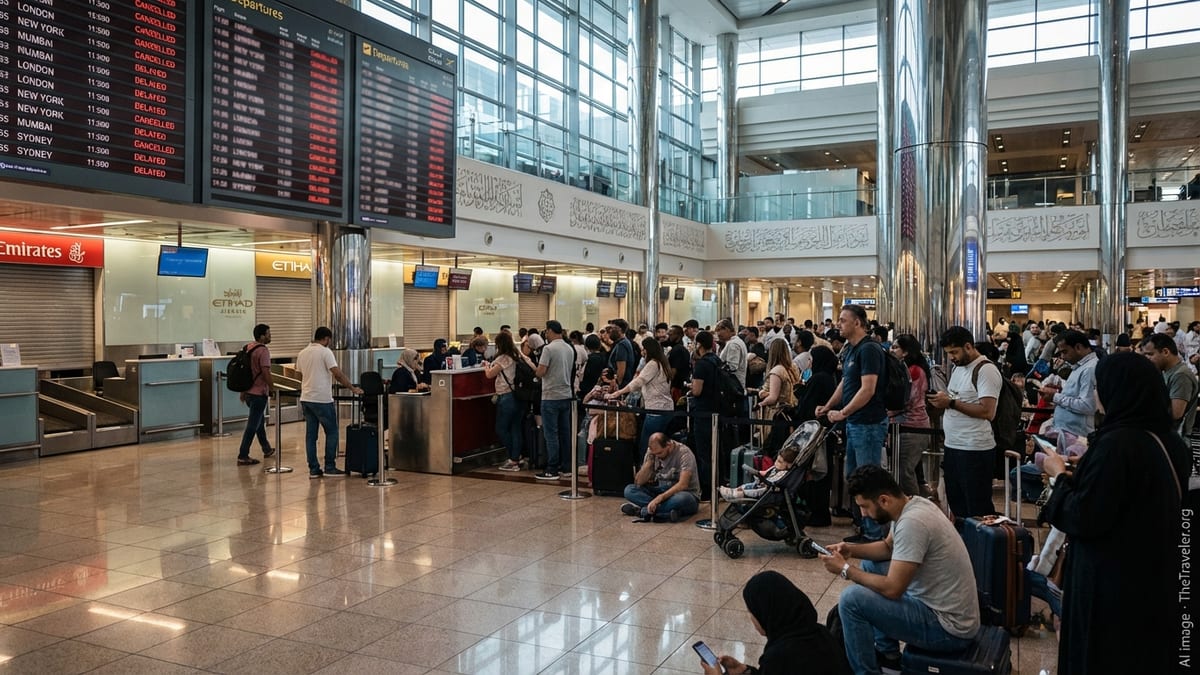
Dubai and Abu Dhabi Brought to an Abrupt Standstill
Dubai’s two major hubs, Dubai International and Dubai World Central, suspended all flight operations “until further notice” from late Saturday, February 28, after the United Arab Emirates moved to partially close its airspace in response to escalating missile and drone activity linked to the conflict, airport and government officials confirmed. Passengers were urged not to travel to the airports and instead contact airlines directly, as departure boards rapidly emptied and arriving aircraft were diverted or turned back mid-route.
In Abu Dhabi, Etihad Airways halted all departures from Zayed International Airport and later extended its suspension of flights to and from the capital until early Monday, March 2, citing evolving safety assessments and the broader closure of regional air corridors. Other carriers serving the UAE, including flydubai and Air Arabia, implemented similar freezes on services, leaving terminals filled with travelers facing indefinite delays.
The dual shutdowns have rippled through global aviation networks, as Dubai and Abu Dhabi normally function as critical east-west transit hubs linking Europe, Africa, Asia, and Australasia. With both hubs heavily curtailed, airlines have been forced into large-scale rerouting or outright cancellations, clogging alternate gateways and stretching crew and aircraft resources worldwide.
Regional Airspace Closures Trigger Global Travel Shock
The UAE measures came amid sweeping airspace shutdowns across the Middle East after coordinated strikes on Iran, with authorities in Iran, Israel, Iraq, Qatar, Kuwait, Bahrain, and others also closing skies to civilian traffic. Aviation regulators warned of a high risk to civil aviation in conflict-affected areas, advising carriers to avoid broad swaths of airspace that typically handle dense long-haul traffic between Europe and Asia.
Industry estimates indicate that well over 1,800 flights have already been canceled across the region, with hundreds more forced into lengthy diversions that add hours to journey times and sharply increase fuel burn. Analysts say knock-on effects are now being felt at major hubs in Europe and South Asia, where aircraft and crew are out of position and terminals are grappling with unexpected waves of disrupted passengers.
For Gulf-based airlines, the disruption is particularly acute. Emirates and Etihad, which together carry tens of thousands of passengers through their UAE hubs every day, have suspended or heavily trimmed schedules, while Qatar Airways has halted services to and from Doha during the height of the airspace closures. Several European and North American carriers, including major US and European airlines, have temporarily stopped flying to the Gulf and neighboring conflict-affected destinations.
Thousands Receive Emergency Accommodation and Travel Support
As cancellations mounted, UAE authorities moved to provide large-scale assistance, coordinating with airlines and airport operators to offer food, hotel stays, and rebooking support to stranded travelers. Officials in Dubai and Abu Dhabi said more than 20,000 passengers had already been affected by rescheduled or canceled flights, with that figure expected to rise if airspace restrictions remain in place through the early part of the week.
Airport teams have set up dedicated help desks for disrupted travelers, while ground staff are working extended shifts to manage queues, distribute meal vouchers, and arrange transportation to temporary accommodation. Families with young children, elderly passengers, and those with urgent medical or visa issues have been prioritized for fast-tracked solutions where possible.
Airlines are waiving change fees and offering flexible rebooking windows, with Emirates and Etihad both allowing passengers booked on affected dates to shift travel at no additional cost or request refunds. However, call centers and online channels remain heavily congested, and officials are urging passengers to wait for proactive notifications where possible rather than rushing to airport terminals.
Safety Concerns and Local Incidents Heighten Tension
While UAE officials stress that the closures are precautionary and aimed at ensuring the safety of passengers and crew, the decision followed a series of concerning incidents. Authorities reported debris and minor damage in parts of Abu Dhabi and Dubai after missile and drone activity in the wider region, with casualties near Abu Dhabi’s airport and several injuries at Dubai International confirmed by local media.
Emergency services in Dubai were also deployed to a fire at a hotel complex on the Palm Jumeirah following what officials described as an incident linked to the broader wave of retaliatory strikes. The blaze was quickly brought under control, but images of smoke rising over one of the city’s flagship tourism districts added to a sense of unease among residents and visitors.
In addition to airspace restrictions, the UAE has temporarily suspended all permits for drones, gliders, and recreational aircraft for at least one week, citing national security concerns. Schools and universities have announced a shift to distance learning for several days, part of a wider package of precautionary steps as authorities pledge “full readiness” to respond to further threats while warning residents against spreading unverified information.
Travelers Worldwide Face Uncertainty as Disruptions Persist
The crisis has stranded travelers far beyond the Gulf, with airports from South Asia to Europe reporting waves of delays and diversions for flights bound to or transiting through the UAE. In India, aviation authorities said hundreds of domestic and international services have been canceled or rerouted because they could no longer safely overfly Iranian or Gulf-region airspace, while airports from Dublin to Istanbul have reported cancellations of services to Dubai, Abu Dhabi, and Doha.
Travel experts say the depth and duration of the disruption will depend largely on how quickly military tensions ease and regulators are satisfied that skies can safely reopen. Even if the UAE and neighboring states begin lifting restrictions in the coming days, airlines are expected to take a cautious approach, gradually rebuilding schedules while maintaining longer alternative routings where necessary.
Until then, passengers with upcoming trips through Dubai or Abu Dhabi are being advised to monitor airline communications closely, consider delaying nonessential travel, and prepare for the possibility of extended layovers or short-notice changes. For one of the world’s most interconnected aviation regions, the sudden freeze in flights is a stark reminder of how quickly geopolitical shocks can upend even the most carefully planned journeys.