

More news on this day
Confronted with unprecedented flight disruptions from extreme weather, regional tensions and global system outages, the United Arab Emirates has responded with an assertive, highly coordinated strategy that is rapidly restoring confidence in its position as one of the world’s most important aviation hubs.
Weather Havoc Meets a Coordinated National Response
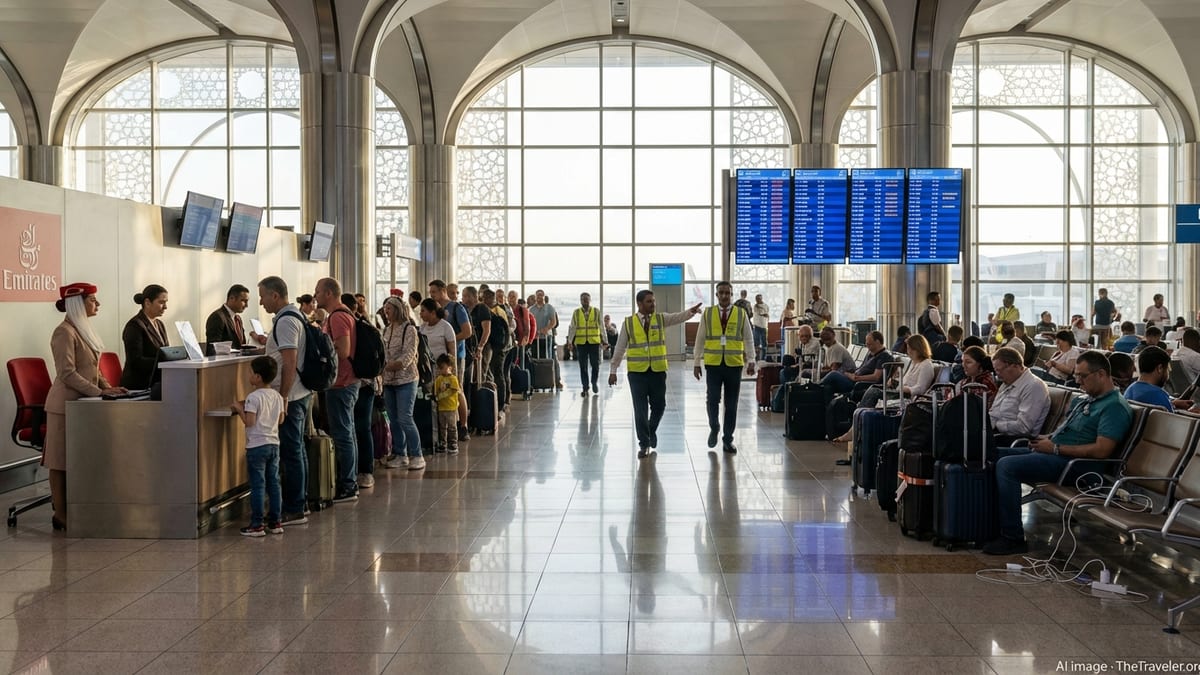
The heaviest rainfall in decades across the UAE turned Dubai International Airport, the world’s busiest international hub, into a stress test for the country’s aviation resilience. More than a thousand flights were cancelled or diverted in a matter of days as taxiways flooded, ground access was choked by submerged highways and metro services were curtailed. The scale of disruption was unlike anything airport officials had previously confronted, with stranded passengers filling terminals and social channels documenting the chaos.
Authorities moved quickly to stabilise operations. Dubai Airports temporarily halted movements to keep runways safe, then gradually restored capacity as water was cleared and safety checks completed. Emergency budgets were authorised to secure food, water and essential supplies for travellers stuck airside, while terminal teams were reinforced to manage queues and triage medical and vulnerable cases. Despite the intensity of the storm, the airport’s chief executive said operations were brought “close to normality” within roughly 24 hours of the worst flooding, reflecting contingency playbooks that had been refined over previous regional shocks.
The response extended beyond the perimeter fence. National emergency agencies coordinated with police, road authorities and public transport operators to prioritise access routes for airport workers, relief supplies and outbound passengers whose flights could still operate. With schools and many offices working remotely, capacity on key corridors was freed for airport traffic, helping the hub resume a workable rhythm even as parts of the city were still drying out.
Behind the scenes, the UAE’s General Civil Aviation Authority worked with airlines, air navigation providers and neighbouring states to sequence arrivals and departures into limited slots. Airspace flow restrictions were calibrated to prevent aircraft gridlock on the ground, trading short-term delays for safer, more predictable movements that allowed airport and airline operations centres to plan recovery waves.
Airlines Activate Robust Contingency and Rerouting Plans
Emirates, flydubai and Etihad Airways all activated disruption control centres as the storms, subsequent infrastructure issues and later regional airspace closures converged into a multi-front operational challenge. Airlines issued rolling travel advisories, temporarily suspended check-in for connecting itineraries through Dubai at the height of the flooding, and rerouted aircraft around closed or congested corridors when geopolitical tensions constricted skies over parts of the Middle East.
Emirates reported that during one recent regional security flare-up it maintained its global schedule with only a small number of cancellations by lengthening flight paths and using alternative routings to avoid conflict zones. The airline said more than 1.7 million passengers travelled on its network in the fortnight around that event, underscoring how quickly carriers sought to pivot from crisis to continuity. Similar measures were mirrored in Abu Dhabi, where Etihad temporarily suspended certain routes, declined to accept transit passengers whose onward legs were at risk and instead focused on safeguarding journeys it could reliably operate.
While some passengers experienced significant delays and missed connections, rerouting strategies allowed the UAE’s major carriers to preserve network integrity and keep long-haul traffic flowing through the Gulf. Additional widebody aircraft were rotated onto high-demand sectors during the recovery phase, and spare crews were mobilised to operate extra sectors once airspace and airport capacity constraints began to ease. These tactical adjustments helped airlines chip away at backlogs while keeping safety margins intact.
A key differentiator in the UAE’s handling of recent disruptions has been the use of joint control rooms linking airlines, airports and regulators. Representatives from each stakeholder sit side by side in 24-hour operations centres, reviewing live data on weather, airspace closures, stand availability and passenger flows. This tight integration enables rapid decisions on flight prioritisation, diversion alternatives and gate allocations, compressing what might be multi-hour coordination cycles elsewhere into minutes.
Passenger Welfare Becomes a Strategic Priority
As terminals filled with travellers facing uncertain departure times, UAE operators sought to demonstrate that passenger welfare was more than a public-relations slogan. Emirates acknowledged early shortfalls in communication as systems and call centres were overwhelmed, but said it rapidly expanded on-the-ground support, dispatching staff volunteers into crowded departure halls and transit zones to identify families with young children, elderly travellers and medical cases in need of immediate assistance.
Airlines and airport authorities together secured thousands of hotel rooms across Dubai and other emirates for displaced passengers who could not be rebooked the same day. Meal vouchers were issued in large volumes and retail concessions were encouraged to keep outlets open around the clock where staffing and safety allowed. At the height of the rain-related disruption, officials said that emergency funds were being directed first to passenger care rather than to calculating the financial toll of the crisis.
One of the most visible pain points was baggage, with tens of thousands of checked bags separated from their owners during the storms and later system outages. Emirates assembled a dedicated taskforce to reconcile, sort and return roughly 30,000 affected pieces, using RFID-based tracking, temporary storage facilities and partnerships with local logistics firms to deliver luggage directly to hotels and residences. The airline offered waivers on excess baggage fees for impacted customers and prioritised the movement of delayed bags on subsequent flights until the backlog was cleared.
Across the UAE’s hubs, airports enhanced real-time information channels, from revised departure boards and public announcements to more frequent updates on social and messaging platforms. Although some passengers reported frustration at changing guidance, aviation officials argued that sharing evolving timelines was preferable to silence, and pledged investments in more resilient communications infrastructure so that future disruption alerts can cut through system congestion faster.
Building a More Resilient Gulf Gateway
The recent succession of challenges has prompted a broader rethink in the UAE about what it means to be a global hub in an age of climate volatility, cyber vulnerabilities and geopolitical shocks. Dubai Airports has signalled it will retain and refine the emergency protocols honed during the April flooding, including earlier activation of joint command centres, stricter controls on access to terminals when outbound capacity is constrained and clearer criteria for pausing operations pre-emptively when severe weather approaches.
Infrastructure upgrades are also moving higher up the agenda. Drainage improvements around key airside areas, resilience works on approach roads and metro stations, and investments in backup power and data systems are being evaluated to blunt the impact of future downpours or outages. Scenario planning now extends beyond traditional contingencies such as single-runway closures, incorporating compound events where weather, IT failures and airspace restrictions may intersect.
For airlines based in the UAE, operational resilience is becoming a core competitive asset. Executive teams have highlighted plans to diversify critical IT suppliers, deepen partnerships with alternate airports in the region for diversions, and expand crew and aircraft flexibility so that recovery waves can be mounted more aggressively after a disruption. The aim is not only to weather the next crisis, but to turn the speed and quality of the response into a differentiator that keeps premium and connecting traffic loyal to Gulf hubs.
Travel industry analysts say that while no global hub can fully insulate itself from extreme events, the UAE’s recent handling of cascading disruptions has underscored a willingness to take decisive command in difficult moments. By pairing strict operational controls with visible investments in passenger comfort and care, the country’s aviation sector is betting that travellers will remember not only that their journeys were delayed, but that when things went wrong, they were not left to navigate the chaos alone.