

More news on this day
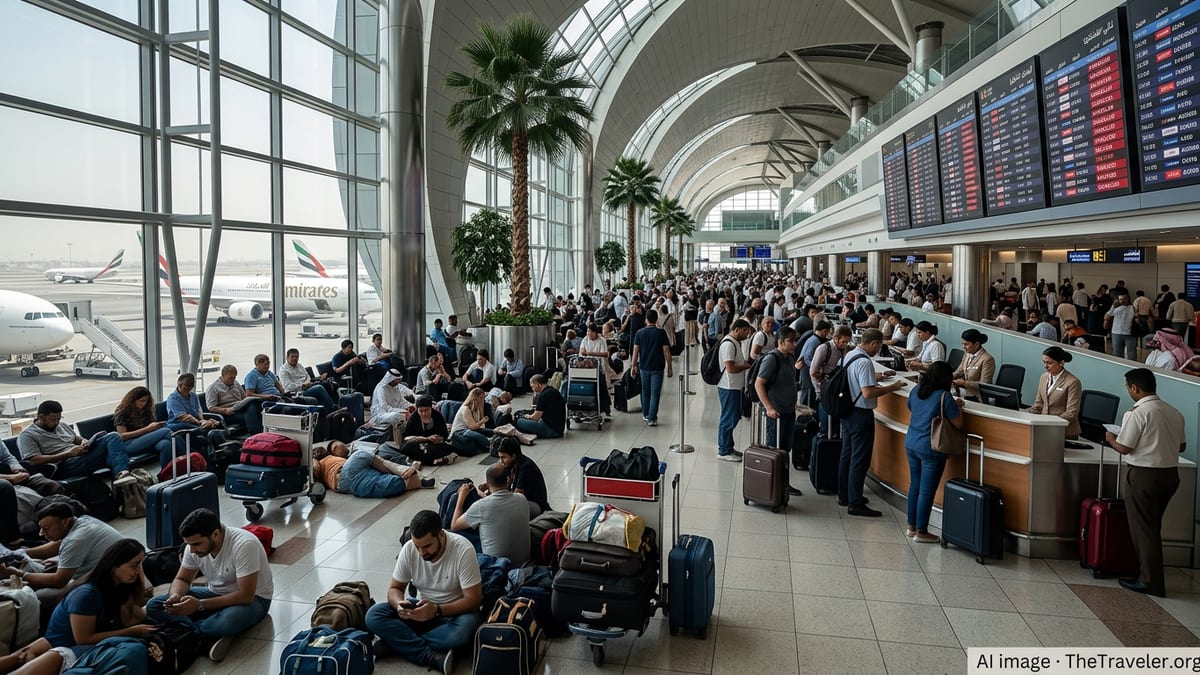
A sweeping airspace shutdown across the United Arab Emirates following strikes linked to the widening Iran war has upended global aviation, stranding hundreds of thousands of travelers and forcing airlines to tear up schedules at some of the world’s busiest hubs.
How the UAE Airspace Crisis Unfolded
The current disruption began on 28 February 2026, when regional airspace closures rippled across the Gulf after coordinated United States and Israeli strikes on Iran triggered retaliatory attacks. In response, the UAE imposed an emergency closure of its airspace, halting nearly all civilian movements and bringing operations at Dubai International, Zayed International in Abu Dhabi, Sharjah International and Dubai World Central to an abrupt standstill.
For roughly 48 hours, major Emirati airports that usually serve as vital bridges between Europe, Africa and Asia were effectively frozen. Flight tracking services showed almost no civilian traffic over the UAE, an extraordinary reversal for a country that normally handles tens of thousands of passengers a day through its hubs.
From 2 March, authorities began a phased, partial reopening using tightly controlled corridors. Limited arrivals and departures were gradually reintroduced, mainly for repatriation, cargo and priority routes. Even with these adjustments, the airspace remains subject to stringent controls, and many previously routine flight paths over Iran, Iraq and sections of the Gulf are still restricted or closed.
Officials stress that the measures are driven by risk assessments related to potential missile and drone activity in the wider region. Aviation regulators continue to issue rolling notices to air missions that define when and where traffic can safely operate, leaving airlines with little choice but to cancel, reroute or consolidate services on short notice.
Current Flight Status at Major UAE Airports
Dubai International, one of the world’s busiest international airports, has restarted only a fraction of its usual schedule. Limited departures toward key long haul markets are operating, but many passengers report same day cancellations or last minute rebookings as airspace windows open or close. Authorities are urging travelers not to go to the airport unless their airline has explicitly confirmed a flight number and departure time.
Zayed International in Abu Dhabi has followed a similar pattern. A short period of resumed services early in the week was followed by renewed suspensions as regional airspace restrictions tightened again. Airlines using the airport are focusing on select evacuation and essential commercial routes, with full scheduled operations still on hold and further updates tied closely to security assessments.
Sharjah International, a critical base for low cost and regional carriers, was among the first to halt operations during the initial closure. While some corridors have technically reopened, the airport continues to handle only a small number of carefully vetted flights. Passengers with bookings through Sharjah are being reprotected onto alternative dates or routes where space allows.
Across the country, airport operators warn that departure boards can change minute by minute. Even after a flight appears as scheduled, it can be pulled if a specific air corridor closes or if military activity is detected near a planned route. Travelers are being told to treat any confirmation as provisional until they have checked directly with the operating airline on the day of departure.
Affected Airlines and Regional Route Changes
Flag carriers Emirates and Etihad, along with low cost operator flydubai and Sharjah based Air Arabia, remain at the center of the turmoil. Both Emirates and Etihad have suspended large parts of their networks, prioritizing a limited set of long haul services where secure routings can be found. Their public advisories emphasize that customers should not travel to the airport without direct notification that their specific flight will operate.
Air Arabia and other budget airlines have temporarily halted many services into and out of the UAE, especially those that would normally overfly restricted airspace. Several have set cut off dates after which tickets can be rebooked without change fees, but seats on alternative routes are increasingly scarce as disruption spreads across the region.
Foreign carriers are also heavily affected. European and Asian airlines that rely on Dubai and Abu Dhabi as connecting points have either suspended UAE services entirely or shifted to indirect routings through airports outside the current closure zones. In practical terms, this has reduced daily connectivity between the Gulf and major capitals in Europe, North America and East Asia.
To keep limited traffic flowing, airlines are flying longer diversionary routes that skirt restricted skies, often adding several hours to flight times. This has knock on effects for aircraft and crew rotations, which in turn forces further cancellations as airlines run out of available capacity. Industry data suggests that cancellations across Gulf hubs have already climbed into the tens of thousands since the end of February.
Passenger Rights, Rebooking and What to Do if You Are Stranded
For travelers caught mid journey, the immediate challenge is often simply reaching their airline. Call centers and chat channels are reporting heavy backlogs, while airport ticket desks in unaffected countries have seen long queues as passengers try to salvage disrupted itineraries. In many cases, carriers are offering free rebooking within a defined travel window, subject to seat availability, but are not providing cash refunds beyond their usual fare rules unless local regulations require it.
Travelers currently in the UAE are being advised to stay wherever they are accommodated and avoid heading to airports in the hope of catching a standby seat. Hotels in Dubai and Abu Dhabi are reporting extended stays from stranded passengers, and some governments have begun organizing chartered evacuation flights that bypass the most heavily restricted routes where security conditions permit.
Those whose trips have not yet begun are encouraged to consider deferring non essential travel to the UAE and neighboring states. Many travel insurers classify war related disruption differently from standard operational delays, so passengers should check policy wording carefully before assuming that additional accommodation or rerouting costs will be covered.
For people with urgent travel needs, such as workers returning to jobs in the Gulf or residents trying to get home, the most practical strategy is to maintain close contact with the operating airline, monitor government travel advisories from both the departure and destination countries, and be prepared for rapid changes. Alternative routings through more distant hubs may become available at short notice, but can sell out quickly.
Safety, Risk Assessments and the Outlook for Reopening
Despite images of crowded terminals and grounded aircraft, aviation regulators insist that the decision to restrict UAE airspace is guided by safety considerations rather than commercial pressure. The primary concern is the risk that missiles or drones could inadvertently strike civilian aircraft or that military operations could interfere with navigation systems along key corridors.
Independent analysts note that modern commercial jets are not designed to operate in or near active conflict zones, and that operators must rely on intelligence shared by governments and defense agencies when charting new routes. The current pattern of limited, tightly managed corridors reflects an effort to balance the need to move essential traffic with the requirement to keep aircraft well clear of potential threats.
For now, the trajectory of the crisis is closely tied to developments in the wider conflict. If missile and drone launches subside and negotiations reduce the likelihood of further strikes, regulators could gradually expand the hours and geographic scope of available airspace. That would allow airlines to reconstruct more stable schedules, although recovery is likely to be uneven and could take weeks even under favorable conditions.
Until then, travelers should treat the region as highly unpredictable from an aviation standpoint. Anyone planning to transit through the UAE in the coming days should build in generous buffers, avoid same day connections to critical events, and stay open to rerouting through alternative hubs. While the Gulf has weathered previous security scares with relatively swift recoveries, the scale and complexity of the current airspace crisis mean a quick return to normal is far from guaranteed.