

The United Arab Emirates and Bahrain have launched an innovative one-point air travel system that allows citizens to complete immigration, customs and security checks before departure, a move officials say will sharply reduce airport queues and mark a major step toward seamless cross-border mobility across the Gulf.
Pilot Project Links Abu Dhabi and Bahrain in First Phase
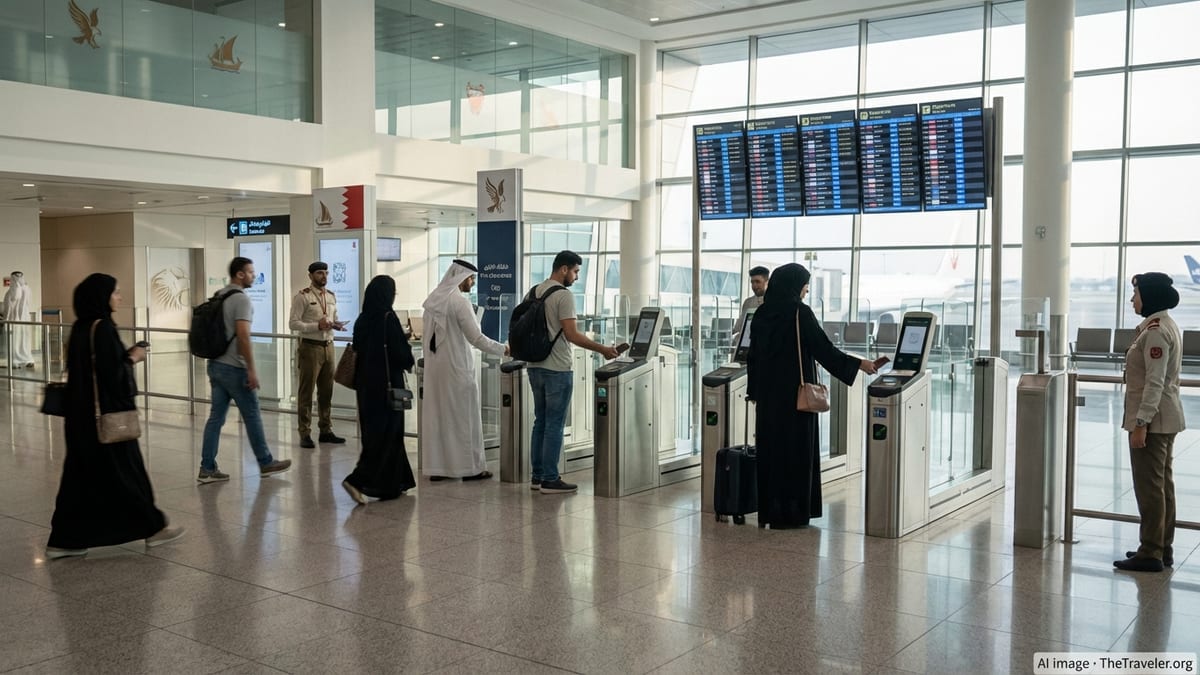
The new One-Point Air Travellers system has entered its pilot phase on routes between Zayed International Airport in Abu Dhabi and Bahrain International Airport. Authorities in both countries confirmed on Monday that selected flights carrying Emirati and Bahraini citizens are now processing all border-control formalities at the point of departure, with no routine checks required upon arrival.
Under the arrangement, travellers complete immigration, customs and security screening in a single sequence before boarding. Once they land, they are able to walk directly to baggage reclaim or onward transport, replicating the experience of disembarking from a domestic flight. For now, participation is limited to citizens of the two states, but officials have described the early phase as a live test bed for wider regional use.
Emirati authorities have framed the launch as part of a broader strategy to position the country as a global leader in smart travel, while Bahraini officials say the streamlined process will strengthen connectivity with the UAE, one of the kingdom’s largest tourism and business partners. Flight frequencies between the two countries are already high, giving the project an active corridor on which to test passenger flows and operational resilience.
How the One-Point System Works for Passengers
For eligible travellers, the new system begins at check-in, when personal and travel data are verified and synchronised with both countries’ border-control platforms. At the security and passport-control stage, passengers pass through a series of coordinated checks that integrate biometric verification, document validation and customs screening in a single controlled zone.
Advanced electronic connectivity between the UAE and Bahrain allows authorities to pre-clear entry and exit records in real time, so that once a traveller is approved at the departure airport, arrival systems recognise that all necessary procedures have been completed. This reduces the need for multiple physical inspections, cutting processing times and alleviating congestion at traditional immigration counters.
Officials have indicated that the pilot heavily relies on existing e-gate infrastructure and facial-recognition technology already in use at both airports, but applied in a more deeply integrated way. The aim is to make the passenger journey feel familiar while removing duplication behind the scenes, allowing people to move from curb to gate, and from aircraft to exit, in noticeably less time.
Technology Backbone and Data-Sharing Safeguards
At the core of the initiative is an electronic architecture designed to securely share passenger data between the two states. Authorities describe a federated model that connects national databases through encrypted channels, enabling pre-arrival risk assessment while maintaining domestic control over sensitive records.
Biometric pre-clearance, particularly through facial and fingerprint recognition, underpins the system’s ability to match passengers to their travel history and verify identities across borders. Officials say the use of biometrics allows for faster processing than manual checks and reduces the risk of identity fraud, a key concern when multiple agencies are involved in a single inspection point.
Both governments have stressed that the system complies with national data-protection frameworks and international aviation security standards. Access to shared information is restricted to authorised personnel, and records of each transaction are logged for audit and security purposes. These safeguards will be closely scrutinised during the pilot period, as regulators gauge how to balance travel convenience with privacy expectations and robust border control.
Part of a Wider GCC Push for Seamless Mobility
The UAE-Bahrain pilot is the first operational step in a wider Gulf Cooperation Council vision for a one-stop travel regime across all six member states. The concept was endorsed by GCC interior ministers at a meeting in Kuwait in late 2025, where officials outlined plans to remove duplicate checks for citizens moving within the bloc.
In parallel, Gulf states are advancing a unified tourist visa that would allow international visitors to travel between member countries on a single permit, often described as a Schengen-style scheme for the region. The one-point air travel system is widely seen as a practical complement to that visa, providing the procedural infrastructure to support multi-country itineraries without adding friction at every border.
Regional policymakers say the end goal is a network in which Gulf citizens and approved visitors can move between cities such as Abu Dhabi, Manama, Riyadh, Doha, Muscat and Kuwait City with minimal formalities, supported by shared standards on security, customs and aviation oversight. The UAE-Bahrain corridor, with its high volumes of business and leisure travel, offers an early proving ground for this ambition.
Economic and Tourism Impact for the UAE and Bahrain
By cutting time spent in queues and reducing uncertainty around airport waiting times, the one-point system is expected to make short trips between the UAE and Bahrain more attractive to both business travellers and tourists. Airlines and tourism boards in both countries have long promoted quick weekend breaks and same-day business shuttles, but travellers are often discouraged by the possibility of crowded immigration halls at peak times.
Officials and industry analysts argue that a smoother arrival experience could translate into higher demand for regional flights, more spontaneous travel and longer stays, as travellers take advantage of easier movement to combine multiple cities in a single journey. Retailers, hotels and event organisers stand to benefit if cross-border visits become more frequent and predictable.
The initiative also aligns with efforts by both governments to diversify their economies through tourism, financial services and logistics. Abu Dhabi and Dubai are investing heavily in airport infrastructure and visitor attractions, while Bahrain is promoting itself as a boutique destination for culture, motorsport and island resorts. A simplified travel corridor between the two could help distribute visitor flows more evenly across the Gulf, rather than concentrating them in a handful of hubs.
Operational Challenges and Early Lessons
Despite its promise, the one-point system presents operational challenges that the pilot is designed to uncover. Coordinating multiple agencies from two countries in a single process requires aligned procedures, compatible technology and clearly defined responsibilities, from frontline officers to back-office systems administrators.
Airlines and airport operators must also adapt their workflows, ensuring that passengers eligible for the new system are correctly directed, while others continue to use traditional channels. Misrouting travellers or failing to synchronise data could lead to delays or, in the worst case, security gaps. Training and communication are therefore critical components of the early rollout.
Officials have indicated that performance metrics such as average processing time, queue length, system reliability and passenger satisfaction will be tracked throughout the pilot. Feedback from travellers and frontline staff will inform any adjustments to procedures, with the results expected to guide decisions on whether, when and how to extend the scheme to more flights, additional airports or other categories of travellers.
Pathway to Expansion Across the Gulf
If the Abu Dhabi–Bahrain corridor proves successful, GCC officials are expected to consider phased expansion of the one-point model to other air routes and eventually to land and sea crossings. Each new node would require its own integration work, but the basic principles of pre-clearance, shared data and unified checkpoints would remain the same.
Future phases could include extending eligibility beyond citizens of the two pilot countries to cover residents and, at a later stage, certain categories of foreign visitors, particularly those using the anticipated unified Gulf tourist visa. Such a move would significantly broaden the scheme’s impact on regional tourism and business travel, but would also raise fresh questions about risk management and information-sharing with third-country nationals.
Officials have emphasised that any expansion will be gradual, contingent on security outcomes and technological readiness. The pilot is as much a test of governance and intergovernmental cooperation as it is of hardware and software. Success will depend on maintaining a consistent passenger experience even as complexity grows.
Reimagining the Airport Experience in the Gulf
The one-point air travel system arrives amid a broader rethinking of what airports represent in the Gulf, where hubs such as Abu Dhabi, Dubai and Doha are investing in automation, biometrics and data analytics to reduce friction at every step of the journey. For many passengers, passport control and security queues remain the most stressful moments of air travel; compressing those procedures into a single, predictable checkpoint could materially change perceptions.
By shifting checks upstream and coordinating them across borders, the UAE and Bahrain are testing a model in which airports become less about repeated scrutiny and more about managed, data-driven trust. If that model holds, regional travellers may come to see cross-border flights as little more complicated than domestic hops, encouraging greater mobility for work, study and leisure.
As the pilot gathers pace, its success or failure will be closely watched by other Gulf states, as well as regions exploring their own mobility corridors. For now, the UAE-Bahrain one-point system offers an early glimpse of a future in which borders are managed increasingly through technology and cooperation, and less through lines of travellers waiting at arrival halls.