

More news on this day
Major Gulf airlines based in the United Arab Emirates and Qatar are reshaping their loyalty programs in real time as the Iran conflict shuts airspace, grounds aircraft and forces sweeping detours across one of the world’s busiest aviation corridors.
Get the latest news straight to your inbox!
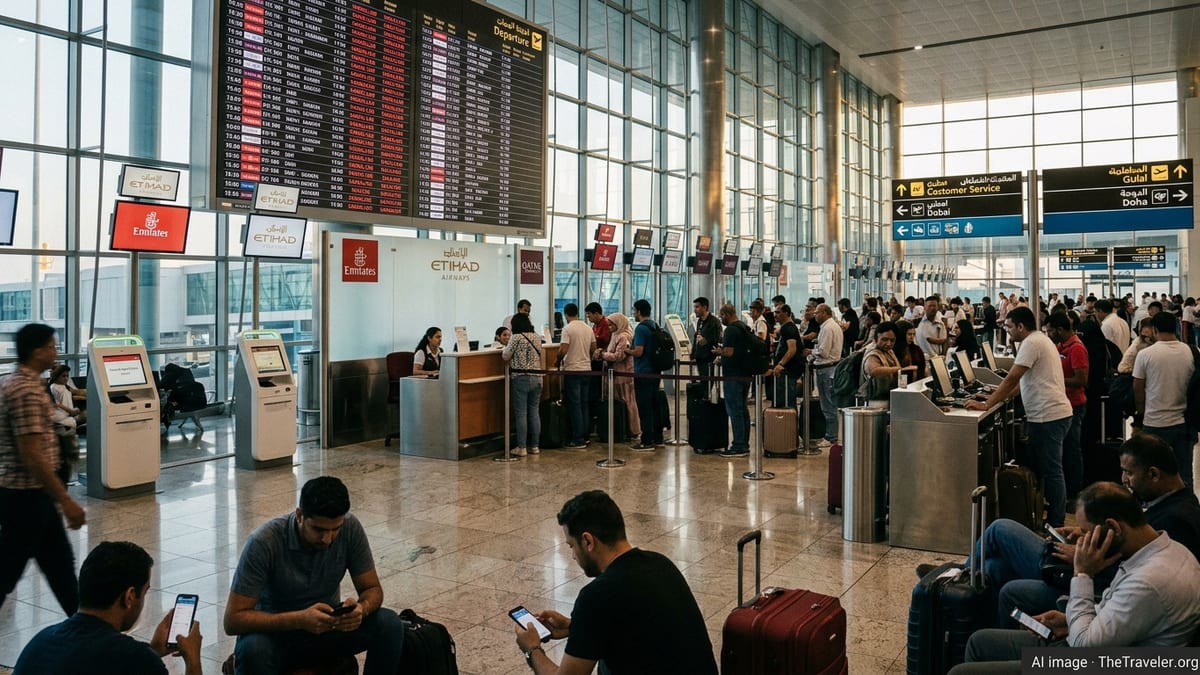
Conflict Ripple Effects Reach Frequent Flyers
The military escalation involving Iran, the United States and Israel since late February 2026 has rapidly turned into a major aviation crisis for the Gulf. Airspace closures and restrictions across Iran, Iraq, Qatar, Bahrain and the United Arab Emirates have disrupted long-haul links between Europe, Asia and Africa, routes on which Gulf carriers are dominant. Publicly available information shows that airlines in the UAE are operating at less than half their pre-conflict capacity, while Qatar’s operations have fallen to low double digits, with many aircraft parked and routes suspended.
This sudden contraction in flying has immediate consequences for frequent flyers. Elite members who typically rely on dense schedules through Dubai, Abu Dhabi and Doha now face limited options to earn status miles, redeem rewards or even reach their destinations. With high-spending passengers at risk of defecting to competitors routing via alternative hubs such as Istanbul or Muscat, Gulf carriers are turning to loyalty programs as a tool to retain their most valuable customers through the turmoil.
Recent updates on airline websites, travel advisories and customer communications indicate a quiet but significant shift: softer rules on mileage expiry and tier requalification, broader change and refund windows for award tickets, and selective status extensions for customers in heavily impacted markets. While framed as temporary measures, these adjustments are reshaping how loyalty works across the region’s flagship carriers.
The changes also highlight how central loyalty economics have become to Gulf aviation. With revenues under pressure from grounded fleets and rising fuel costs linked to disrupted oil flows, airlines appear to be trading short-term liability growth in unused miles for the longer-term value of keeping premium travelers engaged until normal schedules can resume.
Extended Status and Softer Requalification Rules
Frequent-flyer forums, airline advisories and booking engine notices indicate that leading UAE and Qatari carriers have begun extending elite status for members whose travel plans have been derailed by the conflict. In several cases, tier validity has been prolonged by three to six months for customers whose membership years end between March and June 2026, acknowledging that it is now impossible to fly enough segments or miles to requalify on schedule.
At the same time, some programs are lowering requalification thresholds or introducing partial rollover of tier miles. Travelers who flew heavily in 2025 and early 2026 are seeing a portion of their existing tier credits applied toward the current membership year, reducing the incremental flying required once more routes reopen. Reports from travel management companies suggest that corporate account holders are being prioritized for these concessions, reflecting their disproportionate contribution to premium-cabin revenue.
In Qatar, where airspace restrictions have led to a near-total suspension of outbound and inbound flights on many days, loyalty programs appear to be applying blanket protections to local members. Publicly available information shows that some customers based in Doha are being offered automatic status extensions and, in certain cases, guaranteed soft landings to the next tier down rather than a full loss of privileges when their membership year ends during the disruption.
These moves mirror steps taken during previous crises, such as the pandemic, but the trigger is different. Instead of a global collapse in demand, the current squeeze is rooted in regional airspace closures and security concerns, leaving many loyal customers technically willing to travel but unable to board flights. For Gulf carriers competing head-to-head on service and perks, signaling that status will not be lost due to circumstances beyond passengers’ control has become a key retention tactic.
Mileage Expiry, Redemptions and Waivers Loosened
Beyond elite status, mileage balances and award bookings are also being treated more flexibly. According to published coverage and airline customer updates, several UAE-based carriers have paused or extended mileage expiry dates through at least mid-2026, particularly for members residing in countries most affected by the airspace closures and airport disruptions.
Award tickets have become harder to use on their original routings as airlines cut frequencies, substitute smaller aircraft or cancel entire services. In response, loyalty programs are offering fee-free date changes and, in some cases, routing changes on award bookings that transit the Gulf hubs. Travel advisers report that many customers are being rebooked on alternative routings via partner airlines or secondary regional hubs, while still earning or redeeming miles under the original frequent-flyer program.
For travelers holding mixed itineraries that combine cash and miles, policies have also shifted. Some carriers are allowing full refunds of taxes and surcharges on award segments that cannot be operated, while preserving the underlying miles for future use. Others are offering bonus miles or travel credits to customers who accept travel vouchers instead of cash refunds, a strategy intended to keep revenue within the airline system even as schedules remain volatile.
These adjustments come at a cost, increasing the volume of outstanding miles on carrier balance sheets. However, industry analysts note that with capacity sharply reduced and demand uncertain, the immediate pressure from redemptions is lower than in normal times. In effect, airlines are using loyalty currency as a buffer, storing up future travel demand while minimizing confrontation with disrupted customers today.
Rerouting Strategies Reshape Hub Dynamics
The Iran conflict has redrawn aviation maps across the Middle East almost overnight. With swathes of airspace restricted or closed and several major airports, including Dubai International and Doha’s Hamad International, experiencing intermittent shutdowns, long-established corridors between Europe and Asia have fragmented. Flight-tracking data and industry briefings point to a surge in rerouting over safer corridors to the south and west, adding hours to some journeys.
As a result, passengers who once relied on seamless overnight connections via the Gulf are now more likely to find themselves routed through alternative hubs such as Muscat, Jeddah or even cities outside the immediate conflict zone. In many cases, UAE and Qatari loyalty programs are maintaining mileage earning and redemption for itineraries operated by partner airlines over these new paths, trying to preserve some continuity in how customers experience their memberships.
However, the hub-and-spoke model on which Gulf carriers built their loyalty franchises is under strain. With far fewer banked waves of connecting flights and irregular operations, traditional perks such as tight minimum connection times, guaranteed lounge access on every transit, and consistent aircraft products are harder to deliver. Loyalty program communications reviewed by travel agencies stress flexibility and patience, emphasizing that benefits may be adjusted or delivered in alternative forms while the conflict continues.
Some analysts suggest the disruption could accelerate a longer-term diversification of loyalty strategies, with Gulf airlines investing more heavily in partnerships, co-branded credit cards and non-flight earning channels to reduce dependence on any single hub. In the near term, though, the focus remains on shepherding existing members across a patchwork of shifting routes and schedules.
What Travelers Should Expect in the Coming Weeks
With no clear timeline for a durable de-escalation, frequent flyers tied to UAE and Qatar carriers face a period of continued uncertainty. Industry forecasts cited in regional economic analyses warn that aviation recovery will likely lag any political settlement, as infrastructure is repaired, risk assessments are updated and airspace restrictions are gradually eased.
In the meantime, loyalty members can expect more ad hoc adjustments to program rules, often published with little notice. Travelers are being encouraged by airlines and travel management firms to monitor account dashboards and email updates closely for changes to tier validity, mileage expiry and eligible travel dates for waivers. For those with critical trips, especially across Europe–Asia corridors, the safest assumption is that routings may shift again before departure.
Observers note that while loyalty programs are being used to cushion the blow, they cannot fully offset the loss of convenience that made the Gulf hubs so attractive. Long detours, overnight layovers in unfamiliar cities and variable on-board products will remain part of the travel experience for many routes as long as the conflict persists. Still, more generous mileage policies and status protections may help keep committed customers in the fold until the region’s skies stabilize.
Ultimately, the crisis around Iran is underlining how closely intertwined aviation networks, regional security and loyalty economics have become. For airlines in the UAE and Qatar, the current wave of program tweaks is as much about safeguarding future demand as it is about managing today’s disruptions, signaling to their most frequent travelers that they remain central to the carriers’ long-term strategies even in a time of war.