

More news on this day
The United Arab Emirates is once again on high alert as a new spell of unstable weather moves across the Gulf, with Dubai, Abu Dhabi, Sharjah, Fujairah and Ras Al Khaimah all preparing for intense rain, disruptive winds and renewed flood risks that echo the region’s recent climate shocks.
Get the latest news straight to your inbox!
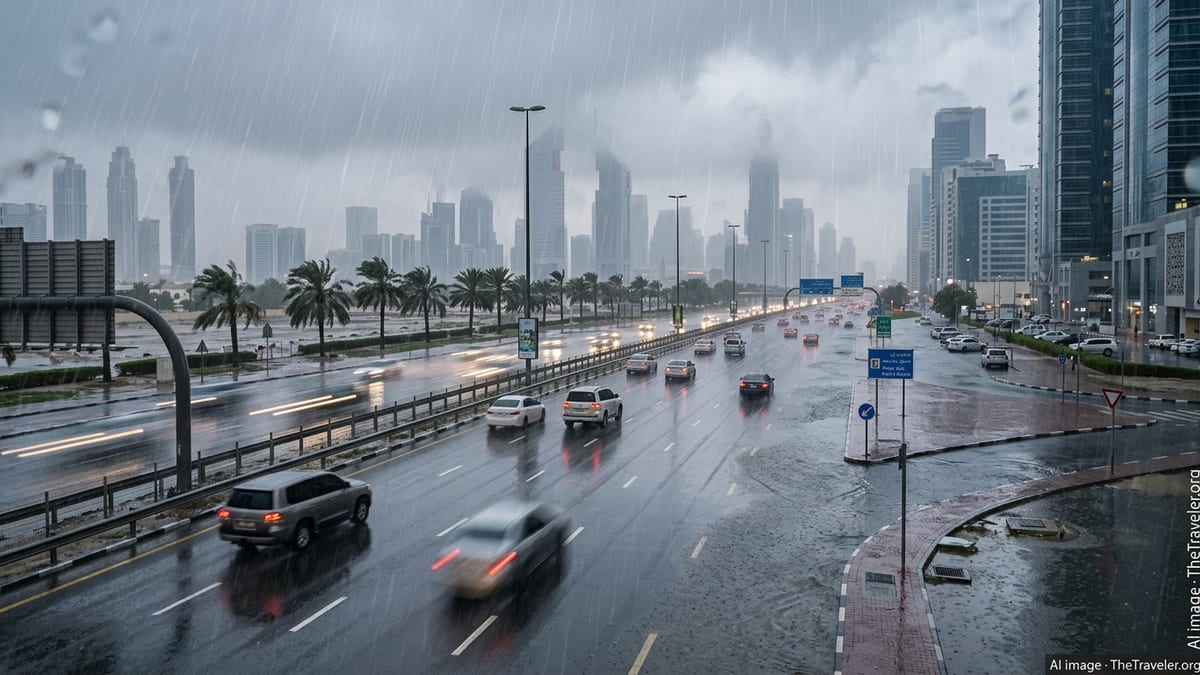
Unsettled Skies Over a Weather-Weary UAE
Publicly available forecasts show a broad swath of unstable weather building over the Arabian Peninsula this week, with bands of rain already reported across parts of Abu Dhabi and Sharjah and further showers expected to spread toward Dubai, Fujairah and Ras Al Khaimah. Radar imagery and regional weather models indicate repeated pulses of moisture moving inland from the Gulf, creating the conditions for scattered thunderstorms, squally winds and abrupt downpours.
Residents in several emirates have already reported intense bursts of rain, rapidly changing skies and gusty winds that reduce visibility on major highways. In some locations, social media posts from commuters describe brief but heavy showers followed by standing water on key routes linking Dubai, Sharjah and Abu Dhabi. While not all districts have seen the same intensity, the overall pattern points to a country-wide bout of unsettled conditions rather than isolated showers.
The National Centre of Meteorology’s bulletins for early March highlighted a trend of partly cloudy to cloudy conditions with a recurring chance of rainfall, freshening winds and rough seas, particularly around Abu Dhabi. More recent short-term outlooks build on that pattern, suggesting that the mix of moisture, instability and strong upper-level winds will keep weather conditions changeable, with storms capable of organizing quickly over both coastal and inland areas.
From Dubai’s 2024 Deluge to Today’s Flood Concerns
The latest weather system arrives less than two years after Dubai’s April 2024 floods, when extremely intense rainfall overwhelmed drainage networks and turned arterial roads into rivers within hours. That event, widely documented by international media, brought a year’s worth of rain in a single day to parts of the city and became a reference point for how vulnerable the urban fabric of the UAE can be when rare but powerful storms strike.
Recent public commentary in the UAE frequently compares the current unsettled spell to the 2024 deluge, underscoring lingering anxiety about whether infrastructure upgrades and flood-mitigation measures can keep pace with a warming climate. While recent forecasts generally point to heavy rain spread over several days rather than an extreme single-day cloudburst, meteorologists note that even moderate totals can create local flooding in low-lying or poorly drained districts, especially when accompanied by strong winds that drive water into buildings and under doorways.
The government previously announced significant investment in stormwater systems, road drainage and transport resilience following past severe weather. However, rapid urban expansion, large paved areas and naturally hard desert soils still limit how quickly rainwater can be absorbed or channeled away. As new showers form over Dubai and neighboring emirates this week, residents are watching underpasses, service roads and older neighborhoods that have flooded before, wary that a sequence of intense bursts could recreate familiar scenes of stalled vehicles and waterlogged homes.
Sharjah, Fujairah and Ras Al Khaimah Face Coastal and Mountain Risks
While international attention often centers on Dubai, the current spell of unstable weather is also a concern for Sharjah, Fujairah and Ras Al Khaimah, which face their own distinct vulnerabilities. Sharjah’s dense urban districts and busy commuter corridors are susceptible to waterlogging when storms track along the coast, funneling runoff toward major junctions. Reports from recent showers describe deep standing water in parts of the city even after relatively short bursts of heavy rain.
On the east coast, Fujairah and its surrounding mountains are particularly exposed to sudden downpours that can trigger flash floods in normally dry wadis. Short but intense thunderstorms can send powerful torrents sweeping through valleys and low-lying communities, cutting roads and isolating villages. With models indicating the potential for convective storms along the Hajar Mountains as the current system matures, residents in these areas are being urged via public information channels to avoid wadi crossings and to monitor local alerts closely.
Ras Al Khaimah shares similar topographic challenges, with steep terrain feeding water quickly into coastal plains and urban zones. In recent days, observers have noted heavy cloud cover and shifting rain bands moving northward from Abu Dhabi and Dubai toward the northern emirates, occasionally delivering very heavy localised showers. Even when rainfall totals are modest on a regional scale, the concentration of water in narrow catchments can lead to hazardous flash flooding, rockfalls and erosion along mountain roads popular with residents and visitors.
Intensifying Climate Signals in the Wider Region
The UAE’s latest bout of severe weather is unfolding against a backdrop of increasingly volatile conditions across the wider Middle East. In March, neighboring Oman has already experienced destructive flooding associated with a strong low-pressure system that brought heavy rain, thunderstorms and damaging winds to several governorates. Farther afield, extreme rainfall has fueled deadly floods in East Africa, while powerful winter storms continue to batter parts of North America and Europe.
Climate scientists and regional analysts point to these concurrent events as part of a global pattern in which a warming atmosphere holds more moisture and releases it through heavier, more erratic downpours. For arid and semi-arid countries such as the UAE, this means that rare storms are becoming more impactful, particularly where urbanization has outpaced the development of resilient drainage and water-management systems.
Research into past UAE floods highlights how the combination of intense rainfall, limited natural absorption and extensive paved surfaces can lead to rapid runoff and sudden surges in wadis and storm channels. Cloud-seeding activities in the UAE, designed to augment rainfall for water security, have also drawn renewed scrutiny in public debate when they coincide with disruptive storms, although expert assessments generally stress that large-scale weather patterns, not single interventions, dominate extreme events.
Travel, Commuting and Safety Implications for Visitors
For visitors and residents alike, the current weather pattern is already influencing day-to-day movement across the emirates. Recent travel advisories for the wider Gulf region describe intermittent disruptions, including delays at airports during periods of thunderstorms, restrictions on certain airspace corridors and temporary closures of roads where visibility or standing water poses a risk. In the UAE, drivers have reported sudden pockets of heavy rain along major highways, with conditions varying sharply over short distances.
Transport operators and hospitality businesses are closely monitoring forecasts as the week’s storms develop. Heavy rain can affect airport operations in Dubai and Abu Dhabi, slow transfers to resort areas in Ras Al Khaimah and Fujairah, and limit access to outdoor attractions such as desert safaris, mountain trails and coastal promenades. Travellers planning inter-emirate road trips are being encouraged through public-facing channels to check real-time weather and traffic updates, allow extra journey time and avoid low-lying underpasses or wadi crossings during intense showers.
Safety guidance for periods of severe weather in the UAE typically emphasizes staying indoors during thunderstorms, keeping clear of flooded roads and not attempting to drive through pooled water, which can hide deep depressions or stalled vehicles. With forecasts pointing to more unsettled conditions over the coming days, the combination of heightened awareness, infrastructure preparedness and cautious decision-making will be central to how well Dubai, Abu Dhabi, Sharjah, Fujairah and Ras Al Khaimah navigate yet another test from an increasingly capricious climate.