

Company-sponsored residency remains the dominant route for foreign professionals to live and work in the United Arab Emirates. Although the specific authority and forms differ between mainland and free zone jurisdictions, the underlying sequence is broadly similar: an employer secures work authorization, obtains an entry permit, completes in-country formalities, and then maintains or cancels the residence status over time. Understanding this sequence in detail is critical for evaluating job offers, timelines, and risks linked to employer-dependent residence status.
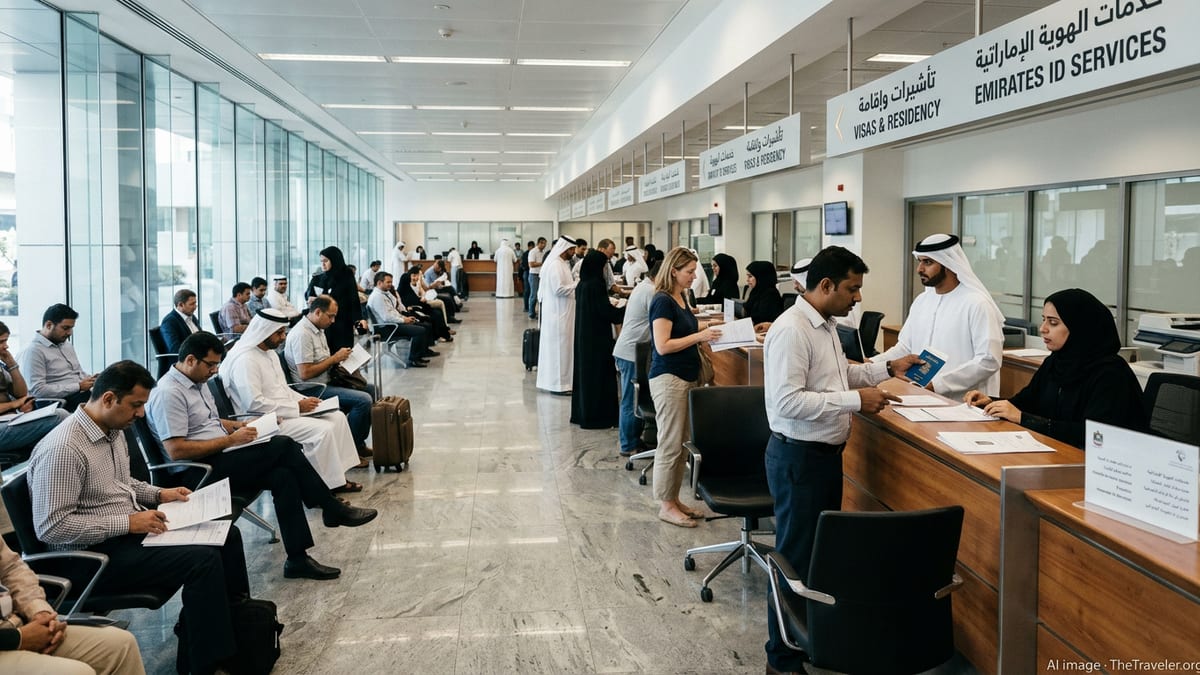
Overview of UAE Company-Sponsored Residency Framework
Under the UAE’s sponsorship-based system, most foreign employees obtain residency through a company that acts as their legal sponsor. The residence visa is tied to the employer’s trade licence and labour approvals and typically has a validity of 2 years for many mainland visas and up to 2 or 3 years in several free zones, although exact durations vary by jurisdiction and category. The visa grants the right to reside in the UAE and, when paired with a work permit, to work for that specific sponsor.
Company-sponsored residency is administered through different authorities depending on location. Mainland companies interact mainly with the Ministry of Human Resources and Emiratisation (MOHRE) for labour approval and with the Federal Authority for Identity, Citizenship, Customs and Ports Security (ICP) or the relevant emirate’s General Directorate of Residency and Foreigners Affairs (GDRFA) for entry permits and residency. Free zones manage much of the process internally through their own immigration units, though medical screening and Emirates ID still run through federal systems.
The employer is generally responsible for initiating and paying for the employee’s work and residence permits. Employment-focused guidance in 2025 and 2026 indicates that standard employment visa packages commonly cost employers in the range of roughly AED 3,000 to AED 8,000 per employee, depending on company category, processing speed, and emirate, though internal corporate costs may be higher or lower. For employees assessing an offer, the crucial point is that the residence right is employer-dependent and can be cancelled if employment ends or the company loses its licence.
From an employee’s perspective, the process can be divided into four phases: pre-arrival work authorization and entry permit, arrival and in-country status change, medical and biometric formalities, and residence visa sticker or electronic issuance coupled with Emirates ID. Each phase has distinct documents, timeframes, and potential bottlenecks that should be understood in advance.
Phase 1: Employer Setup and Work Permit Pre-Approval
Before a company can sponsor employees, it must itself be properly configured in the UAE immigration and labour systems. For mainland employers, this usually means holding a valid trade licence, obtaining a company establishment card from immigration, opening a MOHRE file, and having sufficient visa quota linked to its office lease and activity. New companies often receive an initial small quota automatically, while larger allocations may require inspections or additional justification.
Once the employer is set up, the first employee-specific step is typically the electronic job offer and work permit pre-approval. For mainland roles, this is submitted via MOHRE channels or authorised typing centres; for free zones, through the free zone’s portal. The employer uploads a passport copy, candidate photo, and relevant qualifications, and specifies job title, salary, and contract terms. Approval times are reported in recent practice to average around 3 to 5 working days in straightforward cases, though it can extend if additional security or qualification checks are required.
The pre-approval functions as labour market clearance, confirming that the employer may hire the individual under a defined role and quota. At this stage, many employers also generate an official employment offer or labour contract that will later be registered. Candidates should verify that the role title and basic terms in the work permit pre-approval align with the job offer, as discrepancies can create difficulties in later amendments or in professional recognition.
Work permit pre-approval has a limited validity, often around 60 days. If the employer does not progress to the entry permit stage within that period, the approval may lapse and need to be reapplied for, affecting onboarding timelines. For candidates relocating from abroad, it is prudent to confirm in writing that the employer has secured work permit pre-approval before resigning from a previous job or making irreversible commitments.
Phase 2: Entry Permit Issuance and Arrival in the UAE
After the work permit pre-approval is granted, the employer submits an application for a residence entry permit. This is an electronic document that allows the employee to enter the UAE with the intention of finalising residence. Recent practice indicates standard processing times of approximately 2 to 5 working days, depending on emirate, company category, and whether express processing is used.
The entry permit is generally valid for around 60 days from issuance. During this period the employee must either enter the UAE (if applying from abroad) or complete an in-country status change (if already present on another visa type). Entry permits are increasingly issued as electronic PDFs rather than physical stickers, and airline check-in and border control use the electronic record. Employees should keep a copy easily accessible on arrival.
On entering the UAE with an employment entry permit, the individual’s legal status is linked to that permit while the residence visa process is completed. During this transitional period, the person is not yet a full resident but is expected to proceed promptly with medical testing and Emirates ID formalities. Overstaying the entry permit validity without converting to a residence visa can result in daily fines, so timing coordination between arrival and subsequent appointments is important.
For individuals already inside the UAE on a visit or previous residence visa, employers may request an in-country status change rather than physical exit and re-entry. In this case, an internal status adjustment fee is paid, and the person’s visa status is converted to employment-sponsored residency without border crossing. Processing times for status changes are similar to new entries, but the individual must ensure that their prior visa remains valid until the change is completed to avoid overstay penalties.
Phase 3: Medical Fitness Screening and Emirates ID Biometric Capture
Once in the UAE on an entry permit or after status change, the next major requirements are medical fitness testing and Emirates ID biometrics. Medical screening is mandatory for most adult employment-linked residence visas and is conducted at government-approved centres. Tests commonly include a blood test and chest X-ray focusing on communicable diseases of concern to public health. Results are usually issued within 24 to 72 hours in most major emirates under standard processing, with more expensive fast-track options available.
In parallel or immediately following medical testing, the employee applies for an Emirates ID card through ICP channels, typically facilitated by the employer or a typing centre. The Emirates ID application requires biometric capture including fingerprints and facial image. Individuals are scheduled for an appointment at a designated centre. Recent operational experience indicates that appointment availability can range from a few days to over a week in peak periods, affecting the overall residency timeline.
The Emirates ID serves as the national identity document for residents and is required for a wide range of transactions, from banking to telecom services. The validity of the card generally matches the residence visa duration. Fees for the ID component are modest compared with visa costs and are typically in the low hundreds of dirhams for 1 to 3 year validity periods. In most corporate arrangements, the employer covers these charges for the principal employee, though policies differ for dependants.
Medical clearance is a prerequisite for visa issuance. If an individual is deemed medically unfit according to the prevailing criteria, the residence application can be refused or a visa may be cancelled. Employees should therefore not assume final approval until both medical and biometric steps are successfully completed and the residence visa is formally issued in the system.
Phase 4: Residence Visa Issuance, Passport Endorsement and Timelines
Following successful medical and biometric stages, the employer or its appointed service provider submits the final application for residence visa issuance. In some emirates and free zones this still results in a physical visa sticker placed in the passport, while in others the residence is recorded electronically with no physical label. Either way, the individual’s residence status, sponsor, and validity dates are recorded in the federal system and linked to the Emirates ID.
Recent reports for 2026 suggest that the end-to-end company-sponsored residence process, from work permit application to final visa issuance, typically takes roughly 10 to 20 working days in straightforward mainland cases, assuming prompt document submission and no additional clearances. Free zones often advertise similar or slightly faster timelines due to consolidated processing. However, delays can occur at any stage due to quota issues, security checks, or inaccurate documentation.
Residence visas under company sponsorship commonly have validity periods of 2 years in many mainland scenarios linked to standard employment contracts, while some free zones issue 2 or 3 year visas depending on their licence package. The expiry date is critical. If not renewed before expiry, the individual enters a grace period during which they may remain in the UAE but cannot work; grace rules have changed in recent years and vary by visa category, so employees should confirm the current period at the time of renewal planning.
Once the residence visa is active, employees can typically proceed to sponsor eligible family members, subject to minimum income thresholds and accommodation requirements, using their own residence as the basis for dependant residency. It is important to note that the family’s residency is derivative; if the employee’s company-sponsored visa is cancelled or lapses, dependant visas are also affected and must be cancelled or transferred accordingly.
Renewals, Transfers, and Cancellation of Company-Sponsored Residency
Before a residence visa expires, the sponsoring company must initiate renewal if employment continues. Renewal largely mirrors the initial process but can be faster, often requiring updated medical testing, renewed Emirates ID application, and payment of renewal fees. Many employers begin renewals 30 to 60 days before expiry to avoid lapses. Employees should monitor passport and visa expiry dates closely and confirm with HR when renewal submissions will occur.
If an employee changes jobs within the UAE, a transfer process is required. The new employer must obtain labour approval and a new work permit and residence sponsorship, while the previous sponsor cancels its visa. There is usually a defined window between cancellation by the old company and completion of the new visa, during which the individual remains in the country under a grace status but should not work until the new work permit is issued. Practical experience suggests that smooth transfers require careful coordination between both employers and the employee.
When employment ends for any reason and no new sponsor is immediately in place, the employer is required to cancel the employee’s residence visa. Authorities typically expect cancellation within about 30 days of the employment relationship ending. After cancellation, the former employee usually benefits from a grace period during which they may legally remain in the UAE to search for new work or arrange departure, although the exact length and rules are subject to policy change and visa type.
Overstaying beyond the grace period or after an expiry or cancellation results in daily fines and can complicate future visa applications. Employees should insist on receiving copies of cancellation confirmations and verify their status through official online portals or contact centres where possible. In cases where a company fails to process cancellation despite termination, individuals may need to seek assistance from the relevant labour authority or immigration department to regularise their status.
Risk and Compliance Considerations for Employer-Dependent Residency
Because company-sponsored residency is structurally tied to a single employer, it carries specific risks that should be factored into relocation decisions. The most fundamental is the dependency on the employer’s continued financial and regulatory good standing. If a company loses its trade licence, accumulates unpaid fines that block transactions, or fails to meet quota and compliance obligations, employees can experience delays in visa issuance, renewal, or cancellation.
Another key risk is being asked to work before the residence and work permit are fully in place. Practically, some employers request new hires to start duties while on a visit visa or while the employment visa is in early stages. This practice is not compliant with UAE regulations and exposes both parties to potential penalties. From a residency standpoint, it also leaves the individual without a firm guarantee that sponsorship will be concluded as promised.
Employees should also be alert to patterns of delayed renewals or partial processing, where an employer initiates but does not complete medicals, Emirates ID, or final visa issuance. Such delays can leave the individual in a precarious status where they appear to be in process but lack a fully valid residence record. Requesting clear proof of each completed step (such as medical reports, Emirates ID appointments, and visa approval notices) helps mitigate uncertainty.
Finally, individuals should understand that company-sponsored residency provides minimal autonomy: changing employers requires procedural approvals, and the residence right rarely survives beyond the employment relationship unless combined with other pathways such as long-term visas or investment-based residency. For professionals whose long-term plans involve multiple job changes or eventual self-employment, these structural limitations should be weighed against any benefits offered by the specific role and sponsor.
The Takeaway
Company-sponsored residency in the UAE follows a structured but multi-step path that hinges on employer actions at each stage. From work permit pre-approval and entry permit issuance to medical testing, biometric capture, and final residence visa activation, the process typically takes two to four weeks in standard cases, but can extend when quotas, documentation, or security clearances are complex.
For relocation decision-making, the critical insight is that residence status is inseparable from the sponsoring company. The employer’s readiness, compliance record, and willingness to fund and prioritise visa processing directly affect how secure and predictable an employee’s residency will be. Clear written commitments on sponsorship, realistic timelines, and transparency about each procedural milestone are essential safeguards.
Professionals considering a move to the UAE on a company-sponsored basis should map out each phase of the residency process, confirm who bears each cost, and understand what happens to their status if employment ends or transfers. With that clarity, company-sponsored residency can provide a workable framework for living and working in the UAE, while its constraints and dependencies remain fully visible in relocation planning.
FAQ
Q1. How long does the full company-sponsored residency process in the UAE usually take?
In straightforward cases, the sequence from work permit application to residence visa issuance typically takes around 10 to 20 working days, assuming prompt document submission and no additional security checks, but it can take longer if quotas, inspections, or follow-up requests arise.
Q2. Who pays for the costs of company-sponsored residency in the UAE?
In most standard employment situations, the employer is expected to cover the core costs of work permits, entry permits, medical tests, Emirates ID, and residence visa issuance for the principal employee, although internal policies differ and arrangements for dependants may vary.
Q3. What is the typical validity period of a company-sponsored residence visa?
Many mainland employment-linked residence visas are issued with a validity of approximately 2 years, while some free zones issue 2 or 3 year visas; exact durations depend on the regulating authority and visa category.
Q4. Can an employee start working in the UAE before the residence visa is issued?
From a regulatory standpoint, an individual should only perform work under a valid work permit and residence sponsorship; working on a visit visa or without the required approvals is not compliant, even though it is sometimes informally requested by employers.
Q5. What happens to company-sponsored residency if employment is terminated?
When employment ends, the sponsoring company is required to cancel the employee’s residence visa, after which the individual usually has a defined grace period to find a new sponsor, change status, or leave the country before overstay fines begin to accrue.
Q6. Is the process different between mainland and free zone company-sponsored residency?
The core steps are similar in both cases, but mainland processes run through MOHRE and federal or emirate-level immigration, while free zones manage many steps through their own authorities; this can affect timelines, documentation style, and communication channels.
Q7. Can a person transfer company-sponsored residency from one employer to another without leaving the UAE?
Yes, in many cases it is possible to transfer sponsorship in-country, with the new employer obtaining approvals and the previous employer cancelling its sponsorship, but the individual should not work for the new employer until the new work permit and residence are properly issued.
Q8. Are medical tests always required for company-sponsored residency?
For most adult employment-linked residence visas, medical fitness testing at approved centres is mandatory and must be passed before the residence visa can be issued or renewed, although specific test panels and procedures may change over time.
Q9. How important is the Emirates ID in the company-sponsored residency process?
The Emirates ID is central; it is the primary identity document for residents and is issued only after biometric registration. Its validity is tied to the residence visa, and it is required for most daily transactions and service access within the UAE.
Q10. What are the main risks associated with company-sponsored residency for relocating employees?
Key risks include dependency on a single employer’s compliance and financial health, exposure to delays or non-completion of visa steps, limited flexibility to change jobs without formal transfers, and loss of residency if employment ends without an alternative sponsorship in place.