

More news on this day
Bhutan’s crucial spring tourism season has been abruptly disrupted as the widening conflict centered on the United Arab Emirates chokes regional airspace, forcing flight cancellations on the Paro–Dubai route and prompting a wave of last-minute booking withdrawals.
Middle East War Closes a Critical Gateway to Bhutan
The ongoing U.S.-Israel war with Iran has quickly drawn Gulf states into the line of fire, with the United Arab Emirates absorbing some of the heaviest missile and drone barrages since February 28, 2026. In response, UAE authorities temporarily closed portions of their airspace and sharply curtailed operations at Dubai, one of the world’s busiest aviation hubs and a key connector for long-haul travel from Europe and the Middle East to South Asia.
Dubai’s sudden disruption has rippled far beyond the Gulf. For Bhutan, a landlocked Himalayan kingdom with limited international gateways, the city functions as an essential bridge, especially for high-value visitors from Europe, the Middle East and Israel. With conflict now affecting the country’s air defenses, airlines have canceled or rerouted thousands of flights through the region, leaving Bhutan’s flag carrier Drukair scrambling to adjust.
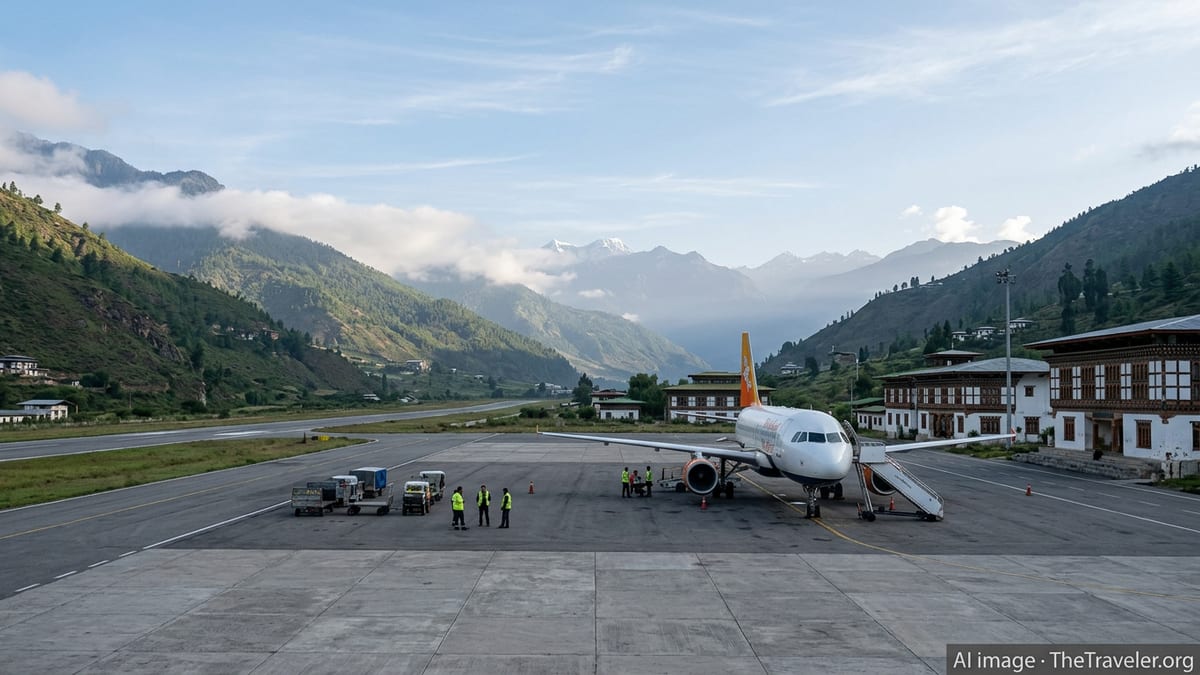
At the center of the turmoil is the Paro–Dubai sector, one of Bhutan’s newer international links and a symbol of the country’s ambition to tap into premium markets transiting through the UAE. As regional tensions escalated, Drukair suspended flights on this route from March 2 to March 17, just as spring arrivals were beginning to build. The airline operates the sector twice weekly, meaning several rotations have already been scrubbed, with more under review depending on security assessments.
Tour operators in Thimphu describe the situation as an abrupt halt rather than a gradual slowdown. Many had forecast a strong spring following a robust 2025, when Bhutan posted double-digit growth in tourist arrivals and a marked jump in Sustainable Development Fee revenues. Instead, they are now dealing with stranded passengers, emergency rebookings and a mounting stack of cancellations from would-be visitors unwilling to transit a conflict zone.
Spring Peak Season Stalled by Cancellations and Fear
Bhutan’s spring high season, spanning roughly March to May, is one of the most lucrative periods of the year. Clear skies, blooming rhododendrons and marquee trekking routes such as the Druk Path and Jomolhari draw well-heeled travelers looking for nature, culture and relative seclusion compared with more crowded Himalayan destinations. After several years of recovery from the pandemic and a recalibration of tourism policy, many operators had anticipated their best March and April since borders reopened.
Those expectations have been upended in a matter of days. According to local industry reports, tour companies are seeing cancellations and postponements from multiple markets, with Middle Eastern and Israeli guests among the first to pull out as direct travel from Dubai became impossible. One Thimphu-based operator, Amen Bhutan Tours and Treks, said more than 70 clients canceled trips outright, most citing the closure of Dubai airspace and security concerns about long-haul transits near an active war zone.
Travel agents say the psychological impact of the conflict is spreading well beyond the immediate region. Even tourists booked to fly via Delhi or Bangkok, routes not directly affected by Gulf airspace closures, are now seeking reassurance about safety or asking to defer to autumn. The result is a sudden gap in forward bookings for March and April, months that normally help sustain the industry through quieter periods.
Hoteliers in popular destinations such as Paro, Thimphu and Punakha report an uptick in empty rooms and last-minute changes. Boutique lodges, which rely heavily on pre-arranged, high-spend itineraries routed via major hubs such as Dubai, say occupancy projections have fallen sharply for the first half of March. Some properties are already adjusting staffing schedules and postponing planned seasonal hires in anticipation of weaker demand.
Airlines and Authorities Scramble to Reroute Travelers
Drukair and Bhutan’s tourism authorities are working to contain the fallout by rerouting affected passengers through alternative international gateways, primarily Delhi, Bangkok and Singapore. Given the limited number of airlines serving Paro International Airport and its challenging terrain, however, options remain constrained. The suspended Dubai leg cannot be easily replaced in terms of connectivity to Europe, the Gulf and parts of Africa.
Industry officials say that in the first instance, priority has been given to passengers who were already en route or due to travel within days of the airspace closures. Drukair has offered rebooking options at no additional fare where seats are available on alternative routes, although peak-season loads on other sectors make it difficult to accommodate everyone. Some visitors, particularly those with tight holiday windows, have opted to cancel rather than rearrange complex multi-stop itineraries.
Bhutan’s tourism regulators, who have spent the past two years fine-tuning a “high value, low volume” model centered on a daily Sustainable Development Fee, now face a different sort of challenge: how to maintain confidence in the destination when global events far beyond their control disrupt access. Officials have emphasized that Bhutan itself remains stable and safe, with no direct security threat on its territory, and are urging potential visitors to consider routing via alternate Asian hubs.
Nevertheless, travel insurers and corporate risk managers are playing an increasingly important role in decision-making, particularly for group and incentive travel from Europe and the Middle East. Advisors point to elevated risk levels across swathes of Gulf airspace and warn that further closures or sudden restrictions are possible as the conflict evolves. That uncertainty makes it more difficult for Bhutanese operators to guarantee seamless journeys, undermining one of the country’s key selling points.
A Hard Setback After a Strong Tourism Rebound
The timing of the disruption is particularly painful given Bhutan’s recent tourism rebound. In 2025 the kingdom recorded more than 200,000 tourist arrivals, a roughly 40 to 45 percent increase over the previous year, as international travelers returned in greater numbers and the government adjusted its fee structure to balance exclusivity with competitiveness. Revenue from the Sustainable Development Fee, a signature policy tool, also reached record levels, helping fund public services and conservation efforts.
That momentum had carried into early 2026, with officials outlining targets that envisioned further steady growth in arrivals, if not a return to pre-pandemic peaks. Key to the strategy was improving air connectivity through partnerships and new routes, including deeper integration with Gulf hubs such as Dubai to attract high-spend visitors from Europe and the wider Middle East.
The new conflict has upended those assumptions almost overnight. While some of the lost business may be recovered later in the year through rebookings to the autumn season, operators warn that not all travelers will return. Competing destinations in South and Southeast Asia, which can be reached more easily via alternative routings, are likely to benefit from diverted demand.
Economists in Thimphu note that tourism is one of Bhutan’s most important foreign exchange earners and a critical employer across accommodation, guiding, transport and handicrafts. A prolonged downturn in arrivals from key source markets would not only weigh on government revenue but also on small businesses in rural communities that depend on visitor spending. The longer the conflict in the Gulf drags on, they say, the greater the risk that Bhutan’s carefully managed recovery will lose steam.
Looking Ahead Amid Ongoing Regional Uncertainty
For now, Bhutan’s tourism industry is focused on crisis management: supporting stranded guests, renegotiating contracts and revising forecasts for the remainder of the year. Travel planners are revisiting route strategies, placing greater emphasis on connections through India and Southeast Asia and limiting reliance on any single Gulf hub for critical long-haul flows.
Some operators see an opportunity to strengthen ties with carriers in Delhi and Bangkok, promoting Bhutan as an add-on to existing regional circuits rather than a stand-alone journey routed primarily through Dubai. Others are exploring targeted marketing in nearer markets such as India, where overland and short-haul connections are less exposed to disruptions in Middle Eastern airspace.
Yet many in the sector acknowledge that the situation remains fluid and unpredictable. If tensions around the UAE ease and airspace restrictions are gradually lifted, the Paro–Dubai route could resume and confidence could begin to rebuild ahead of the autumn high season. If the conflict widens or persists, Bhutan may be forced to rethink parts of its connectivity strategy and revisit its growth expectations for 2026.
Amid the uncertainty, one message from industry leaders is consistent: Bhutan remains open, and the landscapes, monasteries and walking trails that define the country’s appeal are unchanged. What has shifted, at least for now, is the fragile web of flight paths that connect this Himalayan kingdom to the rest of the world, with a war in and around the UAE turning what should have been a buoyant spring into an anxious waiting game.