

More news on this day
The United Arab Emirates has deployed special Etihad Rail passenger services to carry citizens and residents home from the Saudi border, joining Saudi Arabia, Qatar, Oman, Bahrain and Kuwait in rolling out emergency transport and security measures as a fast‑moving Middle East crisis shuts down large parts of the region’s aviation network.
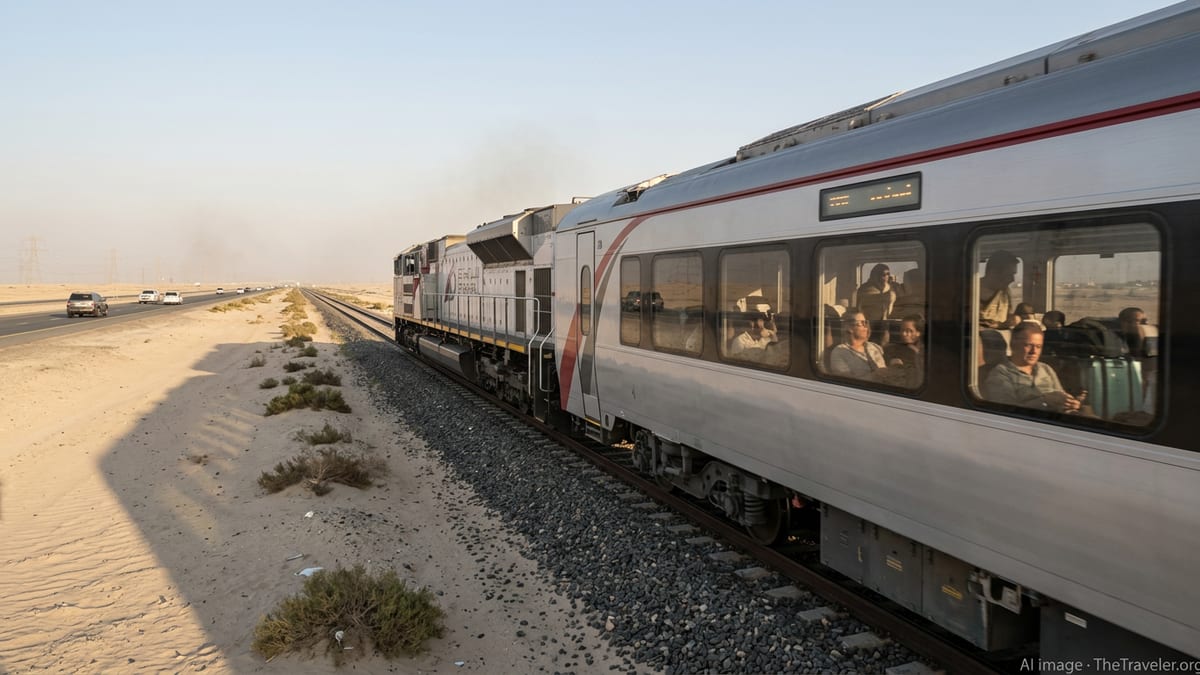
Exceptional Trains Bring Stranded Residents Back to Abu Dhabi
Etihad Rail confirmed this week that it had operated three exceptional passenger trains between Al Ghuwaifat station, near the Saudi border, and Al Faya station in Abu Dhabi, moving more than 350 people back into the country. The services ran on March 3 in coordination with Abu Dhabi’s Emergency, Crisis and Disaster Management Centre as airspace closures and flight cancellations rippled across the Gulf.
Officials described the trains as a precautionary mobility measure designed to support citizens and long-term residents who had been caught on the Saudi side of the frontier or were attempting to re-enter the UAE by land. With highways experiencing heavy traffic and intermittent security checkpoints, shifting some of the flow to rail was seen as a way to speed safe return journeys while easing pressure on road infrastructure.
The special operations also formed part of ongoing trial runs for Etihad Rail’s passenger network, giving authorities a live test of how the system performs under crisis conditions. Railway executives said the smooth handling of the emergency services demonstrated the technical and operational readiness of the national network to support the country during periods of heightened risk.
While the trains were limited in number, their visibility across social media and local news channels made them an important symbol of state capacity, reassuring anxious families following the regional escalation from home. Footage shared by passengers showed crowded but orderly carriages and frontline staff managing boarding at Ghuwaifat under tight supervision.
Gulf States Coordinate Warnings as Airspace Stays Fragile
The UAE’s move to activate rail services comes as all six Gulf Cooperation Council states adopt tougher security messaging and travel guidance in response to the widening conflict. Saudi Arabia, Qatar, Oman, Bahrain and Kuwait have all issued their own emergency advisories, mirroring steps taken in Abu Dhabi and Dubai and underlining the shared exposure of Gulf hubs to regional airspace disruptions.
Foreign ministries from Europe and Asia have updated risk assessments for the Gulf, with some advising citizens to avoid non-essential travel to parts of the region or to prepare evacuation plans in case of further deterioration. Japan’s government, for example, has urged its nationals to refrain from traveling to the UAE, Qatar, Bahrain, Kuwait and Oman, and to carefully monitor evacuation procedures in cooperation with their embassies.
Gulf governments insist that domestic security remains tightly controlled, but acknowledge that their role as aviation crossroads between Asia, Europe and Africa leaves them vulnerable to knock-on effects when conflict flares. With thousands of flights cancelled or rerouted since late February, authorities across the GCC are now looking beyond airports to additional modes of transport that can keep people and freight moving in emergencies.
Diplomats and regional analysts say the parallel tightening of warnings and contingency planning across all six states is a notable departure from previous crises, when responses were often fragmented. This time, coordination on messaging, security postures and alternative transport options is emerging as a central feature of the Gulf’s collective strategy.
Railway Steps Into the Gap Left by Grounded Flights
The aviation shutdown across key Gulf gateways has been one of the most visible impacts of the current crisis, with hubs in the UAE, Qatar, Bahrain and Kuwait logging mass cancellations and extended delays. Although a limited number of relief and repatriation flights have begun to depart from Abu Dhabi and Dubai, airlines warn that schedules will remain heavily disrupted for days, if not weeks.
In this vacuum, Etihad Rail’s emergency services have highlighted the latent potential of the Gulf’s long-discussed regional railway network. The UAE’s national line was designed primarily for freight and domestic travel, but the Ghuwaifat to Al Faya movements have illustrated how passenger operations can be scaled up rapidly to support evacuation and internal mobility when air corridors are constrained.
Rail planners across the GCC have long talked about the benefits of a connected grid stretching from Kuwait in the north to Oman in the south, tying together Saudi Arabia, Bahrain, Qatar and the UAE. The current crisis provides a real-time case study of how such infrastructure could function as a strategic back-up, moving people between states or from borders to interior cities while airspace is contested.
Industry experts say the Etihad Rail operations also underscore the value of diversified transport investments in an era of climate shocks, cyber outages and geopolitical flashpoints. While no single mode can fully replace aviation in a region so dependent on international air links, even limited rail corridors can play a crucial role in keeping essential journeys possible.
Passengers Face Uncertainty as Governments Test Contingency Plans
For travelers on the ground, the shift to emergency timetables and special trains has brought mixed emotions. Many UAE residents who boarded the Etihad Rail services expressed relief at being able to return home after days of confusion, but also described the stress of rapidly changing information and the challenge of reaching the Saudi border station through congested roads and checkpoints.
Across the wider Gulf, stranded passengers continue to navigate a patchwork of ad hoc solutions, from government-organized shuttles and chartered buses to hotel extensions and rebooked itineraries via alternative hubs. Social media channels are filled with first-hand accounts of long queues, inconsistent airline communication and uncertainty over which flights will actually depart.
Officials in the UAE and its neighbors say these stories are helping them identify gaps in existing contingency plans, particularly around how information is shared and how priority is assigned when capacity is scarce. The Etihad Rail movements are being closely studied as an example of how clear coordination between transport operators and crisis agencies can shorten response times.
Emergency planners argue that resilient systems are built not only on infrastructure, but also on rehearsed procedures that can be activated quickly. The visibility of the special trains, together with the gradual resumption of carefully controlled flights, is likely to shape how Gulf governments refine their playbooks for future disruptions.
Future of Gulf Travel: From Visionary Rail to Crisis Lifeline
The broader ambition behind Etihad Rail and the planned GCC railway network has always been to transform how people and cargo move across the Arabian Peninsula, reducing reliance on roads and cutting journey times between key cities. Until now, those plans have been framed mainly in terms of trade integration, tourism growth and environmental gains.
This crisis has added another dimension, recasting rail as a core element of national resilience. In the UAE, the sight of residents stepping off special trains after traversing the desert from the Saudi frontier has given the project a new, human face. Similar conversations are starting to surface in neighboring states that are developing or reviving their own rail links.
Transport authorities in Saudi Arabia, Qatar, Oman, Bahrain and Kuwait will be watching closely as the UAE consolidates lessons from the Ghuwaifat to Al Faya operations. Analysts expect fresh momentum for cross-border agreements on standards, ticketing and emergency protocols so that, in future, special services could move seamlessly between national networks if required.
For now, the exceptional Etihad Rail runs remain a limited operation, but they point toward a future in which trains stand alongside planes as a vital lifeline in the Gulf. As the Middle East crisis continues to reshape travel patterns, policymakers are likely to lean more heavily on rail not just as a symbol of modernity, but as a practical tool for getting people home when it matters most.