

More news on this day
Thousands of travellers across the United Arab Emirates are enduring long queues, missed connections and last-minute itinerary changes as Dubai, Abu Dhabi and Sharjah airports report at least 138 flight cancellations and 248 delays affecting services by Gulf Air, FlyDubai, IndiGo, Qatar Airways and several other carriers, according to emerging operational data and regional media coverage.
Get the latest news straight to your inbox!
Major UAE Hubs Struggle With Systemwide Disruption
Operational data and regional coverage indicate that disruption has spread across all three major UAE gateways, with Dubai International, Abu Dhabi’s Zayed International and Sharjah International each reporting a wave of cancellations and extended delays. The combined tally of at least 138 cancellations and 248 delayed services reflects a systemwide challenge rather than an isolated issue at a single airport.
Dubai International, one of the world’s busiest hubs for international traffic, appears to be bearing the brunt of the disruption due to its dense schedule of connecting flights and heavy reliance on transit passengers. Even where runways remain technically open, reduced airspace capacity, crew rotation issues and aircraft repositioning constraints are limiting the number of flights that can operate on time.
Abu Dhabi and Sharjah, which typically serve as important alternatives during regional aviation stress, have also seen schedules trimmed and departure banks thinned. Publicly available information shows that airlines are using these airports to accommodate diversions and reposition aircraft, a strategy that helps maintain some connectivity but also contributes to irregular operations and rolling delays.
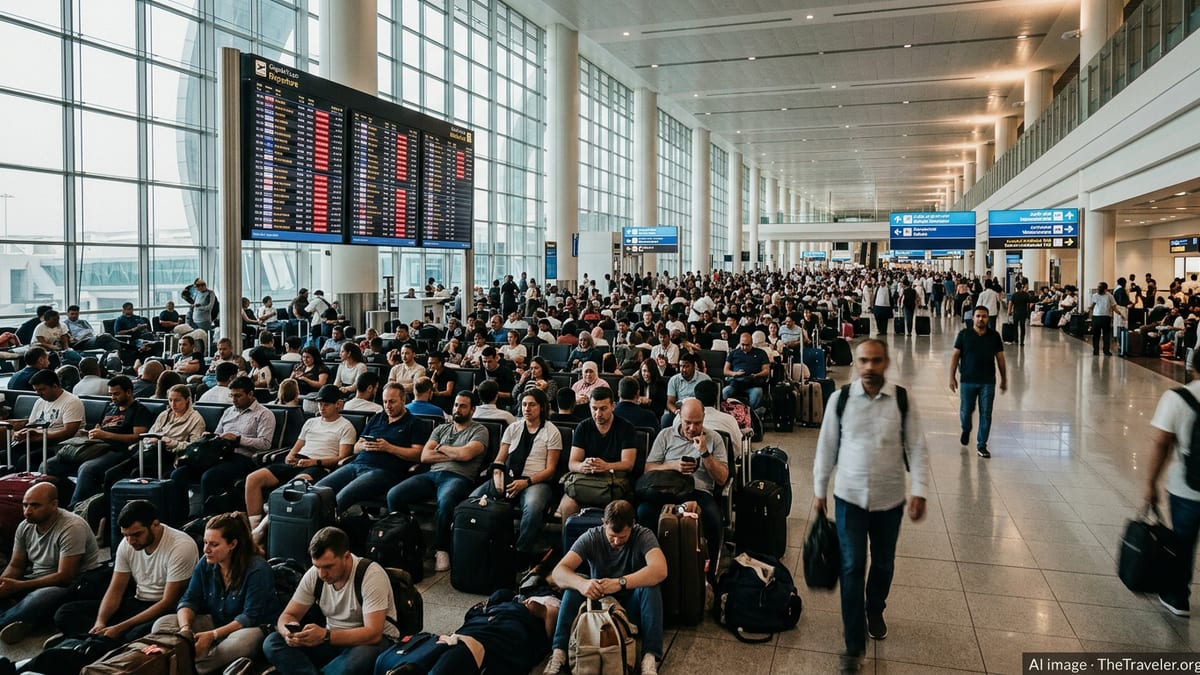
The resulting impact for travellers is immediate and visible, from crowded check in areas and overstretched customer service desks to departure boards dominated by red status indicators. Many passengers are facing unplanned overnight stays, missed tours and rebookings several days beyond their original travel dates.
Airlines From Gulf Air To Qatar Airways Forced To Retool Schedules
Carriers across the region and beyond are adjusting their networks as the situation evolves. Reports indicate that Gulf Air, FlyDubai, IndiGo and Qatar Airways are among the airlines most visibly affected at UAE airports, alongside other regional and international operators that use Dubai, Abu Dhabi and Sharjah as key transit points.
Low cost and hybrid carriers with tight aircraft utilisation, such as FlyDubai and IndiGo, are particularly exposed when irregular operations cascade through their schedules. A single cancelled rotation can ripple into multiple subsequent sectors, turning an isolated problem into a daylong series of delays for travellers moving between South Asia, the Gulf and Europe.
Full service airlines including Gulf Air and Qatar Airways are adjusting by consolidating flights, rerouting aircraft and in some cases upgauging equipment to accommodate stranded passengers. Publicly available schedule data suggests that some flights are being diverted to alternative regional hubs where airspace and turnaround capacity allow more reliable operations.
For passengers, this translates into unexpected routings, extended connections and smaller windows for making onward flights. Travel agents and airline call centres are reporting heavy volumes as travellers seek to understand whether to wait out delays in the UAE or rebook via other Middle East or European gateways.
Knock on Effects For Transit Passengers And Tourism Plans
The UAE’s position as a global transit crossroads means the impact extends well beyond origin and destination traffic. A significant share of passengers currently stranded in Dubai, Abu Dhabi and Sharjah are in transit between Asia, Europe, Africa and the Americas, leaving them dependent on rebooking options that may be constrained by network capacity.
Published travel industry analysis notes that even limited reductions in flight frequency through the UAE can quickly affect tour departures, cruise embarkations and business events across the wider region. Travellers with tightly timed itineraries, such as cruise passengers or those connecting to remote island destinations, are especially vulnerable when a missed connection cannot be easily replaced.
Hotel occupancy data from recent disruption events in the UAE suggests that airport area properties can fill quickly once large numbers of travellers are grounded. As rooms near major hubs tighten, some passengers are pushed further into the city or to secondary locations, increasing transfer times and adding logistical complexity to already stressful journeys.
Local tourism operators are also monitoring the situation closely. While some may see short term gains from stranded visitors extending their stays, the broader concern centres on reputational risk if prolonged irregular operations discourage future bookings or lead travellers to route through alternative hubs.
Airports Issue Advisories As Travellers Seek Clarity
In response to the evolving picture, UAE airports and airlines are publishing frequent operational advisories and status updates. Public communications urge passengers to verify flight details before travelling to the airport, use digital channels where possible and arrive earlier than usual if their flight is still showing as operating.
Check in cut off times and boarding procedures may be adjusted as operators attempt to recover the schedule, meaning that late arriving passengers could be at greater risk of missing flights even when departures are delayed. Ground handling teams are also working within constrained windows, which can result in longer waits for baggage delivery or aircraft turnaround.
Travellers already at the airport are relying heavily on departure boards, airline mobile apps and third party flight tracking services to interpret rapidly changing status information. In some cases, flights initially listed as cancelled have later been reinstated or retimed, adding to confusion for those trying to make time sensitive decisions around accommodation and onward travel.
Consumer advocates advise that passengers keep thorough records of their disrupted journeys, including booking confirmations and expense receipts, which may support later claims under airline policies or applicable passenger rights regimes. However, the availability and scope of compensation varies widely by carrier and route, leaving many travellers uncertain about their eventual entitlements.
What Travellers Can Do If They Are Affected
Travel planners recommend that anyone due to fly through Dubai, Abu Dhabi or Sharjah in the coming days closely monitor their bookings and be prepared for further schedule changes. The most up to date information is typically available via airline apps or official channels, which may reflect gate changes and retimings before airport displays are updated.
Where possible, passengers are encouraged to confirm that their flight is operating before leaving for the airport and to build additional time into connections that still appear viable. For those with non essential trips or flexible tickets, voluntary rebooking to alternative dates or routings may reduce the risk of becoming stranded during peak disruption.
Travel insurers are also urging policyholders to check the specific wording of their coverage related to delays, missed connections and extraordinary events. Some policies may support reimbursement for additional accommodation and meal costs, while others are more limited, particularly when disruption stems from broader operational or geopolitical factors.
For now, the picture across UAE airports remains fluid. As airlines gradually reposition aircraft and crews and airspace constraints evolve, schedules are expected to stabilise, but the backlog of affected passengers means that the knock on effects of the current wave of cancellations and delays are likely to persist for several days.