

More news on this day
Thousands of travelers across Abu Dhabi and Dubai have been left stranded after sudden airspace restrictions prompted Emirates and Etihad to divert or suspend flights, as Iranian retaliatory strikes effectively targeted key air routes over the United Arab Emirates and threw one of the world’s busiest aviation hubs into chaos.
Missile Threats Turn Gulf Skies Into No-Go Zone
The disruption began on February 28, when joint United States and Israeli strikes on Iran triggered a barrage of retaliatory missile and drone attacks across the Gulf. In response, regional authorities moved quickly to close or severely restrict airspace over parts of Iran, Iraq, Qatar, Bahrain, Kuwait and the UAE, effectively shutting down the main corridors that feed long-haul traffic into Abu Dhabi and Dubai.
The United Arab Emirates’ General Civil Aviation Authority issued emergency notices that halted most overflights and commercial movements, citing security risks along established air routes. With Iranian projectiles reported in the wider vicinity of key hubs, airlines were ordered to suspend operations or divert aircraft already in the air to safer airports, some as far away as Europe and South Asia.
Within hours, arrivals and departures from Dubai International, Dubai World Central, Sharjah and Ras Al Khaimah largely ground to a halt. Abu Dhabi’s Zayed International Airport, initially operating on a reduced schedule, soon saw its own flights cancelled, delayed or diverted as carriers weighed the risk of flying anywhere near the threatened skies.
Global knock-on effects were immediate. Major transit flows between Europe, Asia, Africa and Australasia were forced to reroute, adding hours to journeys or wiping entire rotations from schedules, as airlines scrambled to find alternative paths that skirted the expanding conflict zone.
Emirates and Etihad Forced Into Sudden Diversions
For Emirates and Etihad, the two Gulf super-connectors that normally rely on open skies above the UAE, the closures translated into an unprecedented operational standstill. Emirates halted all flights to and from Dubai until at least mid-afternoon on March 3, while Etihad announced a suspension of departures from Abu Dhabi through much of the same period.
Aircraft already airborne faced particularly acute challenges. Several Etihad and Emirates services inbound to the UAE were ordered into holding patterns before being instructed to divert, in some cases back to their points of origin and in others to alternative hubs outside the conflict-affected region. Flight-tracking data showed wide arcs over the Arabian Sea and unexpected U-turns, as pilots received new clearances in real time.
A limited resumption began only after Emirati authorities partially reopened segments of national airspace and authorized a narrow set of “exceptional” and special-service operations. Etihad’s first large passenger departure, an Airbus A380 to London Heathrow, pushed back from Abu Dhabi on March 2 after an earlier blanket closure. Emirates followed later that evening from Dubai with a handful of outbound services, focusing on high-demand markets such as India and the UK.
Even with those departures, regular commercial schedules remain largely frozen. Airlines have told passengers that only those contacted directly will be able to travel on the initial wave of flights, which are being treated primarily as repatriation and repositioning missions rather than a full return to normal operations.
Travelers Stranded in Terminals and Airport Hotels
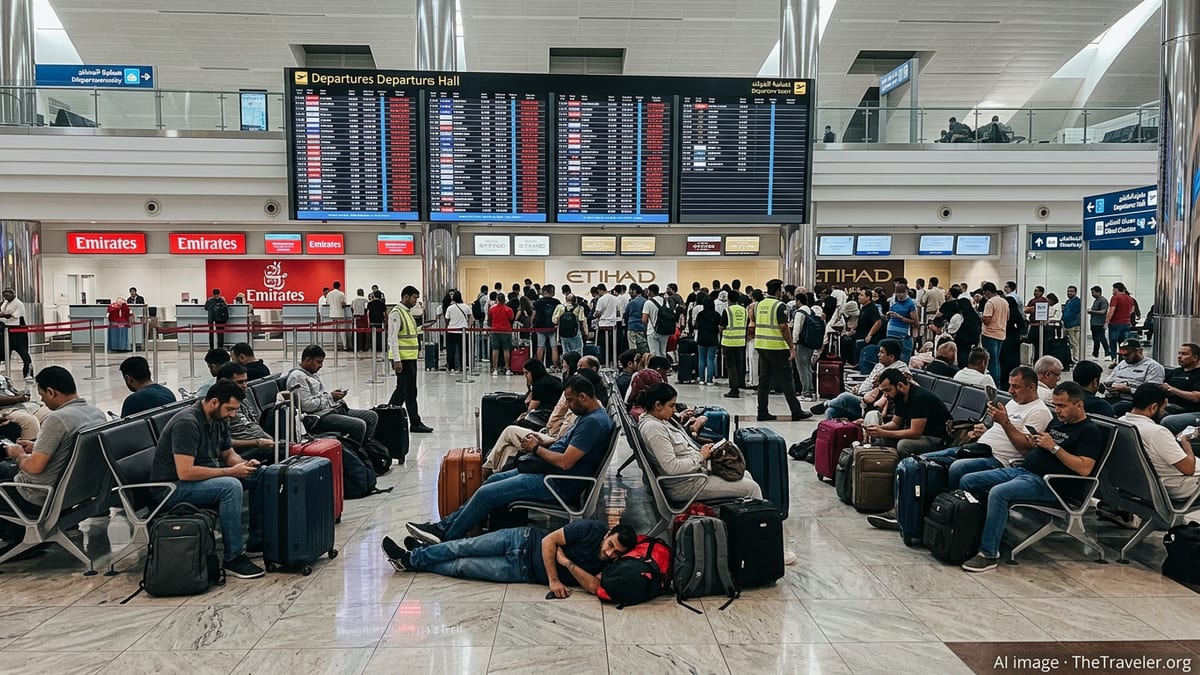
For passengers, the sudden shutdown turned meticulously planned itineraries into open-ended ordeals. Dubai and Abu Dhabi, normally prized for their efficient connections and short minimum transfer times, became holding points where tens of thousands of travelers found themselves waiting on rolling updates and vague reassurances.
Families en route between Europe and Australasia, migrant workers heading home to South Asia and business travelers bound for Africa all converged on the same departure halls, only to find departure boards flickering with the same message: cancelled. Some passengers reported spending more than 48 hours inside terminals as airlines struggled to reassign seats on the few flights allowed to depart.
Authorities and airport operators responded by opening additional rest areas and coordinating with airlines to supply meals, water and hotel vouchers where capacity allowed. The UAE government has stepped in to underwrite accommodation for many stranded visitors, bussing some from packed terminals to nearby hotels as it became clear the disruption would extend well beyond a single news cycle.
Despite official efforts, conditions have varied widely. While premium-class and loyalty passengers have often secured hotel rooms, large numbers of economy travelers and transit passengers without visas have remained in crowded gate areas, sleeping on chairs and floors as they wait to be called for scarce outbound seats.
Partial Reopenings Bring Confusing, Patchwork Relief
By March 2, signs of movement began to reappear. The UAE civil aviation regulator announced the start of special and exceptional flight operations, allowing a small but growing number of departures from Abu Dhabi and, later in the day, from Dubai’s two main airports. These flights, however, are tightly controlled and not open to general sale.
Etihad has operated a series of limited services from Abu Dhabi to major cities including London, Paris, Amsterdam, Moscow, Mumbai, Delhi, Riyadh and Jeddah. Many of these services have adopted improvised routings, threading through open airspace over Oman before cutting across Saudi Arabia to avoid the more volatile northern corridors traditionally used by Gulf carriers.
Dubai Airports has confirmed that only a “small number” of flights are now permitted from Dubai International and Dubai World Central. Emirates, flydubai and other carriers have emphasized that customers should not travel to the airport unless they have been explicitly notified with confirmed departure details. For many, the resumption has therefore felt more theoretical than real.
Compounding the confusion, schedules have remained highly fluid. Airlines have issued and then updated suspension notices within hours, while tracking sites show flights recurring as active, then delayed, then cancelled again as security assessments shift. Travelers attempting to rebook online often face error messages as inventory is ring-fenced for those already stranded in the UAE.
Global Aviation Grapples With Prolonged Uncertainty
Beyond the immediate turmoil for passengers, the crisis has exposed how deeply the global aviation network depends on uninterrupted access to Gulf airspace. Emirates and Etihad act as vital bridges between continents, funnelling huge volumes of traffic through their hubs. With those hubs effectively throttled, airlines from Europe to East Asia have been forced into complex and costly contingency planning.
Some carriers have already begun to reroute flights around the Arabian Peninsula entirely, hugging southern corridors over the Arabian Sea and the Indian Ocean. Others have opted to cancel services outright rather than absorb the additional fuel, crew and scheduling costs, especially as military activity continues and intelligence assessments remain pessimistic about a rapid de-escalation.
Industry analysts note that even a gradual reopening of airspace will not immediately restore confidence. Insurance premiums for flights touching the region are likely to rise, crew unions are pushing for stricter safety protocols, and corporate travel managers are rethinking routings that previously defaulted through Dubai or Abu Dhabi. Tour operators and cruise lines that rely on the UAE as a gateway for winter sun and stopover holidays now face weeks, if not months, of itinerary revisions.
For travelers on the ground, however, the focus remains far more basic: getting home. As airlines and regulators weigh security concerns against mounting pressure to clear the backlog, the UAE’s normally seamless aviation machine is operating in emergency mode, with no clear timeline for when the skies over Dubai and Abu Dhabi will once again feel reliably open.