

More news on this day
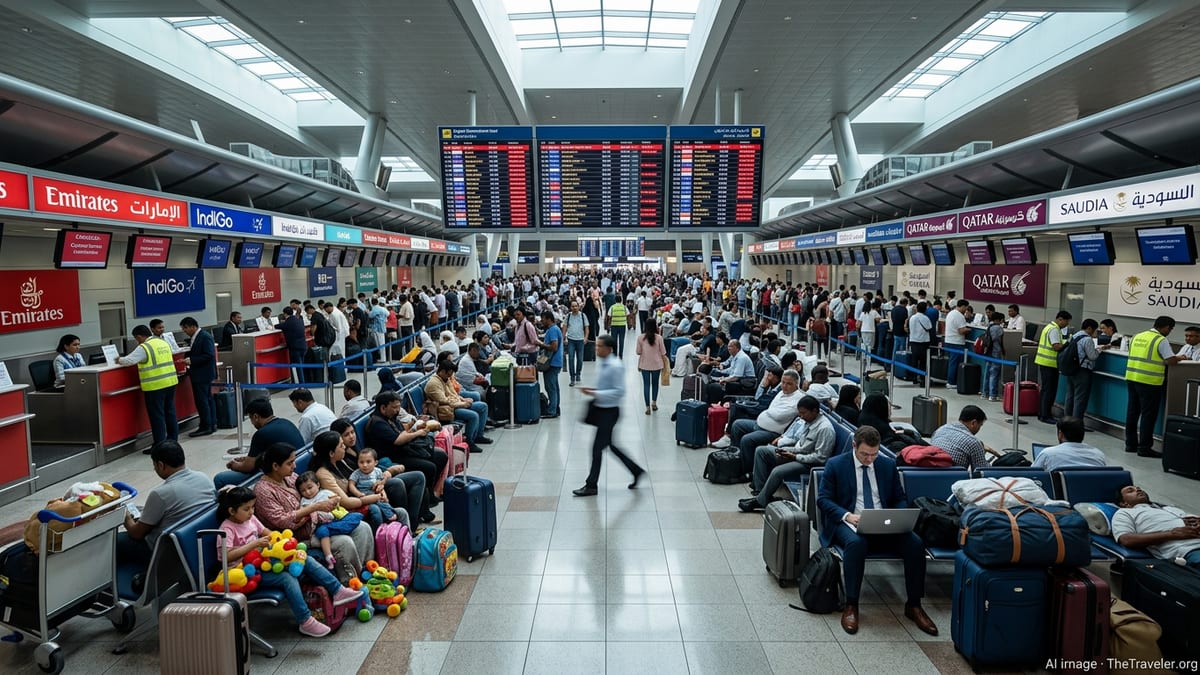
Thousands of travellers across the United Arab Emirates faced chaotic scenes on Tuesday as 197 flight cancellations and 308 delays rippled through the country’s main hubs in Dubai, Abu Dhabi and Sharjah, disrupting operations at leading carriers IndiGo, Saudia, Qatar Airways, Airblue, Emirates and several others.
Major Gulf Hubs Buckle Under Fresh Wave of Disruptions
Operational data from the UAE’s three primary international gateways showed an unusually high volume of last minute schedule changes, with Dubai International, Abu Dhabi International and Sharjah International collectively recording 197 cancellations and 308 delays within a 24 hour window. Aviation analysts said the scale of disruption is significant even for some of the world’s busiest connecting hubs, which are accustomed to managing tight turnaround times and heavy transit traffic.
Dubai International, the region’s largest hub by passenger volume, shouldered the greatest burden as Emirates, IndiGo and other foreign carriers trimmed rotations, rerouted aircraft and held departures on the ground. Abu Dhabi and Sharjah, key bases for Etihad Airways and several low cost and regional operators, reported similar knock on effects as aircraft and crew found themselves out of position and ground handling teams struggled to reset schedules.
The latest wave of disruption follows weeks of instability in Middle East airspace, where conflict linked restrictions and weather related congestion have narrowed routing options for airlines. With many long haul services now operating on extended detours, aircraft and crew are returning late to Gulf bases, compressing turnaround windows and increasing the likelihood of cascading delays.
Airport officials said operations remained safe but under strain, with contingency plans activated to manage queues, rebook passengers and coordinate with airline control centres. However, they acknowledged that the sheer number of affected flights meant many travellers were facing overnight stays or lengthy re-routing.
IndiGo, Qatar Airways, Airblue and Emirates Among Hardest Hit
Low cost giant IndiGo and Gulf heavyweight Emirates were among the most heavily impacted airlines, alongside Qatar Airways, Saudia and Pakistan based carrier Airblue. IndiGo, a major operator on India to UAE routes, saw dozens of its flights to and from Dubai and Sharjah cancelled or heavily delayed, particularly on high demand corridors linking New Delhi, Mumbai and southern Indian cities with the Gulf.
Qatar Airways and Saudia, both reliant on smooth regional feed into their Doha and Saudi hubs, were forced to cancel and retime multiple services touching the UAE. Industry observers said those adjustments reflected continuing airspace constraints across parts of the Middle East, which have forced airlines to choose between lengthy detours and outright cancellations on some rotations.
Emirates, the flagship carrier of Dubai, reported a relatively small number of outright cancellations but a high volume of late running flights as long haul services arrived hours behind schedule. Ground operations at Dubai were further tested by the need to handle arriving passengers whose onward connections had already departed, requiring hotel accommodation, meal vouchers and rapid rebooking onto the next available flights.
Airblue and other regional carriers serving Sharjah experienced a similar pattern, with a mix of cancellations and late departures on routes to Pakistan and the wider subcontinent. Aviation sources said some of these airlines were also dealing with crew duty time limitations, as pilots and cabin crew reached their regulated maximum hours after days of irregular operations.
Passengers Face Long Queues, Limited Options and Mounting Costs
The immediate impact for travellers was visible across all three airports, where long lines formed at check in counters, transfer desks and airline service offices. With a large proportion of flights either cancelled or significantly delayed, many passengers reported struggling to secure alternative connections, especially to popular destinations in South Asia, Europe and the wider Middle East.
Families returning from holidays, migrant workers due back on duty and transit passengers caught mid journey were among those hardest hit. Many found themselves sleeping in terminals or relying on emergency hotel vouchers as airlines worked through backlogs. Travel agents in Dubai and Sharjah said they were fielding a surge in last minute requests to reroute via alternative hubs in Europe or Southeast Asia, although seats at short notice were limited and often significantly more expensive.
Beyond the immediate inconvenience, passengers also faced uncertainty over compensation and refund rules, which vary by carrier and ticket type. Some airlines issued broad waivers allowing free date changes or refunds, while others restricted flexibility to flights directly cancelled by the carrier. Consumer advocates urged travellers to retain boarding passes, receipts and any written communication from airlines, as documentation will be critical for any later claims.
At the airports, volunteers and staff from tourism authorities and ground handling companies provided basic assistance, including directions to temporary accommodation and updated information on departures boards. However, several passengers expressed frustration at what they described as inconsistent updates, with mobile app notifications and social media alerts sometimes lagging behind developments on the ground.
Operational, Weather and Airspace Pressures Converge
Aviation experts said the spike in cancellations and delays across the UAE cannot be pinned on a single cause, but rather on an accumulation of pressures. On the operational side, tight crew rosters and high aircraft utilisation have left little spare capacity for many carriers. When flights arrive late due to airspace or weather constraints, that delay often propagates across multiple legs, leaving airlines with difficult choices later in the day.
Weather has compounded the challenge at times, with bouts of poor visibility and unsettled conditions slowing arrivals and departures at Gulf airports. Even when local skies are clear, knock on effects from storms in Europe, South Asia or other parts of the Middle East can disrupt inbound traffic that feeds through Dubai, Abu Dhabi and Sharjah.
The overarching factor remains geopolitical tensions and related airspace restrictions. Since late February, multiple states across the region have intermittently closed or restricted their skies to civil aviation, forcing airlines to redesign flight plans around large no fly zones. These diversions lengthen flight times, increase fuel burn and upset the delicate network patterns that Gulf hubs rely on to connect passengers between continents.
Carriers including Emirates, Qatar Airways and Etihad Airways have begun to restore parts of their networks, but often on reduced frequencies and with schedules that are revised day by day. Industry bodies caution that as long as airspace restrictions remain fluid, travellers should expect continued volatility in departure and arrival times across the region.
Authorities Urge Travellers to Stay Informed as Recovery Begins
UAE aviation authorities and airport operators have urged passengers to avoid travelling to the airport until they have confirmed their flight status directly with their airline. They emphasised that schedules are being updated frequently as carriers gain access to new routings or deploy spare aircraft to clear backlogs, meaning a flight showing as cancelled early in the day may in some cases be reinstated later with a retimed departure.
Airlines are encouraging customers to use official digital channels, such as mobile apps and SMS alerts, which tend to reflect changes more quickly than call centres or physical ticket offices. Several carriers have also expanded call centre staffing and extended operating hours in an attempt to handle the surge in inquiries generated by the current disruption.
While some relief is visible in gradually improving on time performance indicators, analysts warn that it could take several more days for operations at Dubai, Abu Dhabi and Sharjah to stabilise fully. Aircraft and crew must be repositioned, maintenance checks rescheduled and complex banked wave patterns recalibrated before the region’s major hubs can return to near normal service.
For now, travellers heading to or transiting through the UAE are being advised to build in additional buffer time, maintain flexible plans where possible and consider travel insurance that covers schedule disruptions. With the Gulf’s role as a key bridge between Europe, Asia and Africa, the aftershocks of this week’s cancellations and delays are likely to be felt well beyond the region’s borders.