

More news on this day
Hundreds of passengers across the United Arab Emirates faced fresh disruption today as flight-tracking data and local reports pointed to dozens of cancellations and hundreds of delayed services at Dubai, Abu Dhabi and Sharjah airports, affecting major Gulf and regional airlines.
Get the latest news straight to your inbox!
Flight Cancellations Mount Across UAE’s Busiest Hubs
Operational data compiled from major flight-tracking platforms for today indicates that around 38 departures and arrivals were cancelled and more than 300 services delayed across Dubai International, Abu Dhabi’s Zayed International Airport and Sharjah Airport. The figures cover a rolling 24-hour window and suggest continuing knock-on disruption rather than a full shutdown of UAE airspace.
Dubai International, which remains one of the world’s busiest intercontinental hubs, recorded the largest share of schedule changes. A mix of long-haul and regional services to Europe, Asia and Africa showed prolonged departure holds or revised arrival times, with some flights pushed back several hours after their original slots. Publicly available airport dashboards and aviation analytics show irregular outbound waves and compressed arrival banks as operators juggle available slots.
In Abu Dhabi, where traffic levels are lower than Dubai but still critical for regional connectivity, partial schedules continued but with widespread delays. Some services were retimed into late-night and early-morning windows, underscoring how capacity constraints and ongoing airspace management measures are reshaping daily operations. Sharjah Airport, an important base for low-cost and regional carriers, reported fewer outright cancellations but frequent late departures and extended turnaround times.
The disruption comes on top of a challenging month for Gulf aviation, during which carriers and airports across the region have already handled elevated levels of schedule changes linked to security considerations and shifting traffic flows. Today’s figures point to a system still under strain, with ripple effects felt well beyond the UAE’s borders.
Major Gulf and Regional Airlines Forced to Trim Operations
The latest wave of schedule disruption is hitting a cross-section of airlines that rely heavily on UAE gateways. Emirates, the largest carrier operating from Dubai, continues to run a reduced but stabilising network after earlier large-scale suspensions. According to published schedules and tracking feeds, the airline is operating many of its flagship long-haul routes, but with selected frequencies cancelled or consolidated, particularly on routes where demand has softened or operational risk is higher.
Etihad Airways, based in Abu Dhabi, has been operating limited but gradually expanding services in recent weeks. Publicly available information from airline timetables and independent aviation monitors suggests that Etihad has prioritised core trunk routes to Europe and Asia while trimming some secondary destinations. Today’s cancellations at Zayed International Airport include a mix of Etihad services and partner-carrier operations, reflecting the interconnected nature of the hub model.
At Sharjah, Air Arabia has become a focal point for passengers seeking alternatives to Dubai, but its ability to scale up is constrained. Online travel alerts and customer reports indicate that the airline is operating a thinner schedule than before the current regional crisis, with only select routes fully restored and others operating at reduced frequency. Travellers have reported last-minute timetable changes as Air Arabia adjusts to the number of slots available in UAE-managed airspace.
Other regional operators are also affected. Gulf Air and EgyptAir, which both rely on the UAE for transit traffic and point-to-point demand, have seen individual flights to and from Dubai and Abu Dhabi delayed or withdrawn from today’s schedule. Although these airlines maintain alternative gateways in Bahrain, Saudi Arabia and Egypt, changes at UAE airports are feeding through to their wider networks, prompting aircraft swaps and crew reassignments.
Passengers Face Long Queues, Rebookings and Uncertain Timings
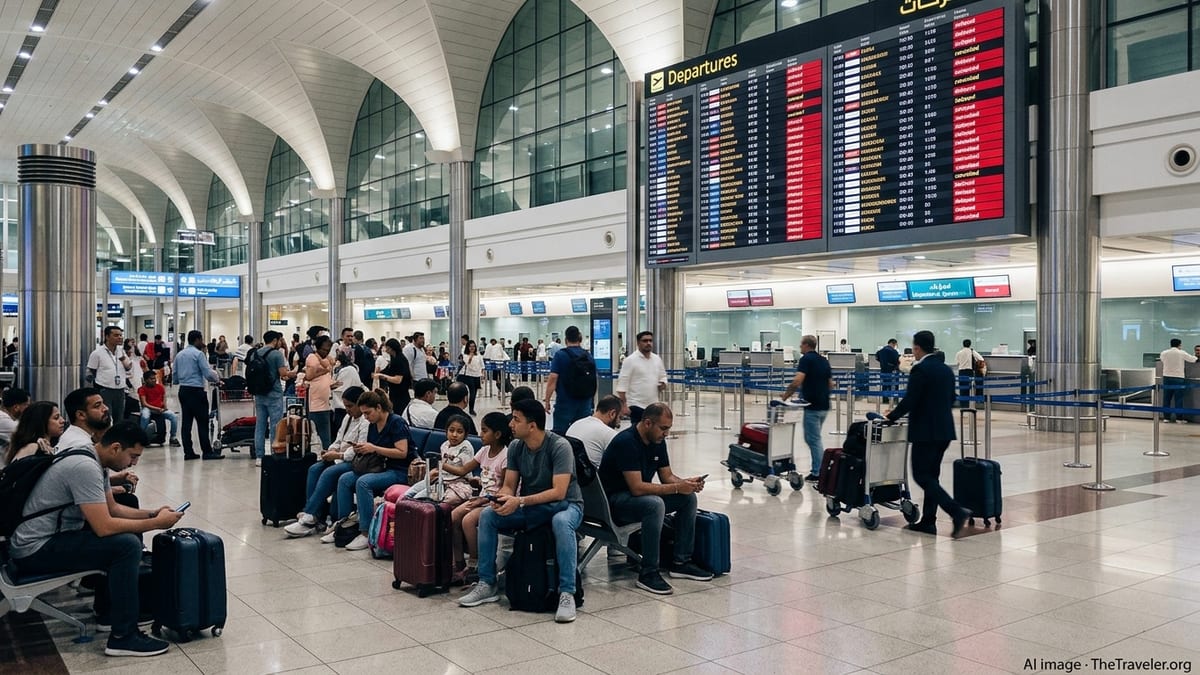
For passengers, today’s disruption translated into extended waiting times, rebookings and, in some cases, unexpected overnight stays. Images and accounts shared on social media platforms show crowded departure halls, long customer service queues and passengers resting in seating areas as they await updated departure information. Many travellers are relying on airline apps and airport information screens, which are being refreshed frequently as schedules shift.
Reports from recent days indicate that some passengers transiting through Dubai and Abu Dhabi have faced missed connections when inbound flights landed too late for onward departures. Airlines have responded by rebooking travellers on later services or rerouting them through alternative hubs in the Gulf and beyond. However, constrained seat availability on popular routes means some customers are being offered new travel dates several days after their original plans.
Those departing from Sharjah have described a different pattern of disruption, with comparatively shorter queues but higher uncertainty over whether flights will operate as planned. In several cases documented online this month, passengers received confirmation that their services were “operational” only to be cancelled later as airspace allocations changed. Such short-notice adjustments are particularly challenging for travellers with time-sensitive itineraries, including migrant workers, students and families returning from holidays.
Travel advisers and industry observers are encouraging passengers to build extra time into journey plans, avoid tight connections through the Gulf and maintain flexible arrangements for accommodation and ground transport. With airlines still rebalancing their networks day by day, even flights that appear on time can be subject to change at short notice.
Regional Airspace Restrictions Continue to Drive Disruption
Today’s flight disruptions are unfolding against the backdrop of continued regional tension and shifting airspace restrictions across parts of the Middle East. Recent travel advisories from risk consultancies and government agencies highlight that several air corridors remain subject to short-notice closures or rerouting, particularly in areas close to recent missile and drone activity.
In late February and early March, the United Arab Emirates and neighbouring states temporarily closed large portions of their airspace in response to escalating conflict involving Iran and allied groups. Published coverage describes how the initial closures brought hubs such as Dubai International close to a standstill, with thousands of flights cancelled across the wider region in the first days alone. While the UAE has since reopened its skies in a controlled manner, ongoing vigilance and interception activity continue to influence daily airline planning.
Airlines operating to and from Dubai, Abu Dhabi and Sharjah must now factor in dynamic overflight permissions, revised routings around sensitive areas and the possibility of holding patterns if air defence operations are underway. This complexity can cascade quickly into delays when aircraft and crews are held out of position, leading to the type of rolling cancellations and late departures seen today.
Analysts note that the UAE’s major airports have historically demonstrated strong resilience and capacity to recover from shocks, from severe weather events to previous regional security incidents. However, the current environment has persisted longer than many short-term disruptions, making it harder for carriers to return to fully predictable schedules.
What Travellers Should Watch in the Coming Days
Looking ahead, most industry observers expect UAE flight operations to remain in a managed recovery phase rather than snapping back overnight to pre-crisis normality. Airline booking engines for the coming week show generally full schedules on paper, but the pattern of selective cancellations and retimed departures suggests that carriers are keeping options open as they assess day-to-day conditions.
Passengers planning to transit through Dubai, Abu Dhabi or Sharjah in the near term are being advised by publicly available guidance to monitor their bookings closely, use airline apps for real-time notifications and avoid travelling to the airport without a confirmed, active flight status. Some carriers are also offering more flexible change policies for tickets touching the Gulf, allowing date or route changes without additional fees on affected itineraries.
Travel insurers and corporate travel managers are reviewing their policies as well, with some recommending that non-essential trips to and through the most affected hubs be deferred until operational stability improves. For essential travel, contingency plans such as alternative routings via other regional gateways, additional layover time and clear communication with travellers are being emphasised as key risk-mitigation steps.
For now, the scene at UAE airports reflects a system still in flux: planes are taking off and landing, but at a tempo constrained by factors beyond the control of airlines or passengers. With dozens of flights cancelled and hundreds more delayed today alone, travellers across the region continue to bear the brunt of a complex and evolving airspace situation.