

More news on this day
Passengers across Dubai and Doha are facing another bruising day of travel disruption as a new wave of delays and cancellations by Emirates, Qatar Airways, Pakistan International Airlines and Saudia ripples through key routes linking the UAE, Qatar and beyond, leaving travelers stranded in crowded terminals and scrambling to rebook scarce seats.
Fresh Wave of Disruptions Across Gulf Hubs
A fresh cluster of operational disruptions has hit major Gulf gateways, with at least 58 flights delayed and 12 cancelled across the wider UAE region in the latest 24 hour period, according to airport and industry tracking data. While the headline figures are modest compared with earlier mass disruptions in early February, they are concentrated on high demand corridors linking Dubai, Doha and other regional hubs, magnifying the impact on passengers.
Operationally, the new wave comes on the heels of a turbulent fortnight for Gulf aviation. Earlier this month, hundreds of passengers were stranded across Qatar, Egypt, Saudi Arabia, the UAE and Turkey when nearly one thousand flights were delayed and close to twenty were cancelled at major hubs such as Doha’s Hamad International Airport and Dubai International Airport. The current pattern of delays and cancellations in the UAE and Doha appears smaller in scale but similar in character, exposing how tightly coupled flight schedules are across the region.
Airport sources say the mix of factors behind the latest disruptions includes late inbound aircraft, airspace congestion on popular evening banks of flights, and continued knock on effects from winter weather and operational constraints at long haul destinations in Europe and North America. While there is no single triggering incident, the cumulative effect is a patchwork of late departures, rolling gate changes and sudden cancellations.
For passengers transiting through Dubai and Doha, the result is hours of uncertainty. Lines at rebooking desks lengthened through Sunday as travelers with missed connections tried to salvage itineraries built around busy Gulf hubs that typically pride themselves on fast, predictable transfers.
Emirates and Qatar Airways Face Pressure on Key Routes
Dubai based Emirates and Doha based Qatar Airways are again at the center of the turbulence, as their global networks funnel traffic through already busy hubs. Both carriers have spent recent weeks adjusting schedules in response to severe winter weather in North America and operational pressures on European routes, forcing them to trim or retime long haul services and to reallocate aircraft.
In parallel, Emirates has been contending with the fallout from a series of weather driven disruptions on its flagship transatlantic services. Over the weekend, flights between Dubai and New York and onward connections via Athens and Milan faced cancellations and rescheduling as a powerful Nor’easter battered the United States East Coast, snarling operations at airports from New York and Newark to Boston. Those changes created ripple effects for passengers originating in or transiting through Dubai, and added to the backlog of travelers seeking fresh seats at short notice.
Qatar Airways, meanwhile, has been managing high load factors on Europe, South Asia and North America routes while also refining its medium term schedule from spring onwards. Recent adjustments on routes such as Peshawar and Sialkot, and capacity tweaks on some European cities, have narrowed options for rerouting passengers caught up in day to day disruptions. At Doha’s Hamad International Airport, the combined effect of late arrivals and constrained onward capacity has intensified pressure on customer service desks and lounges at peak hours.
Airline officials insist that safety remains the overriding priority and say crews are working within regulatory duty time limits that leave little flexibility on days when delays compound. For travelers, that translates into more frequent last minute cancellations of evening departures when flight crew duty limits are reached, and a higher chance of being pushed to flights the following day.
Saudia and Pakistan International Airlines Add to the Backlog
Saudia and Pakistan International Airlines, both important operators into and through Gulf hubs, have also contributed to the latest wave of disruption. Saudia’s dense network linking Jeddah, Riyadh and Dammam with Dubai and other UAE airports means that even a handful of delayed or cancelled rotations can quickly strand passengers who rely on Gulf connections for longer journeys to Asia, Europe or North America.
Over recent weeks, Saudia has faced intermittent delays across key Saudi airports tied to seasonal demand spikes, weather and aircraft rotation challenges. When those late departures connect into already tight evening banks at Dubai or Doha, they can cause missed long haul connections, particularly for passengers heading onwards to South Asia or Southeast Asia on partner or interline carriers.
Pakistan International Airlines, which carries substantial migrant and visiting friends and relatives traffic between Pakistan, the UAE and Qatar, has likewise seen its operational buffers shrink. Any delay on departures from Lahore, Islamabad or Karachi can have outsized consequences for workers traveling to and from Dubai and Doha on limited vacation windows. In the latest disruption cycle, PIA passengers arriving late into the Gulf reported missing onward flights and being left to negotiate accommodation and rebooking amid already stretched ground staff.
The presence of multiple carriers on overlapping routes also complicates recovery. When a PIA or Saudia flight is cancelled or severely delayed, alternative seats on Emirates or Qatar Airways may already be heavily booked, particularly at weekends or during regional events and school holiday peaks. That dynamic was visible again this week, with many stranded travelers reporting little choice but to accept rebooking up to 24 hours later.
Scenes of Stranded Passengers in Dubai and Doha
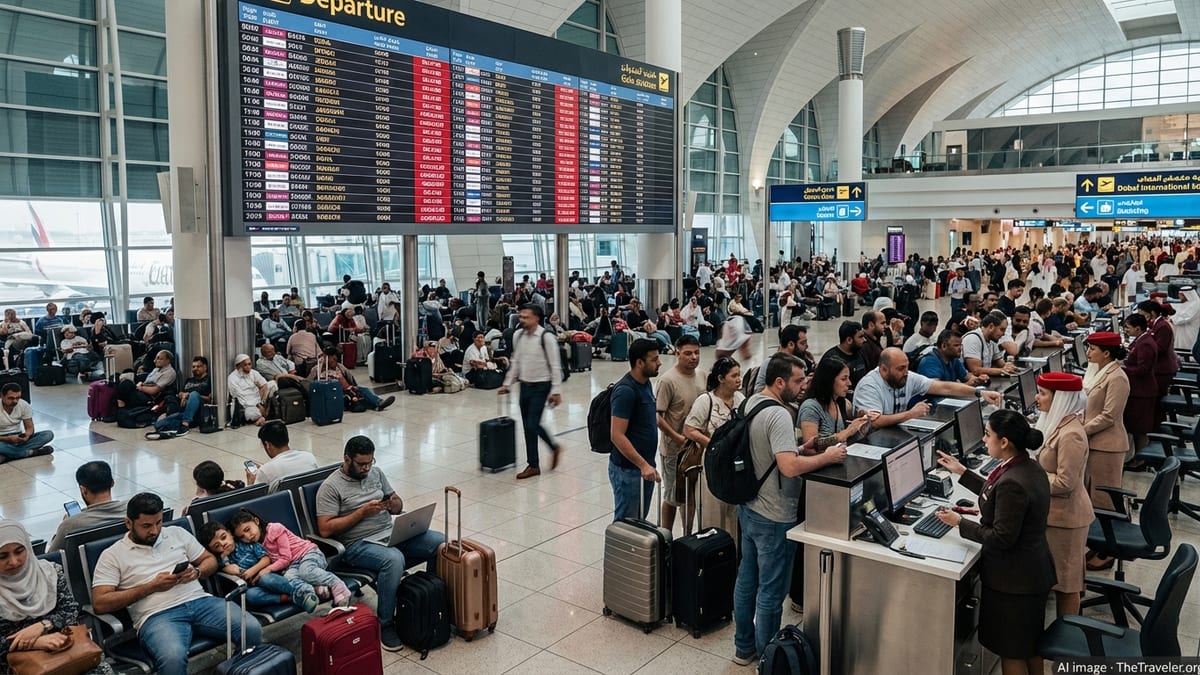
At Dubai International Airport, one of the world’s busiest hubs, the strain was evident across concourses as the latest disruptions unfolded. Seating areas around central gate clusters filled with travelers camped on suitcases or stretched across benches, while flight information screens flickered with a familiar pattern of yellow and red indicators showing late departures and cancellations.
Families traveling with young children appeared particularly affected. Parents described hours of uncertainty waiting for updates, with some told repeatedly to return to the gate only to see departure estimates pushed back again. For budget conscious travelers, the prospect of paying out of pocket for airport meals or off site accommodation added to the stress, especially when flying on non refundable promotional tickets that offer limited protections.
In Doha, similar scenes played out in the transfer halls of Hamad International Airport. The combination of overnight bank timings and delayed inbound aircraft from Europe and Asia created congestion at help desks, where queues snaked across the concourse. Some passengers reported being offered hotel vouchers when minimum delay thresholds were met, while others were handed meal coupons and advised to remain near their gate as airlines tried to consolidate lightly loaded services.
Staff at both airports worked to redirect travelers to alternate routings where possible. However, deep winter schedules in Europe and North America, along with already strong demand on South Asia and Africa routes, meant that rebooking options were often limited. For many, the only realistic option was to accept a lengthy layover and hope that subsequent flights operated on time.
Knock On Impact on Regional and Long Haul Networks
Although the latest tally of 58 delays and 12 cancellations in the UAE may seem modest in isolation, aviation analysts note that such figures can seriously disrupt tightly banked hub operations. Gulf carriers structure their schedules around short transfer windows designed to funnel passengers between waves of arriving and departing flights. When a handful of those flights are delayed by more than an hour, the carefully choreographed bank rapidly loses its alignment.
As connections break, airlines must decide whether to hold departing flights for late inbound passengers, potentially causing further delays, or to protect the wider schedule and rebook affected travelers on later services. On particularly constrained routes where available capacity is already tight, the decision can trigger a cascade of misconnected itineraries that extend the disruption into the following day’s schedule.
The knock on effect is especially acute on long haul links to North America and key European capitals. Weather driven disruptions at destinations such as New York, Newark, Boston or London reverberate through inbound and outbound rotations, tying up aircraft and crews for hours beyond planned cycles. When those flights feed into regional services onward to South Asia or Africa, a single late arrival can lead to multiple late departures.
In recent weeks, the combination of storms in North America, seasonal fog patches around parts of the Gulf and operational challenges at some regional airports has produced a fragile operating environment. Airlines have been able to maintain the bulk of scheduled services, but with little surplus slack to absorb further shocks, leaving passengers more exposed to delays and cancellations than in calmer periods.
What the Updated Disruption List Shows
The new list of affected services circulating among travel agents and industry contacts in the UAE highlights how broadly the latest disruptions are spread across carriers and routes. While Emirates and Qatar Airways account for many of the delayed flights, Saudia and Pakistan International Airlines feature in the tally of both delays and cancellations, reflecting their role in connecting secondary regional cities with the Gulf’s marquee hubs.
Among the most affected services are late evening and overnight departures from Dubai and Doha to South Asian destinations, where aircraft and crew rotations have been complicated by earlier disruptions on Europe and North America routes. Several midday regional sectors linking Dubai with Riyadh, Jeddah and Dammam, and Doha with key Gulf and Levant cities, also appear on the delay list, underlining how far the operational ripples extend.
Industry observers note that the 12 recorded cancellations in the UAE over the latest period are concentrated on routes where alternative frequencies or carriers exist, such as multiple daily services to major regional cities. That strategy allows airlines to consolidate passengers onto nearby departures, reducing the need to charter additional aircraft or arrange large scale accommodation, but inevitably increases crowding on the flights that do operate.
Travel agents say the updated list has become a crucial tool in advising customers, with many now proactively checking for potential hotspots and recommending that travelers build in longer connection times or choose earlier departures where possible. Some corporate clients are revisiting travel policies to permit flexible tickets on critical trips, trading higher fares for greater resilience in the face of mounting disruption risks.
Guidance for Affected Travelers
As the Gulf’s aviation system weathers this latest bout of disruption, airlines and travel experts are urging passengers to take a more proactive stance. Travelers with imminent itineraries through Dubai or Doha are being advised to monitor flight status frequently in the 24 hours before departure, using airline apps and airport information channels to catch any schedule changes as early as possible.
Those already at the airport amid delays are encouraged to make contact with their airline or travel agent as soon as disruption becomes apparent, rather than waiting until a flight is officially cancelled. Early engagement can improve the likelihood of securing scarce seats on the next available departure, particularly on high demand routes where options vanish quickly once disruption hits.
Experts also recommend that travelers build additional buffers into complex journeys that involve multiple connections or separate tickets purchased from different carriers. In a period when operational resilience is being tested across regions, the traditional practice of tightly stitching together minimum connection times leaves little margin for even modest delays.
For now, the message from Gulf aviation officials is that the system remains broadly stable, with the majority of flights operating close to schedule. Yet the experience of passengers left stranded by the latest round of 58 delays and 12 cancellations across the UAE underscores how even a relatively small disturbance can translate into a long, uncomfortable wait when it intersects with some of the world’s busiest hubs.