

More news on this day
Thousands of passengers were left stranded across Dubai, Abu Dhabi and Sharjah on March 1 as US and Israeli strikes on Iran triggered widespread airspace closures and at least 1,401 flight cancellations, crippling operations at key Gulf hubs and disrupting global travel corridors between Europe, Asia and Africa.
Airspace Closures Cripple Dubai, Abu Dhabi and Sharjah
The United Arab Emirates confirmed a temporary and partial closure of its airspace following the overnight strikes on Iran, a move that effectively halted almost all commercial activity at Dubai International, Abu Dhabi’s Zayed International and Sharjah International airports. Flight-tracking maps showed skies over the UAE and much of the northern Gulf virtually empty as airlines scrambled to reroute or suspend services.
Dubai International, the world’s busiest airport for international traffic, suspended all flights as operators cited safety concerns and awaited guidance from civil aviation authorities. In Abu Dhabi, a drone strike on Zayed International caused damage, killed at least one person and injured several others, further complicating efforts to restart operations. Sharjah International also reported heavy disruption as inbound services diverted or returned to their points of origin.
The closures in the UAE came on top of earlier decisions by Iran, Iraq, Kuwait, Bahrain, Qatar, Israel and Syria to shut their airspace, effectively severing one of the planet’s most important aviation crossroads. Analysts warned that even a short-lived shutdown would take days to unwind because aircraft and crews were scattered across multiple continents.
Emirates, Etihad, FlyDubai and Others Slash Schedules
Home carriers Emirates and Etihad Airways were among the hardest hit. Emirates announced a full suspension of flights to and from Dubai until at least Sunday afternoon local time, while warning that knock-on delays and cancellations would extend well beyond any formal reopening of airspace. The airline, which normally carries tens of thousands of passengers a day through its Dubai hub, said rebooking and refund options were being offered where possible.
In Abu Dhabi, Etihad halted all departures until at least 2:00 p.m. UAE time, later extending the disruption window as security assessments continued. Several inbound flights were canceled outright, with others ordered to return to their departure airports mid-route. A statement from the carrier said operations would resume “subject to prevailing conditions” once regulators signaled that flights could safely transit the region.
Low-cost operator FlyDubai also suspended all services in and out of Dubai until mid-afternoon, implementing what it described as “comprehensive customer care measures” for affected travelers. Indian budget giant IndiGo, along with Saudia, Air Arabia and other regional and South Asian carriers, canceled or rerouted numerous flights touching the UAE, compounding a regional tally that aviation data firms put at well over 1,400 cancellations within roughly 24 hours.
Stranded Travelers Face Long Lines, Uncertain Timelines
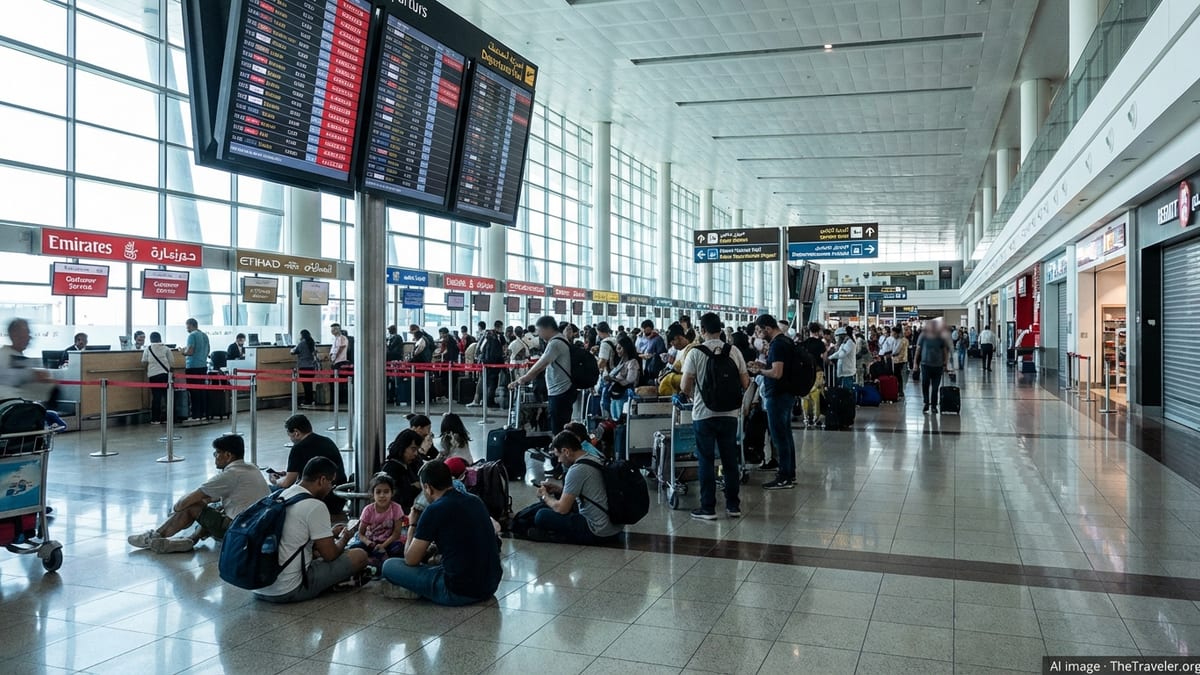
Inside terminals across Dubai, Abu Dhabi and Sharjah, passengers described scenes of mounting frustration as departure boards filled with red "canceled" notices. Long queues formed at airline service desks as travelers tried to secure hotel vouchers, meal coupons or scarce seats on rerouted itineraries that avoided closed airspace over Iran and its neighbors.
Many transit passengers, including families en route between Europe and Asia and migrant workers traveling to and from the Indian subcontinent, were caught mid-journey with no clear indication of when they could move on. With hotel capacity near the major airports quickly stretched, some travelers were directed to more distant accommodation or told to remain in terminal rest areas while airlines worked through the backlog.
Officials in the UAE said authorities were coordinating with carriers to provide meals, lodging and alternative bookings for thousands of disrupted passengers. In some cases, governments arranged special assistance for vulnerable citizens and urged travelers to avoid heading to airports unless they had confirmed new bookings. Travel agents across the region reported an avalanche of calls as customers sought clarity on whether upcoming trips would proceed.
Global Ripple Effects Reach Europe, Asia and Beyond
The shutdown of UAE hubs came as a severe blow to global aviation networks that rely on the Gulf as a bridge between continents. Airlines in Europe and Asia quickly announced wide-ranging changes, with some canceling flights outright and others adding hours to journey times to skirt closed skies. Carriers from India, including Air India and IndiGo, suspended or rerouted services that would normally overfly Iran or connect via Dubai, Abu Dhabi or Doha.
European operators such as Lufthansa, British Airways and Air France also pulled services to key Gulf and Levant destinations, while updating routings to South and Southeast Asia to avoid conflict zones. With Russian airspace still heavily restricted for many Western airlines, the loss of Middle Eastern corridors further narrowed options, forcing longer detours, increased fuel burn and higher operating costs.
Aviation analysts warned that even a brief period of closures and diversions would ripple through global schedules for days, as aircraft rotated off their normal patterns and crews exceeded duty-hour limits. Cargo operations were similarly affected, with time-sensitive shipments stranded in the UAE and nearby hubs, raising concerns about supply chain delays.
Safety, Security and the Road to Recovery
Regulators and airlines stressed that safety and security would determine when normal flights could resume, not commercial pressure to reopen lucrative routes. Regional civil aviation authorities maintained conflict-zone advisories, while Europe’s aviation safety bodies reiterated guidance that there was a high level of risk to civilian aircraft operating near active military operations.
For now, airlines are focusing on contingency planning: extending flexible booking policies, positioning spare aircraft closer to potential recovery hubs, and coordinating with governments on any required evacuation or repatriation flights once airspace gradually reopens. Industry experts said a phased restart, beginning with limited inbound services and tightly controlled overflight corridors, was the most likely scenario.
However, with tensions between the United States, Israel and Iran still elevated and the possibility of further strikes not ruled out, tourism boards, airports and carriers in the UAE face the prospect of prolonged uncertainty. Travel demand, which had been robust across the Gulf, may soften in the short term as leisure visitors and corporate travelers reassess itineraries until a clearer picture of regional security emerges.
For the thousands still camped out in terminals from Dubai to Abu Dhabi and Sharjah, the priorities remain immediate and practical: finding a bed for the night, a confirmed seat out of the region, and reliable information in a fast-changing crisis that has reminded the aviation world just how exposed it is to geopolitical shocks along its most critical routes.