

More news on this day
Travel across the Gulf and beyond faced fresh turmoil this week as major carriers including Gulf Air, Emirates, Qatar Airways and Flydubai cut more than 60 flights, disrupting links between the United Arab Emirates and key cities from Bahrain and Cairo to Prague, Budapest, Munich, Oslo, Stockholm and Riyadh.
Get the latest news straight to your inbox!
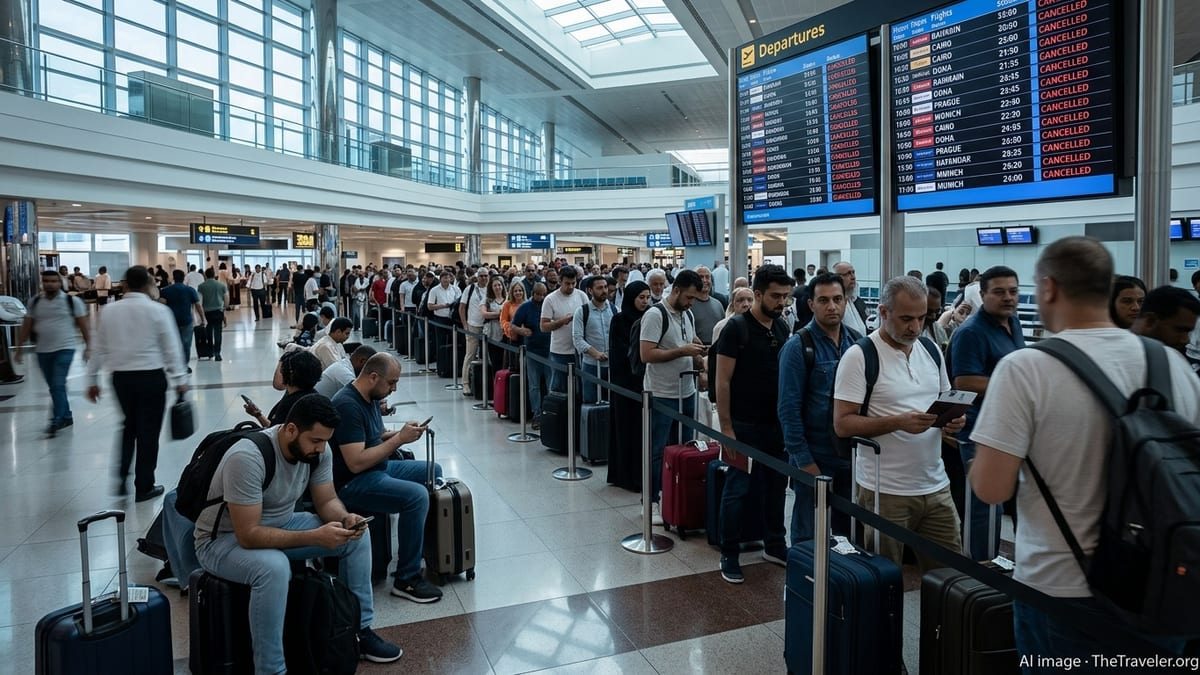
Regional Airspace Strain Triggers New Wave of Cancellations
Published advisories show that continuing airspace restrictions across parts of the Middle East are at the core of the latest disruption for Gulf-based airlines. Travel risk bulletins issued in early March described constrained or periodically closed corridors over the United Arab Emirates, Bahrain, Qatar, Iran and Iraq, with operators warned of short-notice changes to routings and flight permissions.
Those limits have translated into widespread schedule cuts at major hubs such as Dubai International and Abu Dhabi, as well as Bahrain and Doha. According to publicly available summaries of airline operations, carriers have been forced to balance safety considerations with slot constraints, crew duty limits and the need to reposition aircraft, prompting the cancellation or consolidation of dozens of passenger services.
Operational updates compiled by travel management companies and aviation tracking platforms indicate that the cumulative effect now exceeds 60 cancelled flights across the main Gulf brands, with ripple effects spreading to European and North African destinations. Many of the affected services were short and medium haul routes that funnel passengers onto long haul connections, magnifying the impact on global itineraries.
For travelers, the pattern has been a succession of late schedule changes, rolling delays and sudden cancellations, as airlines respond to evolving airspace guidance and adjust their networks day by day.
Gulf Air, Emirates and Qatar Airways Reshape Key Routes
Gulf Air, which relies heavily on Bahrain as a connector between the wider region and destinations in Europe and Asia, has seen repeated disruption on services touching Dubai and Abu Dhabi. Accounts compiled by passengers and travel agents describe multiple Bahrain legs scrubbed in the first half of March, forcing rerouting via alternative hubs or overland journeys to reach remaining flights.
Emirates, the largest operator at Dubai International, initially suspended regular services when regional airspace closures first intensified, before gradually building back a limited schedule. Recent days have brought further fine tuning, with selective cancellations on routes where traffic can be consolidated, including services to European cities such as Prague, Budapest, Munich, Oslo and Stockholm. Public timetable data shows that some frequencies have been temporarily removed while others operate with larger aircraft to absorb demand.
Qatar Airways, which depends on dense short haul flying around the Gulf to feed its Doha hub, has also trimmed UAE-linked sectors. Reports from travelers describe canceled departures on Dubai to Doha flights, with some itineraries rebooked via alternative regional gateways or pushed back by several days. Adjusted schedules have affected onward connections to cities including Cairo and major European capitals, leaving passengers to renegotiate entire journeys.
Together, these changes mean that many of the core spoke routes that normally knit together Bahrain, Doha and Dubai are operating at significantly reduced capacity, even when headline long haul services remain on the boards.
Flydubai and Other Carriers Cut Capacity from Dubai
Flydubai, the low cost carrier based at Dubai International and Al Maktoum International, has played a crucial role in reaching secondary destinations across the Middle East, Eastern Europe and Central Asia. Recent operational summaries circulated by travel forums and agency advisories indicate that its schedule has shifted to a limited operations model, with particular strain on flights to regional capitals.
Routes such as Dubai to Riyadh, Bahrain and Cairo have experienced cancellations or aircraft downgrades, especially on off peak departures. Services to leisure and city break destinations in Europe, including Prague and Budapest, have also been hit, with some rotations removed entirely on specific days. Passengers report short notice notifications in booking apps, requiring rapid decisions on refunds, credits or rebooking.
Other regional carriers serving the UAE, including operators from Saudi Arabia and Egypt, have faced similar constraints. Where possible, airlines have merged lightly booked flights or shifted departure times to windows when airspace availability is more predictable. This has occasionally freed up capacity on certain trunk routes, but at the cost of reliability and advance planning for travelers.
For Dubai in particular, the result is a patchwork network in which some city pairs continue to run close to normal while others see flights cut back to a fraction of usual frequencies.
Passengers Face Missed Connections and Lengthy Rebookings
For individual travelers, the statistics translate into long hours refreshing airline apps and departure boards. Social media posts and online forum discussions from the past three weeks are filled with accounts of passengers stranded in transit hubs or watching confirmed bookings vanish as cancellations cascade through the system.
Connections via Bahrain, Doha and Riyadh have proven especially fragile. When a short feeder leg from Dubai is dropped, entire long haul journeys to South America, Europe or Southeast Asia can unravel, with limited alternative routings available on the same day. Some passengers report being offered rebookings several days later, or on completely different routings via cities such as Muscat or Jeddah.
Publicly available guidance from airlines and travel advisors emphasizes the importance of monitoring flight status up to departure time and ensuring that contact details in bookings are up to date. Flexible tickets and waivers introduced in response to the disruption have given some travelers options to change dates or request refunds, but rebooking into scarce seats during peak travel periods remains challenging.
Families and business travelers alike have described turning to nearby airports or overland connections when possible, including driving between Gulf states to catch flights still operating from alternative hubs.
What Travelers Should Watch in the Coming Days
As of late March, industry observers note that the operational environment for Gulf airlines remains fluid. Airspace restrictions and security considerations continue to shape which corridors are usable, while aircraft and crew positioning constraints limit how quickly full timetables can return.
Travel risk analysts advise that routes touching Bahrain, Cairo, Doha and major Saudi gateways such as Riyadh may continue to experience short notice changes, particularly for services originating or terminating in the UAE. European city pairs including Prague, Budapest, Munich, Oslo and Stockholm, which rely heavily on connecting traffic through Dubai and Doha, are also seen as vulnerable to further adjustments if regional conditions shift.
Publicly available information from airline booking systems suggests that additional schedule refinements are likely as carriers move into April, with some temporary cuts potentially extended and selected routes restored as demand, safety assessments and airspace access allow. Travelers with itineraries involving multiple Gulf hubs are being encouraged by travel advisors to build in longer connection times and to consider alternatives such as flying directly to European or Asian gateways that still have more stable links to the region.
While the latest wave of cancellations has highlighted the vulnerability of hub and spoke networks to regional shocks, it has also underscored the importance of real time information for passengers. For now, those heading to or from the UAE are likely to face a more complex planning process, with flexibility and contingency options a key part of any long haul trip that relies on Gulf carriers.