

More news on this day
Air travel to, from and through the United Arab Emirates remains severely disrupted on March 4, with most regular commercial flights still suspended and tighter airport access rules in place as authorities manage the fallout from regional airspace closures.
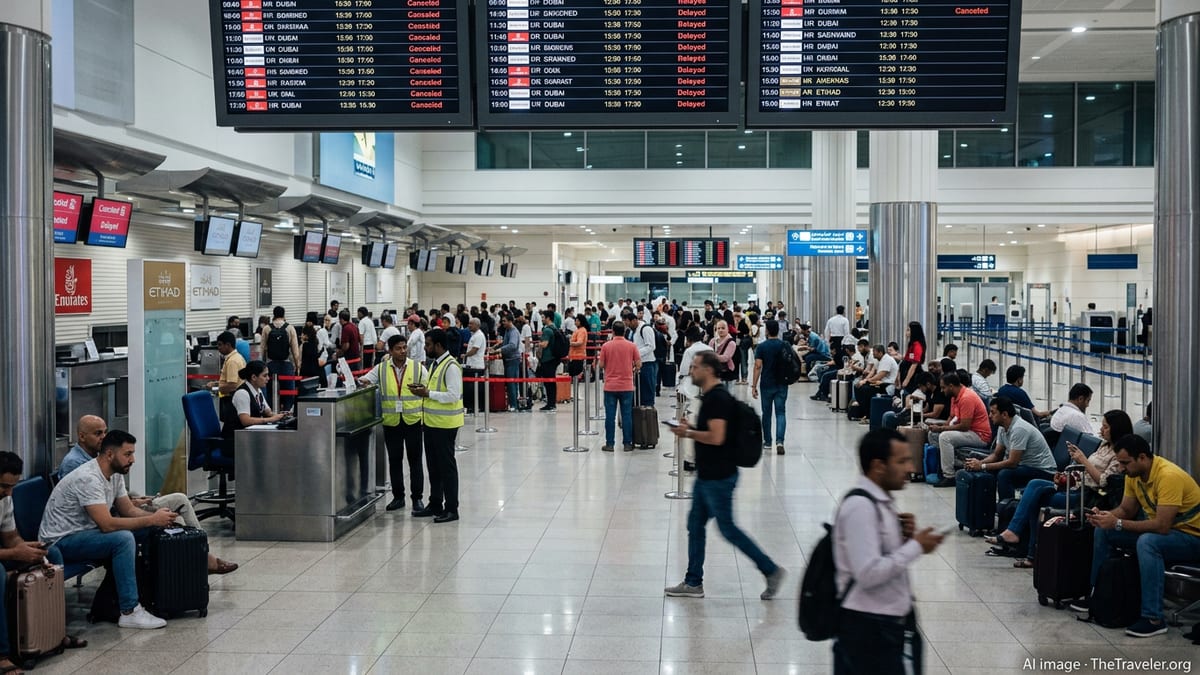
Limited Flights as UAE Airports Run on Emergency Corridors
The UAE’s General Civil Aviation Authority has confirmed that airports across the country are operating on a reduced schedule, using emergency air corridors to move stranded passengers out of the country. According to authorities, current operations are capped at around 48 flights per hour, with plans to gradually scale up to about 80 daily flights in the next phase as conditions allow.
Since March 1, national carriers have used a combination of repatriation and repositioning flights to move tens of thousands of travellers. Officials say these flights are prioritising passengers who were already in transit or whose original journeys were disrupted by the sudden closure of regional airspace. Regular commercial schedules, however, remain largely suspended and are unlikely to normalise before the end of the week.
Authorities stress that safety remains the overriding consideration. The activation of emergency routes has been coordinated with regional partners and international aviation bodies in order to steer aircraft clear of active conflict zones while still maintaining essential connectivity.
Despite the limited resumption, the backlog is significant. Industry estimates suggest that more than 10,000 flights across the wider region have been cancelled or rerouted since the crisis began, leaving major hubs such as Dubai and Abu Dhabi struggling to clear stranded passengers and reposition aircraft and crew.
Emirates, Etihad and Other UAE Carriers Extend Suspensions
Emirates has extended the suspension of its scheduled flights to and from Dubai until 11:59 p.m. UAE time on March 4. The airline is operating a restricted number of passenger repatriation and cargo services on March 3 and 4, mainly to move customers whose original flights were cancelled and to maintain critical freight links. City check in facilities and most nonessential services remain closed until further notice.
Etihad Airways has taken a similar approach from its base in Abu Dhabi. All regular commercial flights to and from Abu Dhabi are suspended until at least 2:00 p.m. on March 5, with only a small number of repatriation, repositioning and freighter flights operating under special approvals. The carrier is urging passengers not to travel to the airport unless they have been directly contacted with new travel details.
Budget carriers are also affected. Flydubai and Air Arabia are running only limited services out of UAE airports and have temporarily halted many regional routes, particularly to neighbouring countries whose airspace remains closed or heavily restricted. Several services into Lebanon, Jordan, Syria and Iraq are suspended until at least March 5, and further adjustments are likely as the situation evolves.
International airlines have added a second layer of disruption. Carriers such as Lufthansa and KLM have suspended flights to Dubai and Abu Dhabi through early March and are avoiding large sections of Middle East airspace, further constraining options for travellers seeking alternative routings via Europe or onward to North America and Asia.
Airport Access Tightened as Passengers Told to Stay Away
Access to key UAE airports has been tightened in an effort to manage congestion and ensure that limited operations can proceed safely. Dubai Airports has reiterated that travellers should not go to Dubai International (DXB) or Dubai World Central (DWC) unless they have been contacted directly by their airline with a confirmed departure time and flight number.
Abu Dhabi and Sharjah authorities have issued similar guidance. Only passengers with verified bookings on confirmed flights and the necessary documentation are being allowed into terminal buildings. Security and airport staff are turning away those who arrive without airline confirmation, in some cases advising them to wait at hotels or with local hosts until they receive updated instructions.
The UAE government has moved to cushion the impact on stranded visitors. Officials say accommodation and basic subsistence costs are being covered for affected travellers who cannot yet depart, with coordination under way between airport operators, tourism authorities and foreign embassies to provide hotel rooms, transport and temporary visas where needed.
Inside terminal buildings, operations look markedly different from normal peak travel periods. With the majority of flights still grounded, many retail outlets are closed or operating on reduced hours, while ground handling teams focus on rebooking, passenger welfare and the processing of emergency departures rather than routine check in and transfer flows.
What Travellers Need to Know Right Now
For passengers with upcoming trips involving the UAE, the overriding message from airlines and regulators is to wait for official communication before heading to the airport. Travellers are being urged to monitor flight status tools, keep their contact details updated in airline bookings and use online rebooking or refund channels wherever possible, as call centres remain heavily congested.
Most carriers are offering flexible rebooking options at no extra cost for tickets issued before the crisis, typically allowing travel to be moved into later March or beyond. Refunds are being made available for those who no longer wish to travel, though processing times may be longer than usual because of volume.
Passengers transiting the UAE from long haul origins face particular uncertainty, as rerouting options are limited by multiple airspace closures and the suspension of many regional connections. Travel agents are advising affected customers to consider alternative gateways where possible, including airports in Europe or South Asia that still maintain links to their final destinations without overflying restricted zones.
Authorities and aviation experts caution that even after scheduled services formally resume, it may take several days for networks to stabilise. Aircraft and crews remain out of position, and airlines will need time to rebuild rotations, clear backlogs and restore normal frequencies on key routes. Travellers are being told to expect rolling schedule changes and to build extra flexibility into any nonessential journeys.
Tourism Stays Open as Aviation Gradually Recovers
Despite the aviation turmoil, the UAE’s tourism industry remains largely open and operational. Government briefings indicate that more than a thousand hotels and tens of thousands of tourism related businesses, including malls, attractions and dining venues, continue to welcome guests under normal or near normal conditions.
Local tourism authorities are working with airlines and embassies to accommodate stranded visitors, extending hotel stays and offering logistical support while travellers wait for outbound flights. In major cities, many hotels have reported higher than usual occupancy, not from new arrivals but from guests whose departures were cancelled and who are now staying on while they await rebooking.
For those already in the country on leisure or business trips, internal travel within the UAE is largely unaffected. Roads, public transport and domestic tourism sites are operating normally, and there are no widespread restrictions on movement between emirates. The principal constraints remain at the international border, where air links are constrained and some neighbouring states’ airspace is still closed.
With a phased restart of flights under way, industry leaders say the coming days will be critical in determining how quickly the UAE can restore its role as a global aviation hub. Much will depend on regional security developments and the speed at which foreign carriers feel comfortable returning to UAE skies. Until then, airlines and airports are focused on moving stranded passengers safely and steadily through a tightly controlled system.