

More news on this day
Travelers flying through the United Arab Emirates on March 15 face an aviation system still under pressure from weeks of regional airspace closures, with Dubai International and Abu Dhabi’s Zayed International Airport operating reduced and highly fluid schedules that are generating rolling delays, cancellations and last minute aircraft and routing changes.
Get the latest news straight to your inbox!
Middle East Tensions Keep UAE Schedules Under Strain
Publicly available aviation trackers and recent advisories show that flight operations across the Gulf remain constrained in mid-March following regional missile and drone strikes that damaged infrastructure and triggered precautionary airspace closures. Large parts of Gulf airspace were closed or heavily restricted from February 28, prompting carriers to suspend or sharply reduce services into Dubai, Abu Dhabi and Sharjah while emergency safety protocols were implemented.
While limited commercial flying has gradually resumed, reports from airline advisories and travel risk bulletins indicate that operations are far from normal. Schedules are being rebuilt in short increments, sometimes only a few days at a time, with priority given to repatriation traffic and key long haul routes. Travelers booked to transit the UAE on March 15 are encountering a patchwork network in which some flights operate on time, others depart many hours late, and certain city pairs disappear from timetables with little warning.
Data compiled by regional travel industry outlets earlier in the week highlighted the scale of disruption. By March 12, Dubai International had recorded more than a hundred cancellations and several hundred delays in a single day, while Abu Dhabi registered dozens of cancellations and disruptions as airlines adjusted to constrained routings around closed or militarized airspace. Those numbers have eased slightly but remain elevated, underscoring that March 15 is still a disruption period rather than a full return to normal flying.
Travel commentary and airport status reports emphasize that conditions remain highly dynamic. Flight status information may change several times between ticket purchase and departure, especially for services touching conflict-adjacent air corridors or connecting onward to Doha, Kuwait City, or other hubs in the wider region where restrictions remain tighter.
What March 15 Travelers Should Expect at Dubai and Abu Dhabi
Passengers scheduled to fly on March 15 through Dubai International or Abu Dhabi’s Zayed International Airport should plan for longer than usual journey times even if their specific flight is still shown as operating. Reduced runway capacity, revised routings around sensitive airspace and congested departure and arrival banks are contributing to knock-on delays throughout the day and into the evening peaks.
Operational updates from airlines and airport bulletins suggest that both hubs are focusing on operating a limited but stable core schedule. That means some daily routes are running with fewer frequencies, and certain secondary destinations may see flights consolidated onto a single service or temporarily suspended. For example, recent days have seen long haul departures retimed to new departure slots or shifted a day later as carriers balance aircraft and crew availability.
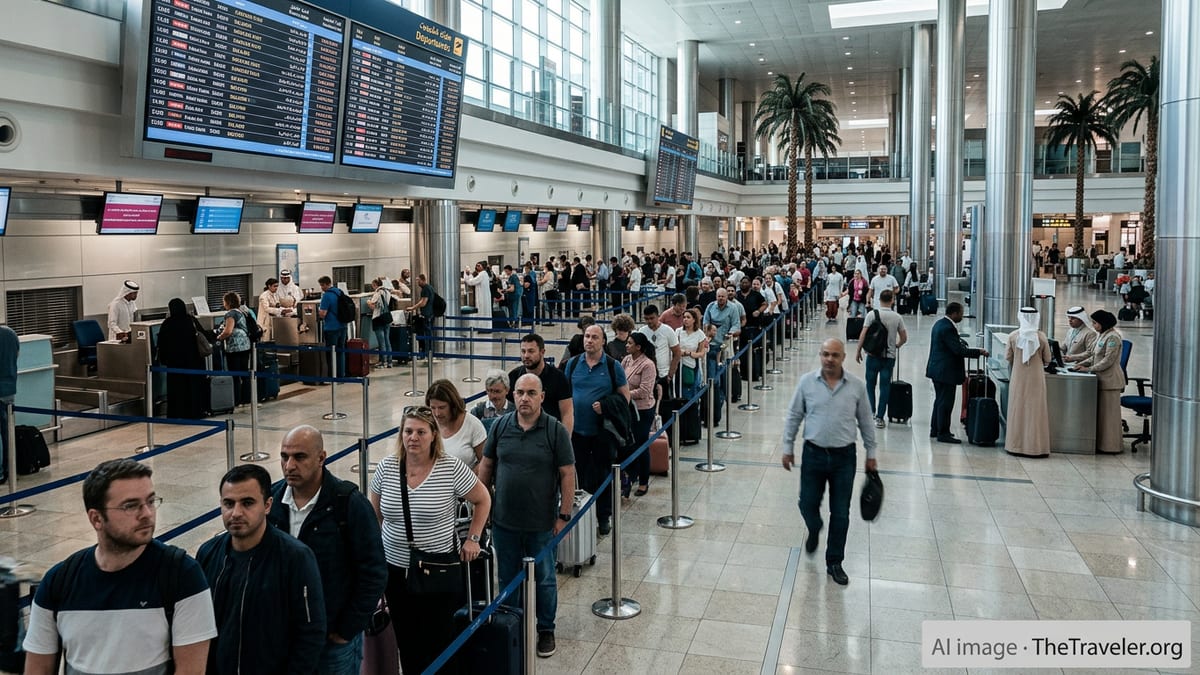
Travel forums and passenger accounts from flights in the week leading up to March 15 describe busy but orderly terminals, with longer queues at check in and transfer desks as travelers seek alternative routings. Some report being automatically rebooked onto later departures or different connection points, sometimes only a few hours before scheduled departure, highlighting the value of monitoring airline apps and email closely throughout travel day.
At the same time, airports are maintaining additional security measures and contingency procedures introduced when the crisis began. Passengers can expect multiple document checks, occasional re-screening at transfer points, and controlled access to certain concourses or lounges. These steps add friction to the journey but are being kept in place while regional risk assessments remain elevated.
Delays, Cancellations and How Rebooking Is Being Handled
Reports from airline advisories, travel compensation platforms and passenger experiences suggest that most major carriers serving the UAE are offering flexible handling for trips affected by the current disruption. Where flights are canceled, travelers are typically being offered free rebooking on the next available service, rerouting via alternative gateways, or refunds according to each airline’s disruption policy.
In many cases, rebooking options are constrained by limited seat availability and tight airspace windows, meaning that a canceled March 15 flight may be shifted by 24 hours or more rather than to another same day departure. Some European and Asian airlines have temporarily suspended certain Dubai or Abu Dhabi services altogether, compelling travelers to move onto partner carriers or connect via different hubs. These structural changes can increase total journey time significantly, especially for long haul itineraries involving multiple connections.
Travel assistance providers note that call centers and online chat channels remain under heavy load, with hold times stretching well beyond normal levels at peak moments. Digital self-service tools such as airline mobile apps are playing a central role in managing changes, allowing many passengers to accept new itineraries or search alternative dates without waiting for an agent. However, travelers report that inventory displayed online can shift rapidly as thousands of people across regions attempt to rebook at the same time.
For those already en route and connecting through the UAE on March 15, airport transfer desks are a crucial resource. Published guidance and traveler reports suggest that passengers with missed connections are typically being reprotected automatically, but that visiting the airline desk in person can help clarify new boarding passes, baggage handling and any hotel or meal support when overnight stays become necessary.
Practical Steps to Minimize Hassle on March 15
Publicly available travel advisories and airport communications consistently stress that passengers should not go to the airport on March 15 unless their flight is clearly confirmed as operating. Checking flight status repeatedly in the 24 hours before departure via official airline channels is described as the single most important step travelers can take, given that operational decisions are still being made close to departure time.
For those with flexible plans, travel specialists recommend considering voluntary changes away from March 15 and the surrounding days, particularly for nonessential trips or complex itineraries involving multiple carriers. Moving travel to later in March, once there is more clarity on airspace access and schedule stability, can reduce the risk of extended layovers or unexpected overnight stays.
Passengers who must travel on March 15 are advised in public guidance to build in additional buffers. That includes arriving earlier at the airport than on a normal day, ensuring adequate connection times between flights, and preparing for the possibility of several extra hours in transit. Carrying essential medications, chargers and a small change of clothes in hand luggage can help mitigate the impact of missed bags or forced overnight stops.
Travel insurance also plays a role, although policies vary widely. Some advisory materials note that coverage for disruptions linked to war or geopolitical events may be limited or excluded, while others may offer compensation for delays, missed connections or additional accommodation costs. Travelers are urged to review policy wording carefully and retain documentation such as cancellation notices, boarding passes and receipts in case claims are possible later.
Key Considerations for Rebooking, Refunds and Future Travel
For many March 15 passengers, the most pressing decisions involve whether to accept an airline-proposed rebooking, request a different routing, or cancel altogether. Consumer travel guidance suggests first clarifying what the operating carrier is formally offering; in many cases, accepting a like-for-like new date or route will be the fastest way to secure a seat out of the region, even if the timing is not ideal.
Where schedules remain uncertain several days out, some travelers are opting for reroutes that avoid the most affected air corridors, even if that means backtracking or adding a stop. Public fare data indicates that alternative routings via more northerly or southerly hubs can sometimes offer more predictable operations, though often at higher prices or with limited remaining availability for March departures.
Looking beyond March 15, published industry analysis expects a gradual normalization of Gulf aviation once airspace restrictions ease, but notes that full schedule restoration could take weeks. Aircraft and crew rotations will need time to stabilize, and airlines may permanently adjust some route networks or frequencies in response to new risk assessments and demand patterns. Travelers booking for later in March and April are likely to see more reliable schedules but should still monitor updates closely.
For now, the clear message across official advisories, airline communications and on-the-ground traveler reports is that flexibility is essential. Anyone flying to, from or through the UAE on March 15 should expect a higher than usual chance of disruption, stay closely connected to their airline’s updates, and be prepared to adapt plans quickly as the regional aviation picture continues to evolve.