

More news on this day
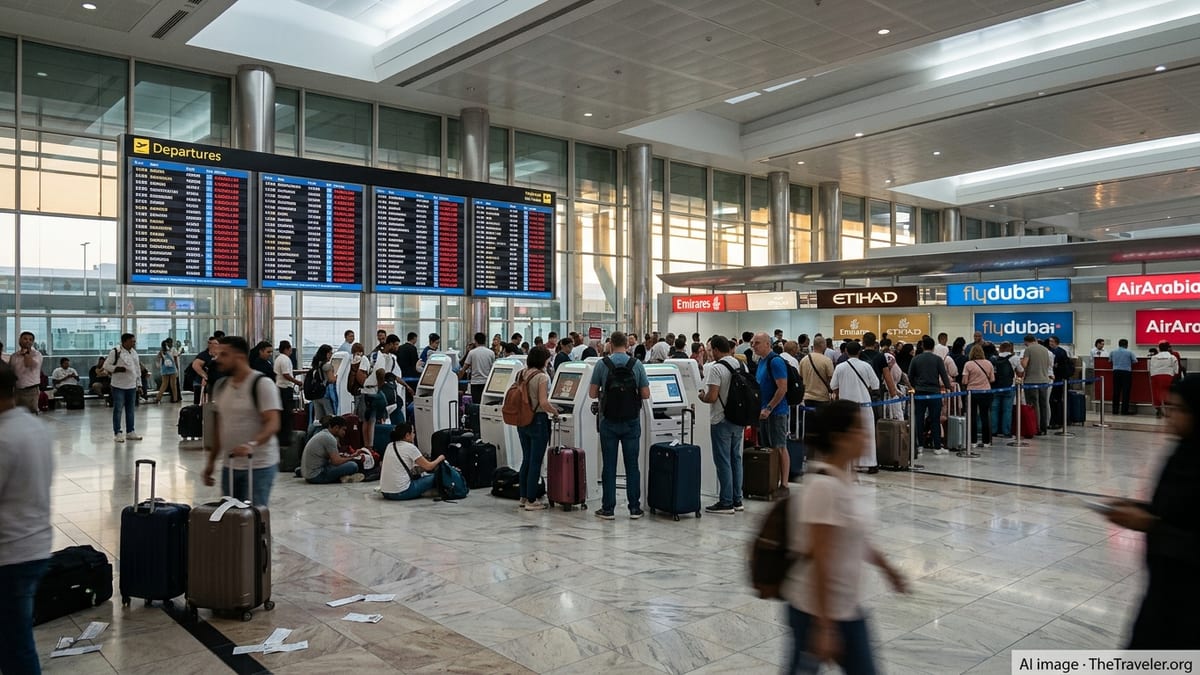
UAE-based airlines are grappling with a new wave of flight disruptions, with publicly available information indicating that Emirates, Etihad Airways, Flydubai and Air Arabia have canceled or curtailed more than 70 services across Europe, the Middle East, Africa and South Asia, disrupting travel to cities including Paris, Munich, Cairo, Hyderabad, Mumbai and Doha.
Get the latest news straight to your inbox!
Regional Tensions Keep Pressure on UAE Airspace
The latest schedule changes come in the wake of ongoing regional instability and intermittent airspace restrictions affecting several Middle East corridors. Aviation bulletins and airport notices for late February and early March 2026 show that key hubs such as Dubai International, Zayed International in Abu Dhabi and Sharjah International have been operating on heavily reduced commercial schedules, interspersed with short windows of limited flight activity.
Industry analyses of traffic data indicate that airspace closures linked to the wider regional conflict have triggered thousands of cancellations across Gulf gateways, with UAE carriers forced to repeatedly adjust operations day by day. Although some exceptional and repatriation services have been permitted, the overall pattern remains one of disruption, with short-lived resumptions often followed by fresh suspensions.
For the UAE’s four main airlines, this environment has translated into rolling waves of timetable changes, including same-day cancellations, last-minute aircraft repositioning and one-off relief flights designed to move stranded passengers out of the region when safe corridors become available.
Emirates Trims Network While Adding Targeted Repatriation Flights
Dubai-based Emirates has been at the center of the disruption, as Dubai International is one of the world’s busiest long-haul hubs. Public travel advisories and airline communications show that, following a suspension of regular scheduled operations, the carrier has been progressively introducing a limited list of flights to and from Dubai, primarily focused on major cities that can act as onward gateways for stranded passengers.
Recent operational updates shared with customers detail specific Emirates services operating as part of these constrained schedules, including flights between Dubai and Paris, Munich, Cairo, Hyderabad and Mumbai. These flights have typically been run at reduced frequency, with some aircraft operating in one direction with few or no passengers in order to position crews and equipment before returning to Dubai with travelers who have been waiting to leave the UAE.
Despite these targeted services, traveler reports and booking records indicate that well over 70 Emirates flights have been canceled or heavily modified during the disruption period, affecting both long-haul and regional routes. Many passengers booked on departures beyond the initial suspension dates have received short-notice cancellation messages or rebooking offers as the airline tries to balance safety constraints with the need to restore parts of its global network.
Emirates’ approach so far appears to prioritize customers whose original flights were canceled in the early days of the crisis, with subsequent seat availability for new bookings remaining extremely limited on the most in-demand sectors.
Etihad, Flydubai and Air Arabia Face Similar Constraints
Abu Dhabi-based Etihad Airways has also implemented extensive cancellations, keeping the majority of scheduled commercial flights to and from Zayed International Airport suspended while gradually introducing a small number of exceptional operations. Public statements and travel-industry summaries describe a pattern of limited departures to key cities such as Paris, Cairo, Mumbai and other strategic destinations, typically framed as repositioning, cargo or repatriation flights rather than a full commercial restart.
Flydubai, Dubai’s low-cost carrier, has maintained only a fraction of its usual network. Flight-status boards and passenger accounts suggest that many of its short- and medium-haul services around the Gulf, to South Asia and to parts of Eastern Europe have been dropped or consolidated. Routes that normally see multiple daily frequencies have, in some cases, been reduced to one or two tentative flights over several days, subject to last-minute changes.
Sharjah-based Air Arabia has adopted a similarly cautious posture. Travelers booked on Air Arabia’s services into and out of the UAE, including flights connecting to secondary cities in the Middle East and South Asia, have reported cancellations and rolling rebookings as the airline adjusts to evolving airspace permissions. The cumulative impact across Etihad, Flydubai and Air Arabia adds dozens of additional cancellations to the tally already recorded by Emirates, reinforcing the overall assessment that more than 70 UAE-operated flights have been directly affected in the current phase of disruption.
Key Routes Impacted: Paris, Munich, Cairo, Hyderabad, Mumbai and Doha
Analysis of partial schedules, airport departure boards and traveler reports indicates that several high-profile routes have been repeatedly reshaped during the disruption. Emirates’ links from Dubai to Paris and Munich, both critical gateways for European connections, have operated on sharply reduced frequencies, interspersed with cancellations and one-off repatriation-style services. Similar patterns are visible on flights to Cairo, where demand from stranded travelers has remained high even as capacity has been constrained.
In South Asia, routes to Hyderabad and Mumbai have been particularly affected. Multiple travelers holding tickets on UAE carriers for departures between early and mid-March have reported a sequence of cancellations and schedule changes, with some eventually moved onto limited relief flights and others offered dates several days later than originally planned. The irregular operation of these services has had knock-on effects for connecting passengers bound for North America, Europe and Australasia.
Doha and other Gulf destinations have also seen significant adjustment, both because of their proximity to affected airspace and their usual role as short-haul connectors into the UAE’s long-haul networks. While some carriers in the region have been able to operate select services via designated safe corridors, the overall pattern remains one of constrained capacity and unpredictable timings on routes that would typically see extensive daily traffic.
Stranded Passengers, Limited Options and a Slow Path to Recovery
The disruption has left tens of thousands of travelers struggling to rearrange plans. Accounts shared via travel forums and social platforms describe crowded airport terminals, long waits to reach call centers and rapidly shrinking inventories of alternative flights on other carriers. Fares on remaining routes through less-affected hubs have in many cases risen sharply, reflecting demand from passengers attempting to bypass the Gulf entirely.
Publicly available guidance from airlines and travel advisers consistently encourages passengers not to travel to the airport without confirmed rebooking details, and instead to monitor flight-status tools and official channels. At the same time, some travelers who did secure seats on newly scheduled services out of Dubai and Abu Dhabi report being advised to arrive early and be prepared for further delays or gate changes.
While there are indications that UAE airports and carriers are working toward a broader resumption of normal operations, industry commentary suggests that recovery is likely to be gradual rather than instantaneous. Restoring a complex global network after such extensive disruption requires the careful repositioning of aircraft and crews, the clearing of backlogs of stranded passengers and the revalidation of airspace routes.
For now, the latest developments point to a fragile but slowly improving situation: more routes are appearing on departure boards each day, yet cancellations and ad hoc changes continue to affect travel plans across Paris, Munich, Cairo, Hyderabad, Mumbai, Doha and many other destinations tied into the UAE’s major aviation hubs.