

More news on this day
Drone and missile strikes linked to the widening Iran conflict are disrupting air and sea traffic across the United Arab Emirates, with suspended flights, port slowdowns and emergency security measures underscoring the region’s growing vulnerability as a global transport and energy crossroads.
Get the latest news straight to your inbox!
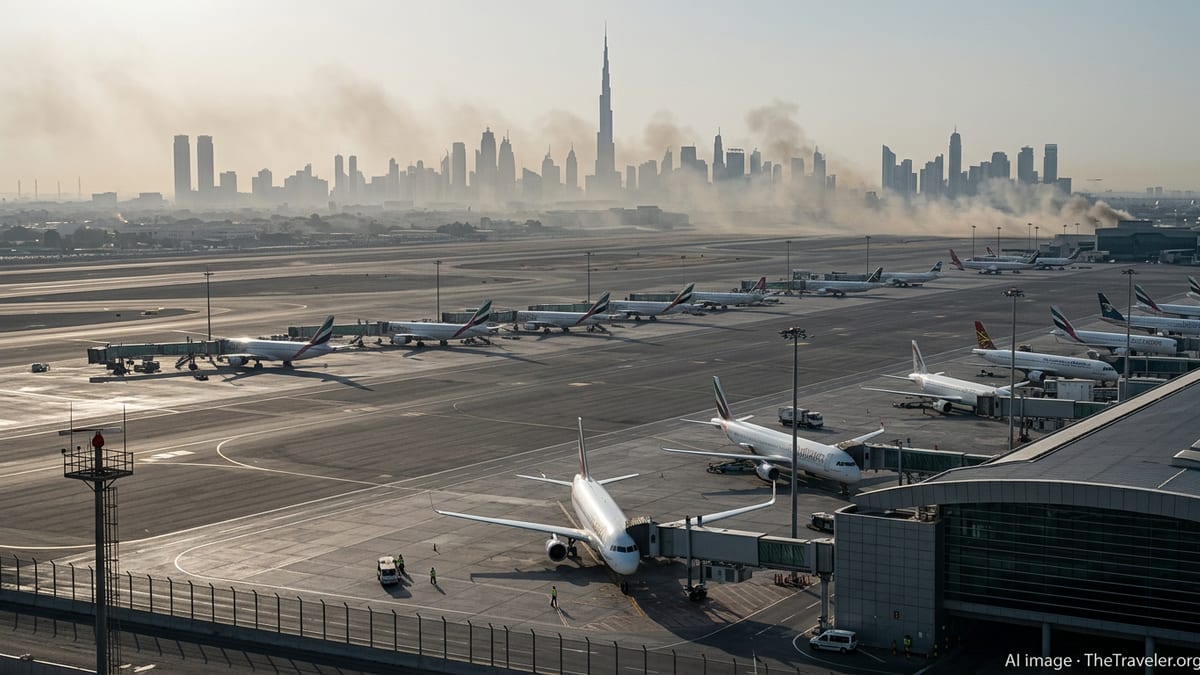
Drone and Missile Barrages Test UAE Defences
Since late February 2026, publicly available information shows that Iranian forces have launched repeated waves of ballistic missiles and armed drones toward targets in the UAE, including major cities, oil facilities and critical logistics hubs. Regional monitoring groups and open-source tallies indicate that hundreds of projectiles have been fired in retaliation for United States and Israeli strikes on Iranian infrastructure.
UAE air defence systems, supported by allied assets, have intercepted the vast majority of incoming weapons, limiting direct damage to key infrastructure. Nonetheless, debris from downed drones and missiles has caused fires and localized destruction in several locations, illustrating the challenge of protecting dense urban and industrial areas even when interception rates are high.
Coverage in regional and international media describes incidents ranging from drone fragments striking residential towers in Dubai to fires at energy sites and industrial facilities. These events have reinforced perceptions that the UAE, long marketed as a safe and stable gateway between East and West, now sits uncomfortably close to an evolving front line.
Analysts cited in think‑tank reports argue that the tempo and geographic spread of the attacks represent a significant escalation compared with previous episodes of missile and drone activity in the Gulf, increasing pressure on both local defence networks and international partners.
Airports Curtail Operations as Airlines Reroute
Dubai International Airport and Abu Dhabi’s main hub, two of the world’s busiest long-haul gateways, have faced intermittent suspensions and emergency procedures as drone and missile alerts intensified. Open-source aviation advisories and airport statements show that commercial flights were curtailed or halted at several points in early March, with operations resuming only gradually under tightened security protocols.
Travel industry coverage indicates that multiple global carriers have temporarily suspended services to the UAE or sharply reduced frequencies, citing security assessments and evolving airspace restrictions across the wider Gulf. Some airlines have rerouted long-haul services around the Arabian Peninsula, adding hours to flight times between Europe, Asia and Africa and increasing fuel and crew costs.
Partial reopenings have been managed through emergency corridors, with priority given to repatriation flights and essential cargo operations. Passenger access to terminals has been restricted at times to ticketed travellers only, while travellers are being advised to check flight status repeatedly as schedules change on short notice.
Safe-airspace mapping platforms show that portions of Gulf airspace remain classified as high-risk, prompting additional diversions and heightening uncertainty for carriers based in the region. Aviation analysts warn that prolonged disruption could erode the competitive position of UAE hubs that have long relied on seamless connectivity and rapid transfer times.
Ports Slow or Halt Operations Amid Security Alerts
Alongside aviation turmoil, maritime traffic through key UAE ports has also come under pressure. Publicly available risk advisories describe sharply reduced vessel movements through the Strait of Hormuz and more cautious approaches to major container and oil terminals as operators respond to the threat of further strikes.
Reports on regional shipping note that Fujairah, Jebel Ali and other ports have faced heightened security alerts, with at least one facility experiencing a fire after drone debris struck an oil-related site. In some cases, insurers and shipping companies have imposed temporary halts or severe restrictions on port calls, effectively slowing or suspending commercial operations until the threat picture becomes clearer.
Maritime briefings circulated to shipowners describe traffic through the Strait of Hormuz as substantially below normal, with many tankers and container vessels delaying transits or rerouting via longer, more costly passages. These diversions are adding to freight rates and complicating logistics for energy importers and exporters that depend on Gulf shipping lanes.
Energy market commentary highlights that even without a formal closure of any waterway, the perceived risk to tankers, export terminals and bunkering hubs is already feeding into price volatility and renewed concern about the security of global oil supplies.
Economic Fallout for Tourism, Trade and Logistics
The UAE’s rapid rise as a global travel and logistics powerhouse has depended on uninterrupted connectivity, predictable schedules and a reputation for safety. The current wave of drone and missile incidents is testing those assumptions. Travel and business press coverage points to a sharp, if uneven, fall in tourist arrivals, with holidaymakers and conference organizers deferring trips or shifting events to alternative destinations.
Hotel and hospitality operators in Dubai and Abu Dhabi are beginning to report higher cancellation rates and softer forward bookings, particularly from long-haul markets where news of airspace closures and drone strikes has dominated headlines. Travel agencies are fielding questions about safety, insurance coverage and contingency plans, adding a layer of complexity to trip planning.
The disruptions are also rippling through cargo and logistics chains. Freight forwarders quoted in trade publications describe delays in time-sensitive shipments, from electronics and fashion to pharmaceuticals and express parcels, as flights are consolidated or rerouted and port calls adjusted. For multinational firms that have based regional distribution centres in the UAE, contingency planning now includes dual-hub strategies and greater inventory buffers.
Financial analysts warn that if heightened risk persists, the cost of capital and insurance for aviation, shipping and energy projects in the Gulf could rise, potentially slowing investment in large-scale infrastructure that underpins the UAE’s diversification strategy.
Escalating Regional Tensions and Diplomatic Pressures
The attacks on UAE territory are unfolding against the backdrop of a wider conflict involving Iran, the United States, Israel and several regional actors. According to published coverage, Iran has framed its barrage of drones and missiles as retaliation for strikes on its own territory and energy infrastructure, while Gulf states seek to avoid being drawn directly into sustained hostilities.
Policy analysts note that the UAE is attempting a careful balancing act: maintaining security cooperation with Western partners and regional allies, while signaling a desire to de-escalate and protect its role as a neutral commercial hub. Statements carried by state-linked media outlets emphasize defensive measures and humanitarian corridors, while also stressing the importance of keeping global trade routes open.
Think‑tank assessments suggest that prolonged aerial threats to airports, ports and industrial zones could accelerate regional discussions on new security architectures, including more integrated air and missile defence networks among Gulf Cooperation Council members. At the same time, the strikes have spurred debate over the vulnerability of high‑tech investments, data centres and planned artificial intelligence campuses that were expected to anchor the Gulf’s next phase of growth.
For travellers, shipping companies and investors, the situation remains fluid. While UAE infrastructure has so far shown resilience, the combination of suspended flights, port disruptions and intensifying regional tensions is reshaping risk calculations in a part of the world that has long marketed itself as a safe and seamless bridge between continents.