

More news on this day
Security-driven suspensions and sharp reductions in foreign airline operations at Dubai International Airport are triggering a cascading emergency for stranded tourists, as governments from the United Kingdom to China, Germany, Canada, France, the United States and Thailand scramble to move their nationals out of the wider Gulf region.
Get the latest news straight to your inbox!
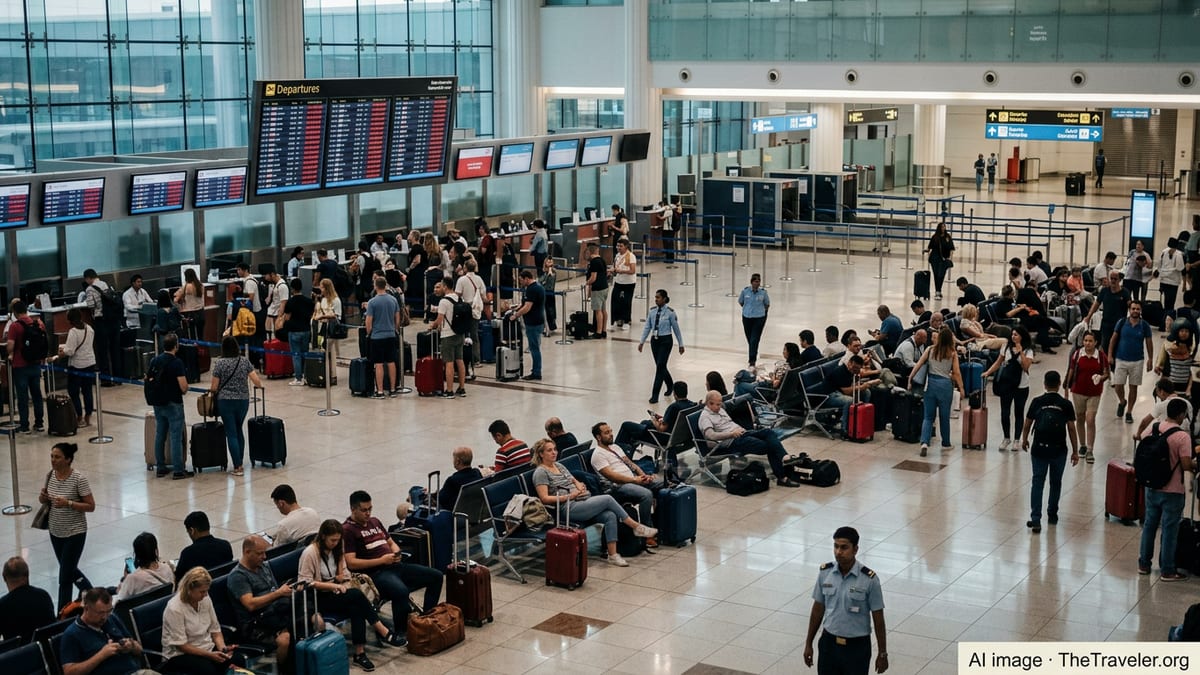
Security Crisis Shuts Down a Key Global Hub
Dubai International Airport, one of the world’s busiest aviation hubs, has seen foreign airline operations dramatically curtailed after a series of security incidents linked to the ongoing regional conflict between Iran and a United States–Israel alliance. Publicly available information indicates that airspace closures and missile and drone attacks have forced the United Arab Emirates to suspend large parts of normal commercial traffic, with flights repeatedly halted or reduced to limited emergency and repatriation services.
Reports from regional media and international outlets describe how a drone strike on fuel facilities near Dubai International on 16 March ignited a fire and led to an abrupt suspension of most flight operations. Earlier in March, airspace restrictions across multiple Middle Eastern countries had already triggered days of cancellations and diversions, leaving aircraft and passengers out of position and creating severe congestion at alternative airports.
While UAE authorities have gradually allowed some movements to resume at Dubai International and Al Maktoum International Airport during brief windows, the overall pattern remains one of sporadic openings and renewed suspensions. Travelers are being told through airline advisories not to approach airports without confirmed digital itineraries, as terminals struggle with crowding and constrained security procedures.
Stranded Tourists From the UK, Europe, North America and Asia
The disruption in Dubai is having global consequences because of the airport’s central role in connecting Europe, Asia, Africa and the Americas. Airlines based in the UAE and partner carriers in Europe and Asia have traditionally used Dubai as a major transfer point, meaning that suspensions there have immediately rippled outward to routes involving China, Germany, Canada, France, the United States, Thailand and beyond.
Travel accounts and media coverage from early March describe thousands of tourists stuck in Dubai, Abu Dhabi, Doha and other regional hubs as flight after flight was cancelled. British travelers have reported being told they may be stranded for up to a week, with only a handful of seats opening on occasional long-haul departures to London and other European cities. Similar situations are being described by passengers from Germany, France and Canada who were either transiting through or trying to depart the UAE when airspace restrictions tightened.
Asian routes have also been heavily affected. Reports from Gulf-based news outlets and online travel forums note that flights linking Dubai with major Chinese cities such as Beijing, Shanghai and Guangzhou have been reconfigured to prioritize repatriation needs. Tourists from Thailand and other Southeast Asian destinations have seen their usual itineraries via Gulf hubs disrupted, forcing last-minute rebookings through alternative airports where capacity is already stretched.
Governments Launch Emergency Repatriation Efforts
With commercial schedules in disarray, governments around the world are increasingly treating the situation as an emergency consular challenge. Public travel advisories and policy notices show that countries including the United Kingdom, United States, Canada, Germany, France, China and Thailand have activated crisis mechanisms that were more commonly associated in recent years with pandemic-era border closures and regional conflicts.
In the United Kingdom, Foreign, Commonwealth & Development Office updates and media summaries indicate that officials are prioritizing vulnerable travelers for the limited number of seats available on flights from Abu Dhabi and Dubai to London. Some of these seats are being secured on regular commercial services operating under special clearances, with a focus on families, older passengers and those with pressing medical needs.
North American and European partners appear to be adopting similar approaches. Publicly available information compiled by international organizations shows that Canada, Germany and France are working with airlines to identify stranded tourists and to funnel them onto any viable departures from the UAE or nearby states, while also warning citizens that options may remain limited for days at a time. The United States has shifted emphasis toward advising travelers on safe sheltering, alternative routing and the likelihood of sudden changes in airport status.
Asian governments are likewise responding. Coverage in regional media indicates that China has adjusted some services between Gulf hubs and major Chinese cities to support nationals seeking to leave the region, while Thai authorities are monitoring the impact on tourists returning from popular destinations such as the UAE itself and onward points like Europe and North America that are often reached via Dubai.
Alternative Routes, Land Corridors and Secondary Airports
As Dubai’s capacity remains constrained, attention is turning to alternative ways of moving tourists out of the region. Travel advisories and on-the-ground reports highlight the growing use of secondary airports in the Gulf, such as Abu Dhabi’s Zayed International and Fujairah International, as well as routes that involve transiting via Oman or Saudi Arabia, where some airspace and airport facilities have remained partially available.
Accounts circulating through travel communities describe buses and private transfers carrying stranded passengers from the UAE to airports in neighboring countries, where they can board long-haul flights to Europe, North America or Asia. Some travelers have reportedly used land crossings into Saudi Arabia to continue journeys toward connecting hubs such as Riyadh, while others have diverted via Muscat in Oman to access still-operating routes.
However, these alternatives are constrained by limited capacity and heightened security checks. Airlines are prioritizing passengers who have been stuck the longest or who face particular vulnerabilities, and governments are cautioning that overland travel may involve long waiting times at border posts and checkpoints. Tourists are being urged, via public information channels, to remain in communication with their airlines and consular services rather than attempting to move independently without confirmed onward transport.
Uncertain Timeline and Guidance for Future Travelers
The timeline for a full restoration of normal foreign airline operations at Dubai International remains unclear. Aviation and security analysts quoted in published coverage suggest that further disruptions are possible as long as missile and drone risks persist in the wider region and airspace restrictions remain under review. Airlines are scheduling only limited services and frequently updating their plans as conditions evolve.
For travelers yet to depart for the UAE or for itineraries transiting Dubai, current guidance from airline notices and government travel pages emphasizes caution and flexibility. Prospective passengers are being advised to avoid nonessential travel through the Gulf, to monitor booking portals closely for changes, and to keep contingency plans for rerouting via alternative hubs in Europe or Asia if necessary.
Tourism stakeholders warn that the impact will extend beyond the immediate emergency. Dubai’s role as a global stopover destination means that tour operators, hotels and attractions face a sharp, if temporary, slowdown, even as authorities and airlines work to bring stranded tourists home. Until security conditions stabilize and airspace fully reopens, the experience of those currently stuck in or around the UAE is likely to shape traveler perceptions and planning for months to come.