

More news on this day
Thousands of travelers across the Middle East and beyond are facing days of disruption after Iranian strikes on Gulf targets prompted sudden airspace closures over the United Arab Emirates, forcing Emirates and Etihad to divert or suspend flights serving Dubai and Abu Dhabi, snarling global schedules at two of the world’s busiest hubs.
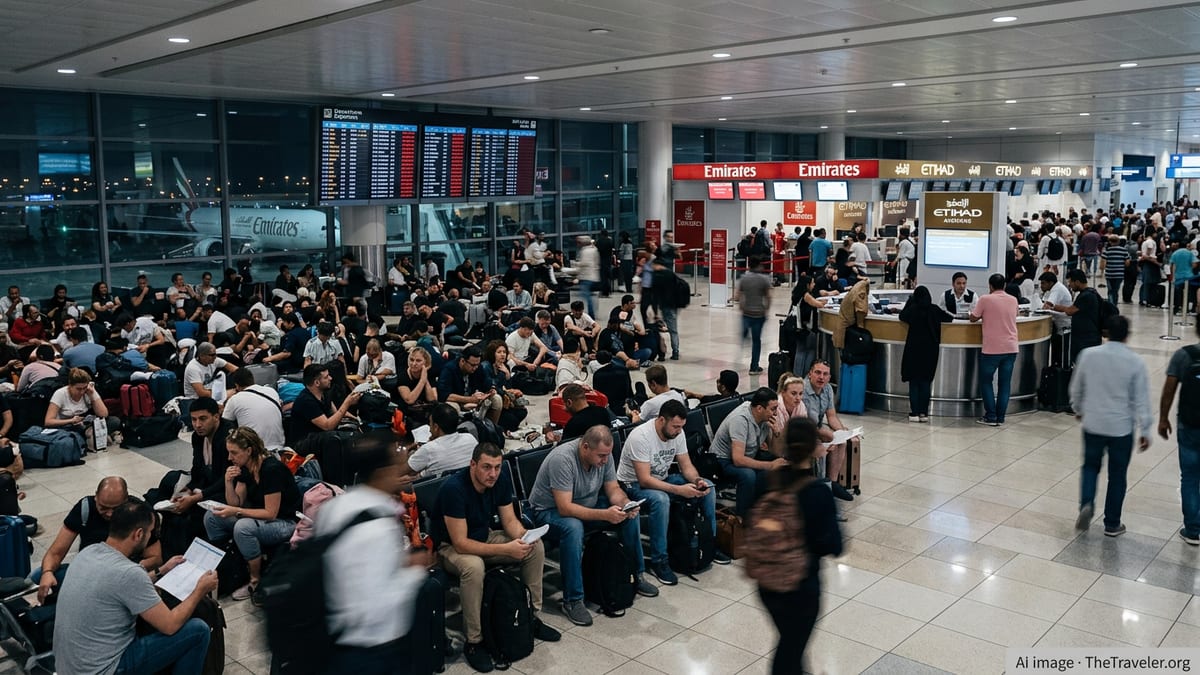
Airspace Closures Turn Gulf Hubs Into Gridlock
The crisis began over the weekend, when Iran launched a wave of strikes across the Gulf in response to United States and Israeli attacks, with missiles and drones targeted at military facilities and key infrastructure in and around major cities, including Dubai and Abu Dhabi. As fragments from intercepted drones fell near runways and terminal areas, UAE authorities moved quickly to shut airspace to commercial traffic as an exceptional precautionary measure.
Within hours, the United Arab Emirates announced a temporary and partial closure of its airspace, effectively pausing most operations at Dubai International, Dubai World Central Al Maktoum, Abu Dhabi’s Zayed International and Sharjah International. Flights already en route were diverted to airports as far away as Muscat, Riyadh, Jeddah and Larnaca, turning these secondary gateways into ad hoc relief hubs as pilots burned extra fuel to skirt newly declared danger zones.
By Sunday, regional flight tracking data showed thousands of cancellations and diversions across at least seven major Middle East airports, including Dubai and Abu Dhabi, as carriers from Europe, Asia and North America abandoned their usual Gulf transit corridors. Analysts described the co ordinated shutdown as one of the most significant interruptions to UAE commercial aviation since the early months of the pandemic.
Authorities later confirmed that debris from the strikes caused damage at Zayed International in Abu Dhabi and that one person had died at the facility. Officials stressed that safety would remain the overriding factor in any decision to reopen airspace, even as the economic cost to a country where aviation underpins a large share of GDP rapidly mounted.
Emirates and Etihad Forced Into Emergency Rerouting
For Emirates and Etihad Airways, the airspace closures amounted to a sudden grounding of their hub and spoke systems. Emirates, based at Dubai International, initially halted all flights to and from the city, citing multiple regional airspace closures and warning that the situation was highly dynamic. Passengers were urged not to travel to the airport unless they received direct confirmation that their flight would operate.
Etihad, operating out of Abu Dhabi, followed suit, suspending scheduled departures and arrivals while it assessed conditions with UAE civil aviation authorities. The airline emphasised that any movements would be strictly limited to repositioning, cargo and select repatriation services operating under tight safety approvals. Regular commercial flights to and from Abu Dhabi were extended as suspended until at least Wednesday afternoon, with the possibility of further delays.
On Monday, a trickle of aircraft began to move again. Flight tracking services showed a small number of Emirates flights departing Dubai to core markets in India and other parts of Asia, while Etihad aircraft lifted off for cities such as London, Amsterdam, Paris, Moscow, Karachi and Mumbai. Many of these operations ran with restricted passenger loads or no paying passengers at all, designed primarily to reposition aircraft and crew and to create capacity for structured repatriation efforts.
Despite these movements, both airlines maintained that the vast majority of their scheduled networks remained on hold. With key nearby airspace segments over Iran, Iraq and parts of the Gulf still constrained, planners faced complex rerouting decisions that added significant flight time, fuel burn and crew duty complications to any potential restart.
Stranded Passengers Face Long Delays and Patchy Communication
Inside terminals and in airport hotels from Dubai to Doha and beyond, the human impact of the shutdown quickly became visible. Tens of thousands of passengers, many of them relying on the UAE as a transit point between Europe, Asia, Africa and Australasia, suddenly found their journeys frozen mid itinerary. With departure boards showing waves of red cancellations, families and business travelers queued at transfer desks hoping for rerouting, vouchers or at least clear information.
UAE airports and airlines scrambled to implement welfare plans, arranging hotel accommodation, meal vouchers and rebooking options for affected customers. However, the speed and scale of the closures left many travelers reporting long waits for updates and customer service lines overwhelmed by calls. With official guidance urging people not to arrive at airports without confirmed flights, some stranded passengers chose to remain in nearby hotels rather than risk further uncertainty in packed departure halls.
Travelers connecting from India and Southeast Asia to Europe appeared among the hardest hit, reflecting the central role Dubai and Abu Dhabi play as bridge points between the two regions. Some European carriers that would normally route through the Gulf opted to cancel services entirely or route via alternative hubs such as Istanbul or Athens, stretching already tight global capacity and complicating rebooking options.
Governments with large numbers of nationals transiting the UAE began exploring contingency plans. In the United Kingdom, officials discussed arranging special services via Muscat to bring stranded citizens home from Dubai and Abu Dhabi, while other countries signalled they would work with Gulf carriers on organised repatriation flights once safety conditions allowed.
Limited Resumption Offers Hope but Uncertainty Lingers
By late Monday, the UAE’s main airports confirmed they would resume only a limited number of services, tightly coordinated with civil aviation regulators and military authorities. Dubai Airports announced that a small slate of outbound and inbound flights would operate from both Dubai International and Al Maktoum International, while Abu Dhabi Airports said operations had partially resumed with a reduced schedule.
Emirates and flydubai each outlined a narrow list of flights they planned to operate, focusing on routes that would help repatriate stranded travelers, including services to major Indian cities and select destinations in Russia and Pakistan. Sharjah based Air Arabia and Doha’s Qatar Airways, both heavily affected by regional airspace closures, also signalled that they would keep most services grounded until at least Tuesday as they assessed risk and received updated guidance from aviation authorities.
Even with the first departures taking off, officials and airline executives warned that it could take days to unwind the backlog of stranded passengers and reposition aircraft around the world. Analysts noted that some long haul carriers may choose to avoid the Gulf corridor entirely for an extended period, instead flying longer routes over the Mediterranean, North Africa or the Indian Ocean to keep clear of the conflict zone.
For now, travelers holding tickets through Dubai, Abu Dhabi, Doha or other regional hubs are being advised to monitor airline advisories closely, keep their contact details updated with carriers and avoid setting off for the airport until they receive explicit confirmation that their flights will operate.
Global Aviation Braces for Longer Term Fallout
Behind the immediate scramble to move stranded passengers lies a deeper concern for the aviation industry: the possibility that heightened tensions between Iran and its adversaries could drag on, keeping some of the world’s busiest and most strategically important air corridors in flux for weeks. The Gulf airspace sits at the crossroads of Europe to Asia and Africa to Asia traffic, and any prolonged disruption pushes airlines into longer and more expensive routing patterns.
Industry analysts warn that each additional hour of flying time on a wide body jet translates into sharply higher fuel consumption, crew costs and maintenance demands. With oil prices already climbing in response to the conflict, the combined effect could squeeze airline margins and eventually filter through to higher fares for passengers, particularly on routes between Europe, South Asia and Australasia that have traditionally relied on efficient Gulf hubs.
Insurance is another pressure point. War risk premiums typically surge in periods of conflict, especially when civilian infrastructure such as airports, ports and hotels are targeted or damaged. Carriers operating near the affected region may face tighter coverage terms and higher deductibles, adding further cost to any decision to maintain or restore flights through the Gulf corridor.
For the UAE, which has built much of its global profile on being a safe, efficient and politically stable transit hub, the current turmoil represents a stark test. Aviation accounts for a significant share of Dubai’s economy, and both Dubai and Abu Dhabi rank near the top of global traffic league tables. How quickly and confidently travelers and airlines return to routing through the Emirates will depend not only on the restoration of airspace but on whether the latest confrontation between Iran, the United States and Israel settles into a tense stalemate or escalates into a more sustained conflict.