

More news on this day
As the United Arab Emirates continues to recover from late-February missile and drone strikes that disrupted one of the world’s busiest aviation hubs, passengers flying on March 14, 2026, are navigating a patchwork of limited schedules, evolving airline rebooking rules, and heightened regional travel advisories.
Get the latest news straight to your inbox!
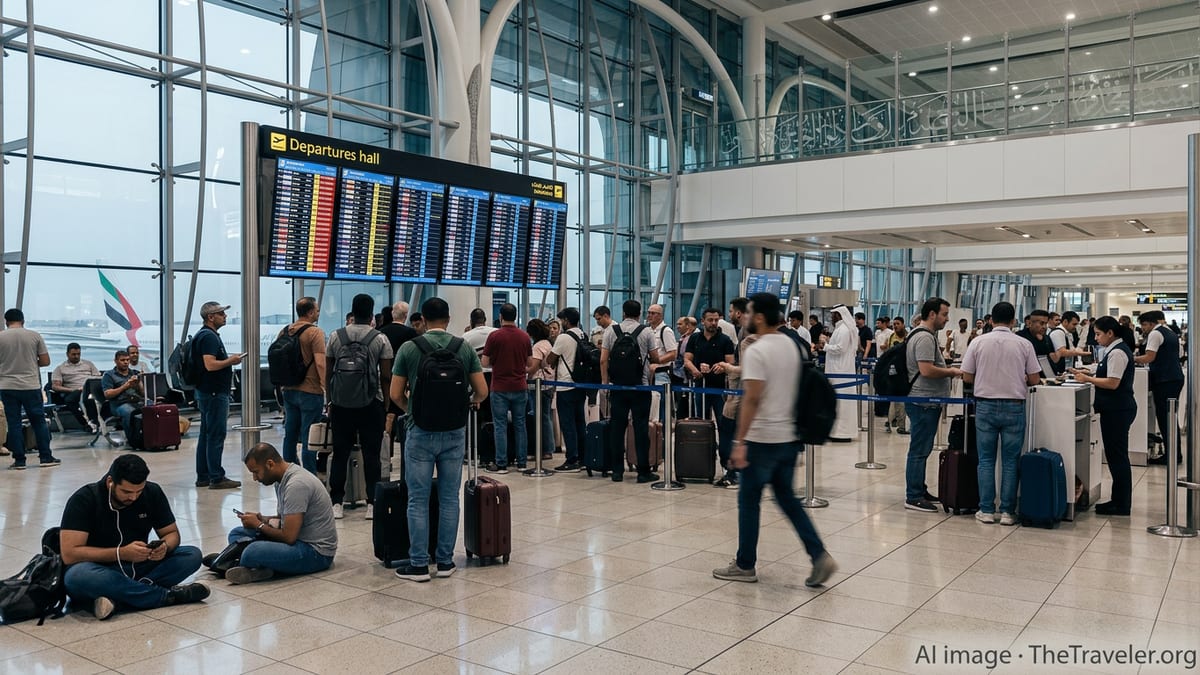
Where UAE Flight Operations Stand on March 14
Publicly available data and recent aviation coverage indicate that flight operations at Dubai International and Abu Dhabi International remain below normal capacity on March 14, even after a gradual reopening of regional airspace earlier this month. Emirates and Etihad have restored portions of their long-haul and regional networks, while flydubai and Air Arabia are rebuilding point-to-point services from Dubai and Sharjah. Despite this progress, schedules are still heavily adjusted, with many flights retimed, consolidated, or operating only several days per week rather than daily.
Reports from regional travel outlets show that UAE carriers sharply ramped up flying from around March 6 to March 11, but they are still short of pre-crisis levels. One recent analysis cited hundreds of daily departures by the four main UAE airlines, yet those figures remain well below typical March traffic for Dubai and Abu Dhabi at this time of year. International carriers serving the UAE are even more constrained, with a number of European and Asian airlines continuing partial or full suspensions of Dubai services due to ongoing security and overflight concerns.
Travel industry advisories describe a fragmented picture across the wider Middle East, with some neighboring states maintaining stricter airspace closures and rerouting policies. This has knock-on effects for flights connecting through the Gulf to Europe, Asia, and Africa. Passengers with itineraries that involve multiple regional connections are particularly exposed to last-minute changes, overnight delays, or unplanned stopovers while airlines seek safe and approved flight paths.
For travelers departing or arriving on March 14, the practical reality is that many flights are operating, but few are operating exactly as originally scheduled. Same-day status checks remain essential, and airports in the UAE are still urging passengers to arrive only with a confirmed, operating booking rather than turning up in the hope of on-the-spot rebooking.
Emirates, Etihad, Flydubai, and Air Arabia: What Rebooking Really Looks Like
Guidance from airline advisories and recent media coverage shows that UAE carriers have introduced temporary rebooking policies tied to the airspace crisis, with eligibility windows that are narrower and more complex than many passengers expect. Emirates has publicly promoted a relatively generous waiver period for tickets issued before the escalation, allowing free date changes for travel between late February and March 31, with new journeys typically permitted through late April. Some coverage indicates that, at least in the early days of the disruption, Emirates was selectively rebooking passengers on partner or alternative airlines when there were no viable Emirates options.
Etihad’s approach, by contrast, appears more restrictive. Multiple published summaries of its policy note that free rebooking is available mainly for tickets issued on or before February 28, with original travel dates falling in the first three weeks of March and rebooked travel limited to mid-May. Open-source passenger accounts indicate that Etihad is, in most cases, rebooking only onto Etihad-operated flights rather than offering rerouting on partner carriers, even when Abu Dhabi connections remain challenging.
Flydubai and Air Arabia have adopted variations of the Emirates model but within narrower operational footprints. Both low-cost carriers are offering at least one free date change for affected tickets over a defined window aligned with the heaviest phase of cancellations. However, the updated schedules they are now publishing reflect the reality of constrained airport slots and ongoing overflight limitations, meaning that some passengers find limited alternative dates or different city pairs available compared with their original bookings.
Across all four UAE airlines, the fine print matters. Many policies distinguish between tickets bought before and after the start of the crisis, with later purchases often subject to standard fare rules. In addition, several advisories specify that rebooking is only permitted to destinations currently being served, which can leave passengers heading to temporarily dropped cities reliant on refunds or separate self-booked itineraries.
International Carriers, Cancellations, and Refund Expectations
Beyond the UAE’s homegrown airlines, the list of international carriers adjusting or suspending flights into Dubai and Abu Dhabi has grown steadily since late February. Recent compilations by travel news outlets show major European and Asian airlines either halting Dubai services entirely or flying significantly reduced schedules, in some cases routing via alternative hubs or adding technical stops to avoid sensitive airspace. Some carriers that halted operations in early March have not yet publicly set a firm date for full resumption.
Published reports indicate that many of these foreign airlines are offering passengers standard disruption remedies, including free date changes, routing via different hubs, or full refunds where rebooking is not practical. However, capacity on alternative routes is tight, particularly on Asia–Europe and transatlantic legs, with some travelers reporting that new tickets on unaffected routings are far more expensive than their original fares.
Industry advisories recommend that travelers holding codeshare tickets that touch the UAE pay close attention to which airline is actually operating each segment. While a booking may appear as a single itinerary, disruption policies are typically applied by the operating carrier. In practice, this means that a passenger ticketed through a European or Asian partner but flying an Emirates or Etihad-operated segment will often fall under the UAE airline’s crisis policy, not the partner’s usual flexibility rules.
Travelers are also being reminded by consumer advocates to document all communication with airlines, including screenshots of rebooking offers and policy pages valid on the day they make changes. With waiver windows and eligibility rules being updated frequently in response to the evolving security picture, proving what options were available on a given date can be important in any later refund or insurance claim disputes.
How to Check Flight Status and Navigate the Airports Today
Regional travel advisories and airline updates are consistent on one core point for March 14: passengers should not travel to the airport without confirming that their flight is operating. Many UAE-facing carriers are still finalizing schedules only a few days in advance, and some same-day cancellations remain possible if security conditions change or overflight permissions are adjusted.
Most airlines serving the UAE are directing customers to their official mobile apps and websites as primary tools for real-time status checks. Third-party flight-tracking platforms continue to provide a useful overview of airport-wide disruption, but passengers are being cautioned that only the operating airline’s systems will reflect last-minute equipment swaps, retimings, or rerouting. Call centers and online chats remain heavily congested, with several travel reports describing long hold times and occasional technical outages.
At the airport level, updates indicate that some city check-in facilities and early baggage drop counters in Dubai remain closed or partially restricted, and that priority is being given to passengers with imminent, confirmed departures. Travelers with complex itineraries or tight connections are being encouraged to allow extra time inside the terminal, both for document checks related to rerouting and for possible crowding if several delayed flights depart in close succession.
Security measures inside and around the airports also remain heightened following last month’s strikes. While specific protocols are not fully detailed in public advisories, passengers can expect additional screening, occasional temporary closures of individual gates or concourses, and visible infrastructure repairs in certain areas. All of this can add to journey time even when flights operate as planned.
Travel Advisories, Insurance, and Practical Steps for March 14 Flyers
Risk consultancies and regional travel advisories currently describe the security situation in the Gulf as fluid, with the possibility of further missile or drone activity and corresponding adjustments to airspace permissions. Although there has been no region-wide legal closure of key maritime straits, airspace across multiple Gulf states has been periodically restricted or rerouted, and this uncertainty remains a central factor in airline scheduling decisions for flights connected to the UAE.
For passengers flying on March 14, publicly available guidance emphasizes a cautious, documentation-heavy approach. Travelers are encouraged to keep digital and printed copies of all tickets, rebooking confirmations, and policy statements, along with proof of any additional expenses such as hotels and meals incurred due to cancellations. Those with travel insurance are being advised to check whether their policies classify the current situation as a security-related event, a war-related exclusion, or a generic operational disruption, as this can significantly affect claims.
Practical steps highlighted in travel risk bulletins include building greater flexibility into itineraries, avoiding non-essential same-day connections across multiple carriers, and considering longer layovers at more stable hubs. Passengers whose journeys are not time sensitive are being urged by some commentators to delay travel until late March or April, when airlines expect to have a clearer view of airspace availability and more robust schedules in place.
For those who must travel through the UAE on March 14, the advice coalesces around three themes: verify flight status repeatedly in the 24 hours before departure, understand the precise rebooking and refund rules that apply to the specific ticket, and remain prepared for last-minute changes driven by factors beyond any individual airline’s control. In an environment shaped by security concerns rather than typical operational issues, flexibility and patience have become essential parts of navigating the skies.