

More news on this day
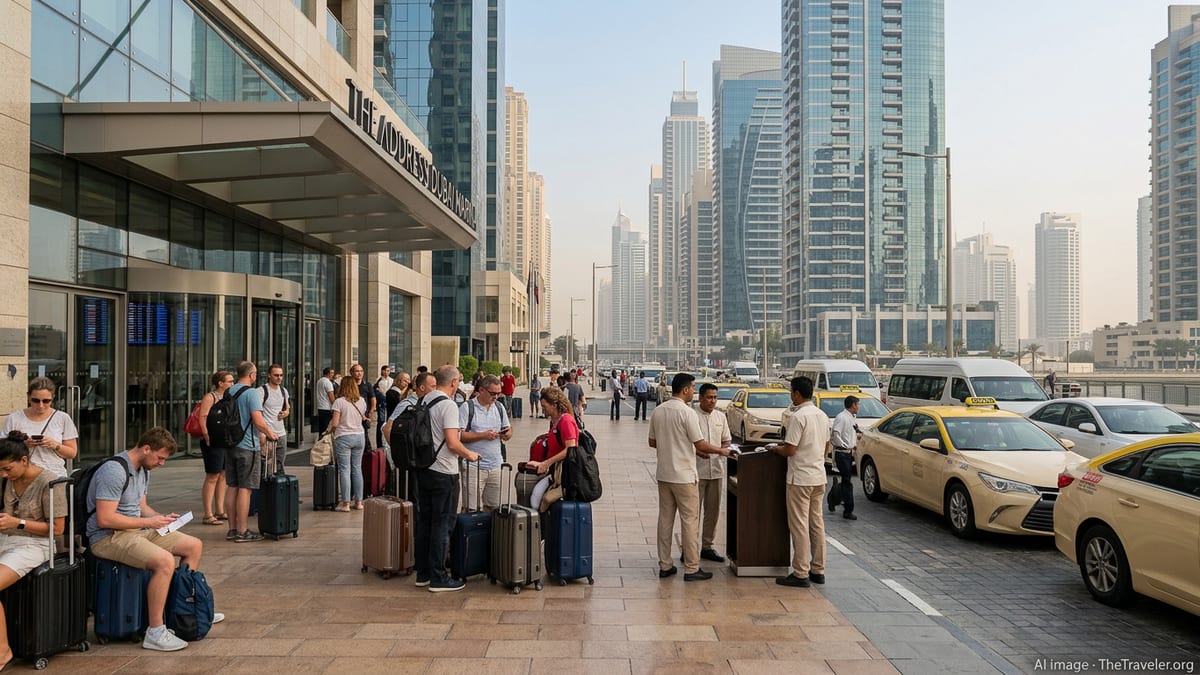
The United Arab Emirates’ hospitality sector is holding firm on room pricing even as unprecedented aviation disruptions linked to the widening Middle East conflict leave tens of thousands of travelers stranded across Dubai and Abu Dhabi.
Get the latest news straight to your inbox!
Stable Rates in an Unstable Regional Backdrop
While airspace closures and missile strikes have temporarily paralysed much of the Gulf’s aviation network, hotel executives in the UAE say room prices remain broadly aligned with pre-crisis levels. Rather than sharp rate hikes, many properties are keeping published tariffs steady and focusing on managing a sudden influx of long-stay guests whose flights have been cancelled or indefinitely delayed.
The stance contrasts with earlier regional shocks, when scarcity often translated into rapid price surges. Analysts note that the UAE enters this crisis from a position of strength, after a record year for tourism and robust hotel performance in 2025, with national occupancy close to 80 percent and average daily rates already elevated compared with pre-pandemic benchmarks.
Recent government and industry data indicate that while forward bookings for the next few weeks have softened, there has been no broad-based collapse in rates. Instead, hotels are selectively deploying tactical discounts to stimulate demand in softer segments, while preserving headline pricing to protect yields over the rest of 2026.
In Abu Dhabi, preliminary January figures showed average daily rates and revenue per available room still benefitting from a strong events calendar, suggesting that the capital’s pricing power remains intact despite the aviation shock now gripping the wider region.
Emergency Measures: Protecting Stranded Guests
As missile strikes and retaliatory attacks prompted widespread airspace closures at the end of February, authorities in Dubai moved quickly to shield stranded visitors from being forced out of their rooms. The Dubai Department of Economy and Tourism issued urgent instructions to hoteliers not to evict guests whose flights had been cancelled, effectively obliging properties to extend stays even where reservations had technically expired.
Hotel managers say the directive has reshaped short-term inventory planning. Many properties have had to freeze incoming bookings on popular dates to ensure sufficient capacity for travellers who suddenly require additional nights, often without clarity on when they will be able to depart. Some operators report converting transient bookings into ad hoc long-stay arrangements at the same, or only slightly adjusted, nightly rates.
Operators add that, instead of opportunistic pricing, the focus is squarely on safety, communication and basic services. With large numbers of guests unable to leave, hotels have expanded housekeeping cycles, increased food and beverage capacity and strengthened security protocols, particularly at beachfront and landmark properties that have featured in recent reports of debris strikes.
Industry sources also highlight closer coordination with airlines and embassies, with hotel front desks fielding rebooking queries, helping passengers upload travel documents for new itineraries and, in some cases, arranging transport to newly scheduled evacuation flights.
Occupancy Shock, Not a Pricing Freefall
The immediate impact of the aviation standstill has been felt most acutely in occupancy rather than in headline rates. With Dubai International and Abu Dhabi’s main airport operating at a fraction of their usual capacity, inflows of new visitors have slowed sharply, pushing down hotel utilisation in districts that rely heavily on transit and short city-break traffic.
Market reports point to pronounced softness at some midscale and upscale properties that typically feed off high passenger churn through the major hubs. In these segments, hoteliers are using targeted promotions and value-added packages to capture what demand remains, but are generally avoiding deep, across-the-board rate cuts that could undermine the sector’s pricing structure for the rest of the year.
Luxury beachfront and branded resort properties appear more insulated, supported by guests who arrived before the escalation and are either extending holidays or waiting out the disruptions on insurance-backed stays. For these hotels, the key challenge is operational rather than commercial: keeping services running smoothly with staff also affected by mobility constraints and supply chain delays.
Analysts caution that if flight suspensions persist well into the second quarter, pressure to adjust rates could build, particularly in secondary and tertiary markets. For now, however, the pattern is one of lower occupancies layered over relatively stable advertised prices, reinforcing the UAE’s message that it is open for business even as much of the region struggles to move people.
Policy Support and Long-Term Strategy Underpin Resilience
The UAE’s ability to keep hotel pricing stable amid severe aviation turbulence is rooted in a broader tourism and economic strategy that emphasises diversification and long-term market development. The country’s non-oil economy, with hospitality as a key pillar, has grown steadily over the past two years, and hotel revenues climbed to the mid-double-digit billions of dirhams in 2025 as new laws and investment-friendly regulations took hold.
Officials have repeatedly framed the current disruptions as a stress test rather than a reversal of direction. The national tourism strategy envisions welcoming tens of millions of hotel guests annually by the early 2030s, supported by a pipeline of new properties, attractions and transport links. That outlook has encouraged operators and owners to resist panic-led pricing, prioritising brand equity and guest trust over short-term windfalls.
At the same time, sector-wide advisory councils bringing together government entities, hotel chains and tourism bodies have continued to meet in early 2026, focusing on sustainability, guest safety and demand diversification. Recent sessions have underscored the need to balance crisis response with ongoing initiatives around eco-certification, extended-stay offerings and new source markets beyond the traditional Europe and Asia corridors currently most affected by flight re-routings.
International chains active in the UAE say the coordinated approach from regulators has offered clarity on operating expectations, from cancellation policies to guest welfare obligations. That, in turn, has reduced the temptation for individual properties to raise rates sharply in isolation, helping preserve a consistent market signal to nervous travellers monitoring developments from abroad.
Airlines, Hotels and Travellers Adapt to a New Normal
As limited services gradually resume at Dubai and Abu Dhabi, airlines and hotels are working in tandem to stitch together a more predictable experience for passengers still navigating a patchwork of restrictions. Carriers are staggering departure waves and using larger aircraft on approved corridors, while hotels are adjusting check-in and check-out times to align with irregular flight schedules and overnight delays.
Frontline travel agents and tour operators report that many clients are less concerned with price than with reliability and flexibility. Package providers are renegotiating allotments and rate conditions with UAE hotels, seeking to lock in stable pricing in exchange for looser cancellation terms and the ability to shift guests between properties if security advisories or airport closures change at short notice.
For travellers currently in the UAE, the practical impact of stable hotel rates is mixed. Those relying on insurance or government-arranged evacuation packages benefit from predictable costs, while self-funded visitors facing extended stays must budget for additional nights at broadly normal tariff levels rather than distressed discounts. Industry groups say clear communication around rate policies, rebooking options and guest rights remains essential to avoid disputes at check-out.
Looking ahead, analysts expect the UAE’s hospitality sector to leverage its established infrastructure and crisis-management experience to recapture demand once airspace fully reopens. How quickly that recovery materialises will depend on the trajectory of the conflict and consumer confidence, but for now, the decision to maintain stable pricing is seen as a calculated bet that a reputation for fairness and reliability will pay dividends when travellers start planning their next trips.