

More news on this day
Dubai and Abu Dhabi, normally among the world’s most reliable aviation hubs, were struggling on Monday to restore order after US and Israeli strikes on Iran triggered sweeping airspace closures, sudden airport shutdowns and mass flight cancellations that stranded tens of thousands of tourists and business travelers across the United Arab Emirates.
Airspace Clampdown Shuts Down Gulf Gateways
The UAE’s civil aviation authority imposed a temporary and partial closure of national airspace over the weekend as regional skies emptied following coordinated US and Israeli attacks on targets inside Iran. The move effectively brought the country’s key international gateways in Dubai and Abu Dhabi to a halt, with operators warning that normal schedules could not safely be maintained amid missile interceptions and drone debris incidents reported across the Gulf.
Dubai Airports confirmed that all flights at Dubai International Airport, one of the world’s busiest international hubs, and its secondary Al Maktoum International Airport were suspended until further notice at the peak of the crisis. Abu Dhabi’s Zayed International Airport reported waves of delays, diversions and cancellations as airlines held aircraft on the ground or turned them back mid route, citing rapidly changing airspace restrictions across Iran, Iraq, the Gulf and parts of the eastern Mediterranean.
Data from flight tracking services showed near-total silence over large swathes of Middle Eastern airspace through Sunday, with no scheduled traffic passing over the UAE for several hours at a time. The unprecedented clampdown followed similar closures by Iran, Israel, Iraq, Qatar, Bahrain, Kuwait and Oman, effectively severing some of the world’s most important east west corridors linking Europe and North America with Asia, Africa and Australasia.
Authorities in the UAE said the measures were taken in coordination with regional partners and air defense forces, after intercepted drones sent debris raining down on parts of Dubai and Abu Dhabi and prompted warnings to residents to avoid damaged sites and rely only on official information channels.
Emirates, Etihad and Local Carriers Freeze Operations
Home carrier Emirates, the world’s largest long haul airline, suspended all flights to and from Dubai, initially until Sunday afternoon local time and later extending cancellations into Monday as airspace remained severely constrained. The airline told customers they could rebook within days of their original travel date or request refunds, while warning that call centers were overwhelmed and urging passengers not to proceed to the airport unless their flight was shown as operating.
In Abu Dhabi, Etihad Airways halted all departures and arrivals for extended periods, announcing that flights to and from the capital would remain suspended until at least early Monday. Aircraft already en route were diverted back to their origin points or to alternative airports where slots were available, leaving travelers scattered across cities from Europe to South Asia as the carrier worked to rebuild a skeleton schedule around remaining open corridors.
Low cost operators were hit just as hard. Sharjah based Air Arabia temporarily suspended all services to and from the UAE, while flydubai cancelled its entire Dubai operation for hours at a time as the situation evolved. Regional and foreign airlines including Qatar Airways, Saudia, EgyptAir, Air India, IndiGo, Lufthansa and Air France either halted UAE services outright or rerouted planes away from Gulf airspace, extending journey times and creating knock on delays far beyond the Middle East.
Aviation analysts warned that even as airports begin to reopen, airlines will take days to reposition aircraft and crew, with rolling disruptions possible well into the week. Carriers are also being forced into longer flight paths that skirt closed skies, increasing fuel burn and operating costs that could eventually filter through to higher fares if the crisis persists.
Thousands of Travelers Stranded in Terminal Gridlock
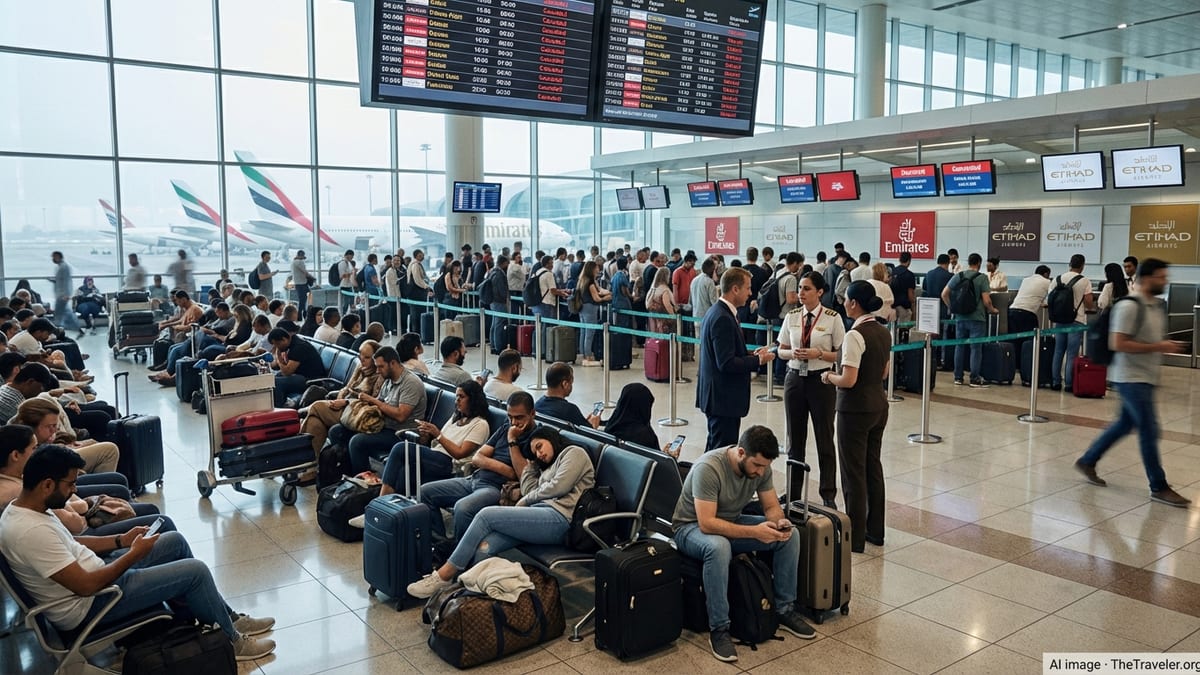
Inside the UAE, the abrupt shutdowns turned normally efficient terminals into makeshift holding zones. At Dubai International, passengers described departure boards filling with red “canceled” notices within minutes, as security lines emptied and check in queues dissolved into crowds clamoring for information. Families bound for holidays in Asia and Europe found themselves camped on terminal floors, while business travelers missed meetings and conferences with little clarity on when they could leave.
In Abu Dhabi, long haul passengers arriving on flights that had taken off before the closures were held on aircraft or bussed to immigration halls where they were informed that onward connections were suspended indefinitely. Some were issued emergency transit visas and hotel vouchers, while others chose to stay airside in the hope that connecting flights would be reinstated quickly once airspace restrictions eased.
Travelers reported jammed airline apps and phone lines, with many turning to airport staff for basic updates about which destinations might reopen first. Large tour groups, including religious pilgrims and school delegations, were seen being escorted in clusters through terminals as handlers scrambled to secure block bookings in already tight hotel markets near the airports.
Hotels across Dubai and Abu Dhabi reported a spike in last minute reservations as stranded visitors sought a bed for the night. In popular tourism districts such as Dubai Marina and Downtown, reception staff said they were fielding constant calls from guests trying to extend stays, while operators warned that room rates could rise if the disruption continues to feed emergency demand.
UAE Rolls Out Emergency Support for Stuck Visitors
As the scale of the gridlock became evident, UAE authorities moved to contain the fallout for overseas visitors. Officials and local media reported that the government had authorized an extensive support package covering accommodation, meals and rebooked flights for tens of thousands of travelers whose journeys were disrupted by the crisis, with priority given to families, the elderly and those in transit without valid visas.
At Dubai International and Zayed International, extra help desks were set up in arrivals and departures halls to guide passengers through rebooking procedures, visa extensions and hotel placements. Airport staff and volunteers distributed water and snacks to those forced to wait for hours in crowded concourses, while shuttle buses ferried stranded tourists to partner hotels that agreed to take in large numbers at short notice.
Travel advisers in the UAE urged visitors to keep boarding passes, booking confirmations and receipts for incidental expenses, noting that most major airlines were offering fee free changes and refunds on affected sectors. Insurance brokers said policies that include travel disruption or war risk cover may reimburse additional accommodation and transport costs, depending on specific terms, though many warned that conflicts can quickly become exclusions as events evolve.
Tourist boards and hotel groups stressed that visitors already in the UAE remain safe, emphasizing that disruptions were concentrated in the skies and at airports rather than in resort areas, shopping districts or desert attractions. However, they acknowledged that the reputational impact on the country’s carefully cultivated image as a hyper reliable transit hub could linger long after the immediate crisis is resolved.
Global Ripple Effects and an Uncertain Timeline
The paralysis at Dubai and Abu Dhabi, together with parallel shutdowns in nearby Qatar and other Gulf states, has sent shockwaves through the global aviation network. Industry data indicates that the three major Gulf hubs typically handle close to 90,000 connecting passengers a day, many of them on multi leg journeys between continents. With those hubs hobbled, airlines are scrambling to redistribute connections through secondary airports in Europe, Central Asia and North Africa.
Logistics operators warned that cargo flows are also being hit, with dedicated freighters and bellyhold shipments on passenger jets forced into longer routes that bypass closed airspace over Iran and its neighbors. The disruption threatens to slow just in time supply chains for sectors ranging from electronics and fashion to pharmaceuticals that rely on fast transit through the Gulf.
Analysts cautioned that the speed of any recovery will depend heavily on the security situation and coordination between military and civil aviation authorities. Even a partial reopening of airspace would initially come with tight routing and altitude restrictions, limiting capacity and complicating efforts to clear the backlog of stranded passengers. Airlines are preparing phased recovery schedules that prioritize major trunk routes while gradually restoring secondary destinations.
For now, travelers with upcoming itineraries involving the UAE or wider Middle East are being advised to monitor airline communications closely, consider flexible tickets and allow extra time for potential rerouting. With governments signaling that further military exchanges cannot be ruled out, both tourists and business travelers face the prospect that the region’s role as the world’s layover capital may remain fragile in the days ahead.