

More news on this day
Regional strikes linked to Iran have disrupted Dubai International Airport, injuring four airport workers, damaging a concourse and forcing the suspension of flights across the United Arab Emirates, as authorities race to manage one of the most serious shocks to Gulf aviation in years.
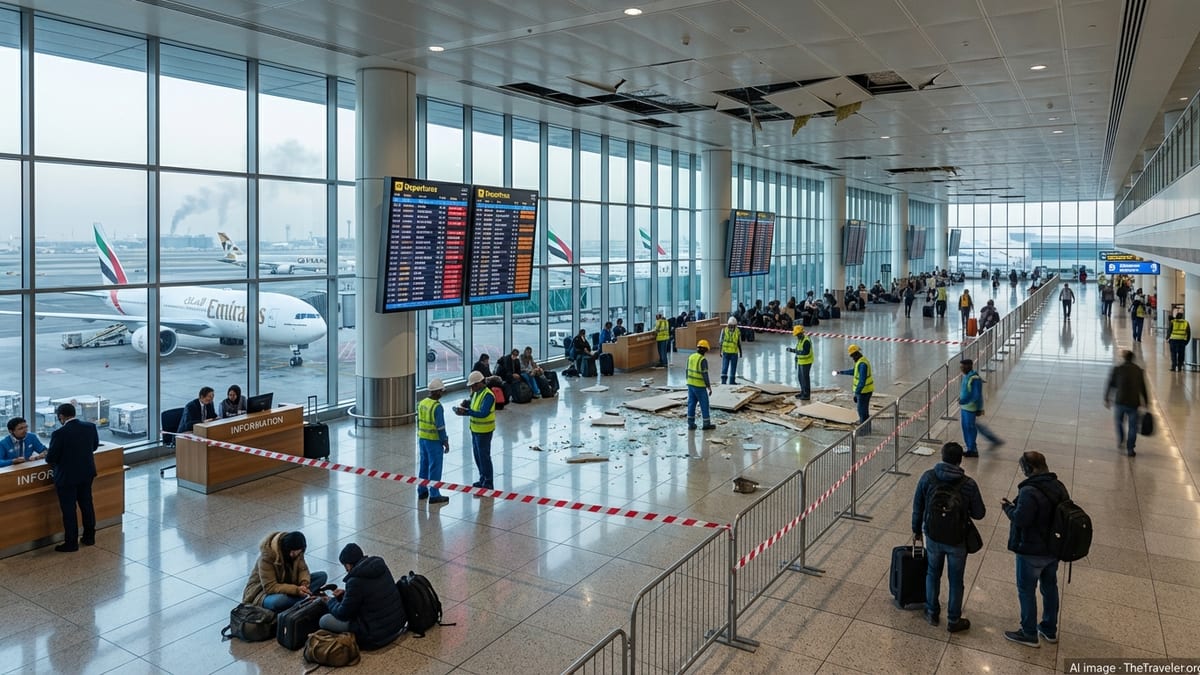
Missile Strikes Reach Key Gulf Aviation Hub
Dubai International Airport, the world’s busiest hub for international passengers, confirmed that one concourse sustained minor structural damage after an incident tied to Iranian missile and drone strikes sweeping across the Gulf. Emergency response teams were deployed within minutes, with officials stressing that the situation was quickly contained and that the overall integrity of the terminal buildings remains intact.
The Dubai Media Office said four staff members were injured and received prompt medical care. Contingency plans had already reduced the number of passengers in the terminals when the strike occurred, a factor authorities say helped avoid more serious casualties in one of the world’s most crowded transit nodes.
The incident at Dubai International comes amid a wider wave of retaliatory attacks following joint United States and Israeli strikes on Iran. The exchange has spilled into the airspace of several Gulf states, including the UAE, where authorities briefly faced plumes of smoke over the airport complex and visible debris on parts of the apron and concourse roof.
Elsewhere in Dubai, officials reported drone debris causing minor fires and facade damage at landmarks such as the Burj Al Arab and parts of Palm Jumeirah. Civil Defence teams brought those incidents under control, but the strikes underscored how rapidly the conflict has reached densely populated, tourism‑dependent coastal districts.
Flights Suspended as UAE Partially Closes Airspace
Within hours of the airport incident, the UAE’s civil aviation authorities moved to partially close national airspace, prompting Dubai Airports to suspend all operations at both Dubai International (DXB) and Dubai World Central Al Maktoum International (DWC). Passengers were urged not to travel to either airport and instead to contact airlines directly for the latest information on their flights.
Home carrier Emirates temporarily halted all operations to and from Dubai, citing multiple regional airspace closures. The airline said it is working with regulators and air navigation authorities to assess routing options and will rebook affected travelers or offer refunds where necessary. Low‑cost carrier flydubai also suspended flights, while Sharjah and Abu Dhabi airports reported delays, diversions and cancellations.
The airspace restrictions extend beyond the UAE, with Iran, Iraq, Kuwait, Bahrain and Qatar all limiting or closing key corridors used by long‑haul flights between Europe, Asia, Africa and Oceania. Flight‑tracking data shows previously crowded skyways over the northern Gulf and parts of the Arabian Peninsula largely empty, as airlines divert aircraft over Saudi Arabia or cancel services outright.
Aviation analysts say the closures have triggered thousands of cancellations and diversions in less than 48 hours, with knock‑on effects likely to ripple through global timetables for days. The loss of access to these corridors further constrains already limited routing options, following earlier restrictions over Russia and parts of Eastern Europe.
Injuries, Passenger Disruption and On‑the‑Ground Chaos
While officials emphasize that structural damage at Dubai International is limited, the human toll on both staff and passengers has quickly become apparent. Four airport workers were treated for injuries at DXB, and authorities in Abu Dhabi reported additional casualties near Zayed International Airport after falling debris from intercepted missiles.
Inside Dubai’s terminals, travelers described scenes of confusion as departure boards shifted rapidly from delays to mass cancellations. Some long‑haul flights turned back mid‑journey or diverted to alternative hubs in Europe and the eastern Mediterranean, leaving passengers facing unexpected layovers, missed connections and complex rebooking challenges.
Families en route to holiday destinations, business travelers transiting between continents and residents attempting to return home all found themselves stranded as airlines scrambled to reposition aircraft and crew. Airport hotels filled quickly, prompting authorities and carriers to arrange emergency accommodation, meal vouchers and onward travel assistance for thousands of travelers stuck in the emirate.
Local officials stressed that public safety remains the priority and urged residents and visitors to follow official updates, avoid approaching any debris from interceptions and refrain from sharing unverified images or videos on social media. Public prosecutors warned that spreading misinformation about security incidents could trigger legal penalties under UAE law.
Impact on Gulf Carriers and Global Aviation Routes
The latest strikes strike at the heart of the Gulf’s aviation‑driven economic model. Dubai International typically handles hundreds of thousands of passengers daily, and Emirates operates an extensive network linking Europe, Asia, Africa and the Americas through its DXB hub. With operations temporarily paused, aircraft utilization has plummeted and airlines are incurring higher fuel, crew and disruption costs.
Etihad Airways in Abu Dhabi and Air Arabia in Sharjah and Ras Al Khaimah have also suspended or curtailed services, while Qatar Airways and major international carriers from Europe and Asia are rerouting or cancelling flights across the region. Industry experts say the immediate hit stems less from reduced demand than from operational inefficiency, as jets are forced into longer detours and complex schedule changes.
With Russian airspace still off‑limits to many Western carriers, long‑haul routes between Europe and East Asia had already been channeled heavily through Middle East air corridors. The sudden reduction in available routes around the Gulf adds further congestion and fuel burn, eroding schedule resilience and stretching crew‑duty limits. Airlines are also likely to face higher war‑risk insurance premiums and increased security compliance costs.
Logistics and cargo operations are feeling parallel pressure. Dubai and Abu Dhabi serve as critical hubs for time‑sensitive freight, from electronics to pharmaceuticals. Even a short‑term suspension of flights can disrupt supply chains and delivery timelines, particularly for businesses relying on just‑in‑time inventory models.
Tourism and Traveler Confidence Under Strain
The strikes arrive at a sensitive moment for the UAE’s tourism sector, which has heavily promoted Dubai as a secure, stable and easily accessible gateway between regions. The sight of smoke near terminal buildings and drone debris hitting luxury waterfront districts risks denting that image, even as authorities move swiftly to demonstrate control and resilience.
Hotel operators across Dubai have reported a sudden influx of distressed transit passengers seeking last‑minute rooms, while travel agencies and online platforms have been flooded with requests to reroute journeys or postpone trips. Some tour groups have temporarily suspended excursions, particularly to high‑profile coastal attractions closest to recent incidents.
Regional tourism boards are working to reassure visitors that key infrastructure remains safe and that emergency protocols functioned as designed, limiting casualties. At the same time, governments are tightening restrictions on recreational drones, gliders and other aerial activities for at least a week, and schools across parts of the UAE have shifted to distance learning as a precaution.
Travel industry observers say the duration and intensity of the airspace closures will shape how quickly confidence returns. If strikes remain limited and defenses continue to intercept most incoming projectiles, demand could rebound relatively quickly, as it has after previous regional crises. Prolonged uncertainty, however, risks pushing travelers to alternative hubs and routes, challenging the UAE’s dominant role in global air travel.