

More news on this day
The United Arab Emirates has expanded its already strict regional travel guidance, as Kuwait joins Israel, Saudi Arabia, Bahrain, Jordan, Iraq and other Middle Eastern states on a growing list of destinations flagged for heightened security risks, passport validity checks and tighter customs enforcement amid an escalating conflict centered on Iran and the Gulf.
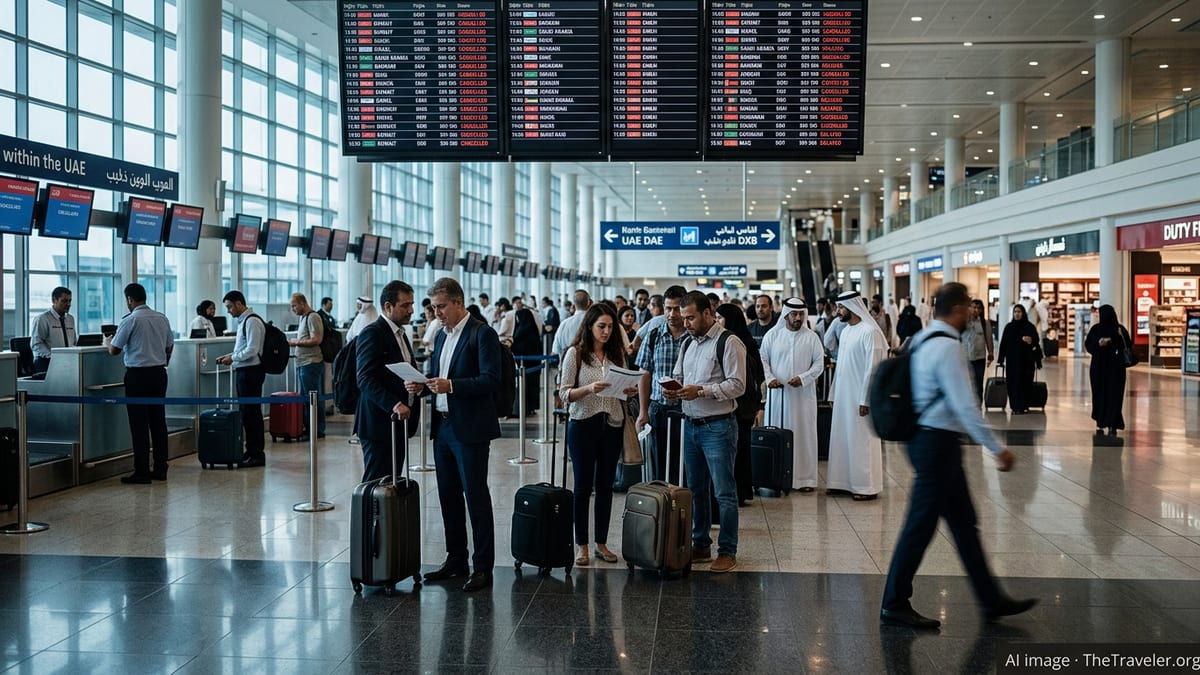
Regional Conflict Triggers Coordinated Travel Warnings
The UAE’s latest advisory comes in the wake of a rapid deterioration in security across the Gulf, following coordinated United States and Israeli strikes on Iran on 28 February 2026 and subsequent Iranian missile and drone attacks on multiple countries including the Emirates, Bahrain, Kuwait, Qatar, Saudi Arabia and Israel. Airspace closures, flight cancellations and intermittent airport shutdowns have upended normal travel patterns, forcing governments and carriers to rely on limited evacuation and relief flights rather than regular commercial schedules.
Foreign ministries in Europe, North America and Asia have moved in parallel, warning citizens to avoid or reconsider nonessential travel to a cluster of Middle Eastern destinations that now routinely includes Israel, Saudi Arabia, Bahrain, Jordan, Iraq, Kuwait and the UAE itself. Several governments have ordered the departure of nonessential diplomatic staff from Abu Dhabi, Doha and Riyadh, and raised their formal advisory levels for the Emirates to thresholds that, until recently, were reserved for states in active war zones.
For the UAE, long marketed as the region’s safe, business-friendly hub, the shift is particularly stark. Just weeks ago, Dubai and Abu Dhabi were hosting major trade fairs, cruise calls and peak-season leisure visitors. Today, travel insurers describe the country as lying within an active conflict zone, with war-risk surcharges added to policies and multiple providers narrowing coverage for disruptions linked to missile strikes, airspace closures or military action.
The widening web of advisories means that travelers are now grappling with overlapping layers of restriction: their own government’s warnings, the UAE’s outbound and inbound guidance, and tightening rules in neighboring states that serve as common transit points or onward destinations.
Kuwait Joins a Growing List of High-Risk Destinations
The most recent update prominently highlights Kuwait alongside Israel, Saudi Arabia, Bahrain, Jordan and Iraq as destinations requiring particular caution from Emirati residents and foreign travelers departing from the UAE. Kuwait’s inclusion reflects both its geographic proximity to Iran and Iraq and its exposure to the same waves of missile and drone activity that have targeted Gulf infrastructure, energy facilities and, increasingly, civilian aviation corridors.
Regional risk assessments now tend to treat these countries as an interconnected zone. Advisories refer not only to the danger of direct attacks but also to knock-on effects such as sudden airspace closures, diversion of flights, congestion at alternative hubs and temporary shutdowns of key highways and land crossings. Travelers attempting multi-stop itineraries that link Dubai with Riyadh, Manama, Amman, Tel Aviv or Kuwait City are being warned that even short-notice operational decisions can leave them stranded without clear rebooking options.
Officials and travel-security analysts stress that, while frontline combat remains outside most major urban centers, the unpredictability of missile and drone trajectories, coupled with the strategic importance of Gulf airspace and ports, has made routine civil aviation particularly vulnerable. This is why Kuwait has been grouped with Israel and Gulf states like Saudi Arabia and Bahrain in urgent advisories, despite differing political alignments and domestic security capabilities.
For tour operators, corporate travel planners and airlines based in the Emirates, Kuwait’s formal addition to the warning list is another signal that regional itineraries must be redesigned, with contingency plans for rapid rerouting via safer third countries or, where possible, temporary substitution of virtual meetings for in-person visits.
Passport Validity Rules Tighten Across the Middle East
Alongside security warnings, the UAE’s advisory underscores a technical but consequential issue for travelers: stricter enforcement of passport validity rules across many Middle Eastern countries. States including Israel, Saudi Arabia, Bahrain, Jordan, Iraq and Kuwait already commonly require that passports remain valid for at least six months beyond the intended date of departure, a standard that airlines and border authorities are now applying with little tolerance for exceptions.
As tensions mount and border officials face rising workloads, travelers who might previously have been waved through with just under the required validity are increasingly being turned away at check in or denied boarding on connecting flights. Carriers operating from Abu Dhabi and Dubai report a noticeable uptick in last-minute refusals linked to passport dates, particularly on routes touching Israel, Jordan and Iraq, as well as to Gulf neighbors on the advisory list.
In its communication, the UAE urges residents and visitors to review the entry rules of every country on their itinerary, not just their final destination, and to renew passports well in advance of travel. Transit passengers are reminded that some states apply six-month rules even if the traveler never leaves the airport, a catch that has surprised those using regional hubs in Saudi Arabia, Bahrain or Kuwait as stepping stones to Europe, Asia or Africa.
Travel agents in Dubai note that the convergence of conflict-related disruption and stricter documentation checks has made itinerary planning significantly more complex. They are advising clients bound for any of the flagged countries to build in additional time for immigration and security procedures, and to carry printed copies of visas, residency permits and hotel confirmations in case digital systems are degraded by cyberattacks or outages linked to the wider crisis.
Customs, Imports and On-the-Ground Controls Under Scrutiny
The advisory also points to tightening customs and import controls, particularly on items that could be construed as dual-use or sensitive in a heightened security environment. Travelers heading from the UAE to Israel, Saudi Arabia, Bahrain, Jordan, Iraq, Kuwait and other nearby states are being cautioned that goods which ordinarily raise few questions, such as high-spec drones, powerful telecommunications equipment or large quantities of electronics, may now trigger secondary inspections or confiscation.
Across the region, customs agencies have stepped up screening of luggage and cargo, while security services are monitoring the movement of communications gear, satellite phones and certain industrial components more closely than before. In some countries, there are anecdotal reports of laptops, hard drives and storage devices being subject to more detailed checks at border crossings and airports, part of a broader push to curb espionage, smuggling and the transfer of sensitive data or technology.
For leisure travelers, the practical impact is most likely to be felt at airport security and customs lines, which have lengthened in several capitals as authorities balance the need to keep air links open with concerns over potential sabotage or intelligence-gathering. The UAE’s advisory recommends that passengers avoid transporting items that could plausibly be misinterpreted as professional surveillance tools or military-grade equipment, and that they comply fully with local instructions, even when procedures differ significantly from those in the Emirates.
Businesses relying on frequent cross-border movement of staff and equipment find themselves navigating a patchwork of evolving regulations. Logistics managers in Dubai say shipments bound for Iraq and Jordan via Saudi Arabia or Kuwait now face additional documentation requirements and, in some cases, rerouting through alternative ports to avoid high-risk corridors. These operational frictions add another layer of uncertainty on top of security and insurance concerns.
Travelers Weigh Risks as the UAE Reassesses Its Hub Role
With the UAE repositioning its travel advice and highlighting the risks associated with nearby states such as Kuwait, Israel, Saudi Arabia, Bahrain, Jordan and Iraq, travelers are confronting difficult choices about whether to proceed with plans, delay trips indefinitely or rebook through different regions altogether. Some governments explicitly warn that those who choose to travel contrary to official advice may find consular assistance limited if conditions deteriorate further.
At the same time, Emirati authorities emphasize that essential connectivity must be preserved, especially for residents, migrant workers and business travelers who have long relied on Dubai and Abu Dhabi as gateways between continents. Aviation regulators have authorized carefully controlled “exceptional flights” to move stranded passengers out of the conflict zone when airspace windows open, while local carriers adjust schedules day by day based on security assessments.
Travel experts say the UAE’s updated guidance reflects a broader reality: in the current climate, journeys involving Israel, Saudi Arabia, Bahrain, Jordan, Iraq, Kuwait and surrounding countries cannot be treated as routine. From verifying passport validity and insurance coverage to understanding customs rules and monitoring fast-moving political developments, travelers must accept a higher degree of preparation and residual risk than they did even a month ago.
For now, the Emirates continues to function as the region’s primary aviation and logistics hub, but the latest advisory underscores how fragile that role has become. Each new missile salvo, airspace notice or diplomatic rupture has immediate implications for flight paths, border queues and the everyday decisions of people contemplating whether it is still safe, or even feasible, to cross the region.