

More news on this day
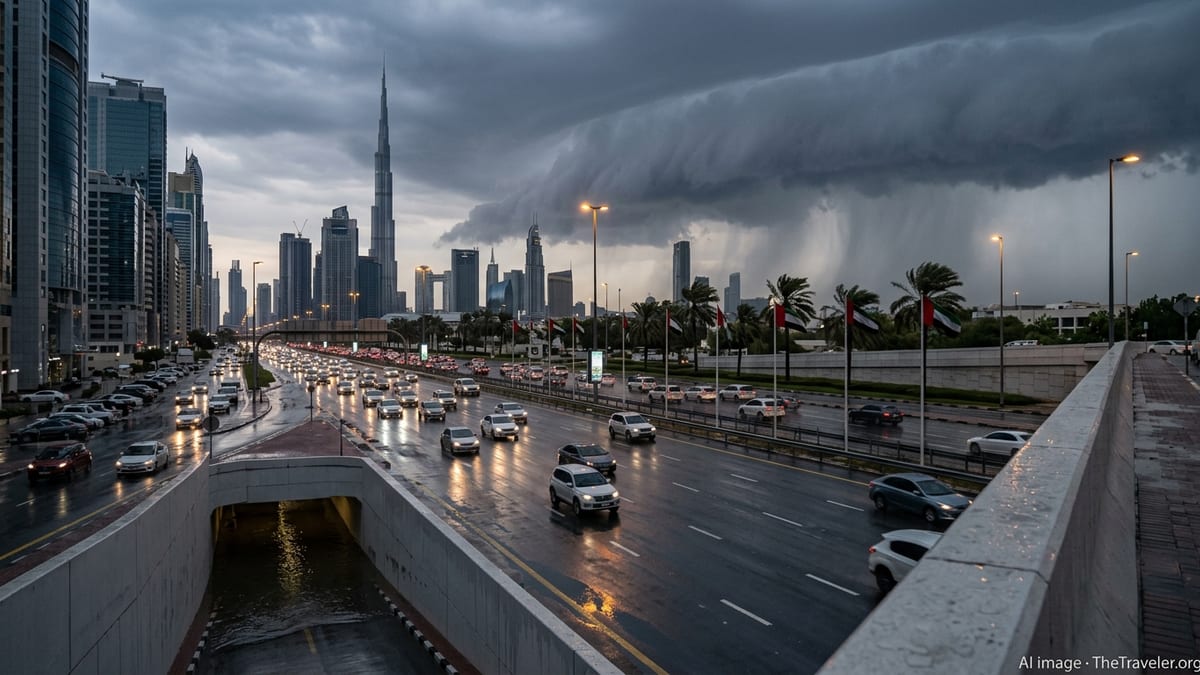
The United Arab Emirates has issued a travel alert as a powerful weather system is forecast to bring intense rain, flash flooding and a rare tornado risk to Dubai and surrounding emirates over the coming days, prompting airlines, residents and visitors to prepare for potential disruption on the ground and in the air.
Get the latest news straight to your inbox!
National Forecast Warns of Unusually Severe Conditions
Publicly available forecasts from the UAE’s National Centre of Meteorology indicate a deep and slow moving low pressure system drawing moist air over the Arabian Gulf toward the Emirates, with models pointing to multiple waves of heavy rain through the end of the week. Meteorological bulletins highlight the likelihood of strong convective storms, frequent lightning and localized squall lines capable of producing damaging wind gusts.
Special warnings circulated through official channels describe the risk of sudden downpours that could drop significant rainfall in a short window, particularly over Dubai, Sharjah and coastal areas. Weather enthusiasts tracking forecast models have noted projected totals that, if realized, would rival or exceed some previous high impact rain events in the UAE, though concentrated over a longer period rather than a single day.
The same unstable air mass is also expected to generate strong vertical wind shear and rapidly developing storm cells, creating what regional weather discussions describe as a low but notable risk of brief, desert-based tornadoes. While such phenomena are rare in the Gulf, the combination of deep convection and wind shear has led forecasters to flag the possibility of isolated rotating storms in parts of the country.
Marine updates point to rough seas, poor visibility in heavy rain and blowing dust, and hazardous conditions for small craft in offshore waters. Travelers planning boat excursions or ferry crossings around the Gulf coast are being advised in public advisories to monitor the evolving situation closely.
Travel Alert Highlights Flight, Road and Airport Disruption Risks
Travel advisories circulating from regional risk consultancies and travel assistance providers now classify the overall risk level for journeys through the UAE as elevated during the peak of the storm system. These advisories outline the possibility of flight delays, diversions and short notice cancellations at Dubai International Airport and other UAE hubs if intense thunderstorms temporarily reduce visibility or require adjustments to air traffic flows.
Operational updates shared in early March for previous weather and security related disruptions at Dubai International Airport showed how quickly airspace restrictions and ground delays can cascade into missed connections and extended layovers for passengers. Current guidance stresses the importance for travelers of holding a confirmed, updated booking and avoiding unnecessary trips to the airport without verification from their airline.
On the ground, recent flood experience across the Emirates has demonstrated the vulnerability of some arterial routes, underpasses and low lying districts to rapid water accumulation. Public information notes that even a few hours of very heavy rain can lead to road closures, stranded vehicles and congestion as traffic is diverted away from inundated sections of major highways and city streets.
Ride hailing services and public transport networks are also at risk of intermittent disruption if localized flooding affects depots, metro access points or bus corridors. Travel risk bulletins suggest that visitors build in additional time for transfers between airports, hotels and attractions, and consider flexible itineraries that allow for weather related delays.
Rare Tornado Risk Draws Attention After Previous UAE Storms
The mention of a potential tornado threat in official style meteorological language has drawn particular attention, as such events are uncommon in the Arabian Peninsula. Regional weather analysts describe the current setup as one that could produce short lived funnel clouds or landspout type tornadoes embedded within vigorous thunderstorms, especially where sea breezes and frontal boundaries intersect.
Online discussions referencing model guidance and radar output point to Thursday and Friday as the period of greatest concern for any rotating storms near Dubai and along parts of the northern coastline. While the probability of any single location experiencing a tornado remains low, the presence of that risk, combined with high rain rates, is contributing to the heightened alert tone in travel and safety messaging.
The renewed concern comes less than two years after an historic storm system in April 2024 triggered extreme flooding across Dubai and neighboring emirates, disrupting flights, damaging property and overwhelming drainage networks. Aviation sector reports on that event documented how convective storms and prolonged heavy rain led to waterlogged taxiways and temporary suspensions of airport operations.
Current meteorological outlooks emphasize that the coming system may deliver its rainfall in several bursts rather than one continuous deluge, but also warn that saturated ground from earlier showers could still amplify flood impacts. The added tornado component, even at low likelihood, reinforces calls for residents and visitors to pay close attention to warnings.
Guidance for Residents, Tourists and Transit Passengers
Publicly available guidance from government communication channels and civil protection messaging encourages people across the UAE to avoid unnecessary travel during periods of intense rain, particularly through known flood hotspots, wadis and poorly drained underpasses. Drivers are urged in these advisories to reduce speed, maintain greater following distances and avoid attempting to cross water covered roads where depth and flow are difficult to judge.
For visitors, travel risk notes recommend monitoring airline apps and airport information channels closely, keeping contact details updated in booking records, and preparing for the possibility of longer waits at terminals if screening and boarding procedures are slowed by weather conditions. Travelers transiting through Dubai with tight connections are being advised to review their options for rebooking and overnight accommodation in case of extended disruption.
Hotel operators and destination management companies around Dubai and Abu Dhabi are also following developments as they prepare contingency plans for airport transfers, excursions and outdoor activities. Some tour providers have already begun flagging the potential for cancellations or rescheduling of desert safaris, dhow cruises and rooftop events during the height of the storm system.
Insurance specialists point out that policies vary widely in their treatment of weather related disruption, and note that travelers may wish to confirm coverage details for missed connections, additional accommodation and alternative transport before departure. Several risk assessments suggest that flexible bookings and clear documentation of any airline or airport notices can help support claims if plans are significantly affected.
Preparedness Measures Aim to Limit Impact of Dubai Storm Crisis
Municipal updates across the Emirates, along with media coverage of recent civil defense briefings, indicate that drainage crews, emergency responders and utility providers have been placed on heightened readiness as the storm approaches. In Dubai, previous flooding incidents have prompted upgrades to pumping capacity, enhanced monitoring of underpasses and expanded use of temporary barriers in known trouble spots.
According to publicly reported information, the National Centre of Meteorology will continue to issue updated bulletins as new data become available, while the National Early Warning System remains the primary channel for any urgent safety messages. Media reports stress that residents and visitors are encouraged to rely on these official outlets rather than unverified social media forecasts when making decisions about travel and outdoor activity.
For the travel sector, the evolving situation is being viewed as both a test of contingency planning and a reminder of how climate variability is reshaping risk profiles in destinations that were once considered relatively insulated from severe weather. Airlines, airports and tourism operators are expected to refine their response protocols based on how this latest event unfolds.
With heavy rain, flooding and a small but noteworthy tornado threat all in play, the coming days are likely to be closely watched by meteorologists and travelers alike. For those currently in the UAE or scheduled to pass through Dubai, preparedness, flexibility and careful attention to official updates are emerging as the key recommendations as the region braces for a potential storm crisis.