

More news on this day
The widening conflict involving the United States, Israel and Iran is reshaping tourism across the Middle East, as destinations such as the United Arab Emirates, Turkey, Egypt, Oman and Jordan confront mass flight cancellations, rising safety concerns and rapidly shifting perceptions in key source markets.
Get the latest news straight to your inbox!
Airspace Closures Hit Regional Hubs and Holiday Hotspots
In late February 2026, coordinated strikes on Iran and subsequent retaliatory attacks triggered sweeping airspace closures from the Gulf to the Levant, disrupting some of the world’s busiest travel corridors. Published aviation data shows that airspace over Iran, Iraq, Kuwait, Bahrain and parts of the Gulf was closed or heavily restricted, forcing airlines to ground or reroute thousands of flights linking Europe and Africa with Asia.
Reports from global flight trackers indicate that the United Arab Emirates, normally a linchpin for long-haul connections, temporarily shut portions of its airspace, with Dubai and Abu Dhabi hubs suspending large volumes of services. Analysts describe the resulting gridlock as the most severe test for airlines since the pandemic, with hundreds of thousands of passengers stranded or diverted across multiple continents.
For tourism-dependent economies, the impact has been immediate. Travel industry assessments suggest that inbound arrivals to the broader Middle East could fall between 11 and 27 percent in 2026 compared with earlier growth forecasts, as carriers continue to trim schedules and insurance costs rise on routes touching the conflict zone.
UAE Tourism Momentum Meets a Sudden Stress Test
The UAE enters this turbulent period after several years of record-breaking visitor numbers. Official statistics from Dubai’s Department of Economy and Tourism show the emirate hosting nearly 19.6 million international overnight visitors in 2025, building on a strong performance in 2024 and cementing its role as one of the world’s most visited cities.
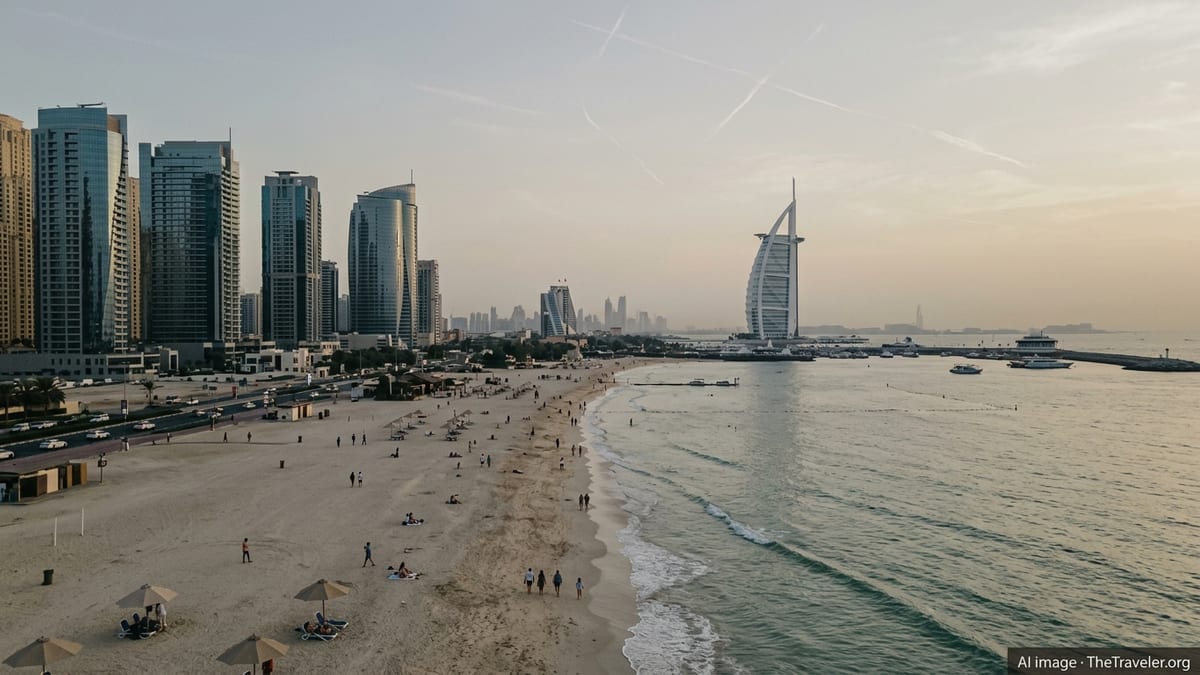
That momentum has begun to falter as regional insecurity filters into traveler decision-making. Recent coverage from regional business media notes that Dubai hotels, which had enjoyed high occupancy and strong room rates, are now discounting more aggressively to stimulate demand. Travel photography from local beachfront districts and souqs, published by international news agencies, shows noticeably thinner crowds than during peak seasons just a year earlier.
Publicly available information indicates that UAE authorities and tourism partners are prioritizing operational continuity, with airports gradually restoring limited services and hospitality providers emphasizing normal day-to-day activity inside the country. Yet the combination of rerouted long-haul traffic, higher aviation costs and nervousness among long-haul leisure travelers is expected to weigh on the sector through at least the first half of 2026.
Neighboring Destinations Grapple With Cancellations and Perception Shifts
Beyond the Gulf, traditional cultural and beach destinations around the Eastern Mediterranean are facing a parallel downturn. Booking data cited by travel analytics firms since the eruption of the Israel-Gaza war in 2023 already showed sharp drops in demand for Jordan and Lebanon, with double-digit declines in ticket sales as tour operators rerouted groups away from the Levant.
Those headwinds have intensified with the new phase of conflict. Industry reports covering the spring 2026 season describe a “catastrophic” wave of cancellations affecting Jordan’s Petra and Dead Sea resorts, as well as Egypt’s Nile cruises and Red Sea beach towns, despite many sites remaining far from direct military activity. Major European tour brands have paused group departures to parts of Jordan and Egypt following missile salvos and escalatory rhetoric that have unsettled travelers.
Oman, typically marketed as a calm alternative to busier Gulf neighbors, has also seen demand soften. According to regional tourism briefings, some European operators have temporarily suspended packages combining the UAE and Oman, citing both logistical uncertainty and traveler reluctance to transit Gulf hubs while images of airstrikes and drone interceptions dominate international news cycles.
Turkey and Egypt Balance Bargain Prices With Risk Aversion
Turkey and Egypt, two of the region’s volume powerhouses, are simultaneously exposed to and insulated from the current shock. Both countries have large domestic populations that support internal tourism, and both have diversified source markets across Europe, Russia and the Gulf. However, forward-booking analyses show that war-related headlines are dampening appetite among higher-spending long-haul visitors who are particularly sensitive to perceived instability.
In Turkey, media coverage highlights how operators along the Mediterranean and Aegean coasts are ramping up discounts for shoulder-season packages in a bid to offset weaker bookings from Western Europe. While the country’s main resort areas are geographically distant from the Gulf and Levant flashpoints, analysts note that many travelers abroad continue to view the wider Middle East as a single risk zone, blurring distinctions between coastal holiday regions and conflict-affected territories.
Egypt faces a similar dilemma. Economic assessments from international financial institutions observe that tourism revenues had been one of the few bright spots supporting foreign currency inflows, even as the war in Gaza weighed on demand in late 2023 and 2024. The latest escalation risks undermining that recovery if perceptions of danger around the Eastern Mediterranean harden, despite the fact that Cairo, Luxor and Red Sea resorts remain physically untouched by current fighting.
From Crisis Management to Long-Term Image Repair
Across the region, tourism boards, airlines and hotel groups are moving through distinct phases of crisis response. The immediate priority has been operational, focused on rebooking stranded travelers, managing refunds and reshaping schedules around closed airspace and higher fuel costs. Several large carriers have introduced temporary waivers and flexible change policies for itineraries touching the Middle East, seeking to preserve customer loyalty during an unpredictable period.
Attention is now shifting to medium-term demand and brand resilience. Industry forecasts suggest that destinations perceived as orderly, secure and well-governed, including the UAE and Oman, may be better positioned to win back visitors once flight patterns stabilize. However, recovering lost confidence in core markets such as Western Europe and North America could take multiple seasons, particularly for countries bordering active conflict zones.
Tourism strategists tracking the situation argue that the next phase will hinge on targeted messaging and diversification. This includes amplifying stories of on-the-ground normality where appropriate, leaning more heavily on regional and domestic travelers who are familiar with local realities, and investing in products less vulnerable to sudden geopolitical shocks, such as business events, medical travel and long-stay digital nomad segments.
For now, the combination of closed skies, anxious travelers and volatile news cycles has placed the region’s tourism renaissance on hold. How quickly the UAE, Turkey, Egypt, Oman, Jordan and their neighbors can adapt to this tougher tourism landscape will depend not only on security developments, but also on the agility of their aviation networks and the strength of their global reputations as places to visit, meet and invest.