

More news on this day
The United Arab Emirates has opened a network of safe air corridors capable of handling up to 48 flights per hour, launching one of the most significant emergency aviation operations in recent Middle East history as authorities race to evacuate stranded travelers and restore vital global connectivity amid a rapidly escalating regional conflict.
Controlled Reopening Amid Widespread Airspace Shutdowns
The new corridors, activated this week by the UAE’s General Civil Aviation Authority in coordination with neighboring Gulf states and international aviation bodies, mark a turning point after days of sweeping airspace closures following clashes involving the United States, Israel and Iran. Large swathes of sky over Iran, Iraq and parts of the Gulf remain restricted or closed, forcing airlines to suspend or heavily curtail services across the region.
UAE officials say the emergency routes, agreed with regional partners and validated against real-time security assessments, are designed to thread civilian aircraft through safer airspace away from potential military activity. The capacity of 48 flights per hour is being treated as an upper limit rather than a target, with authorities emphasizing that flows will be tightly managed and can only increase if security conditions improve.
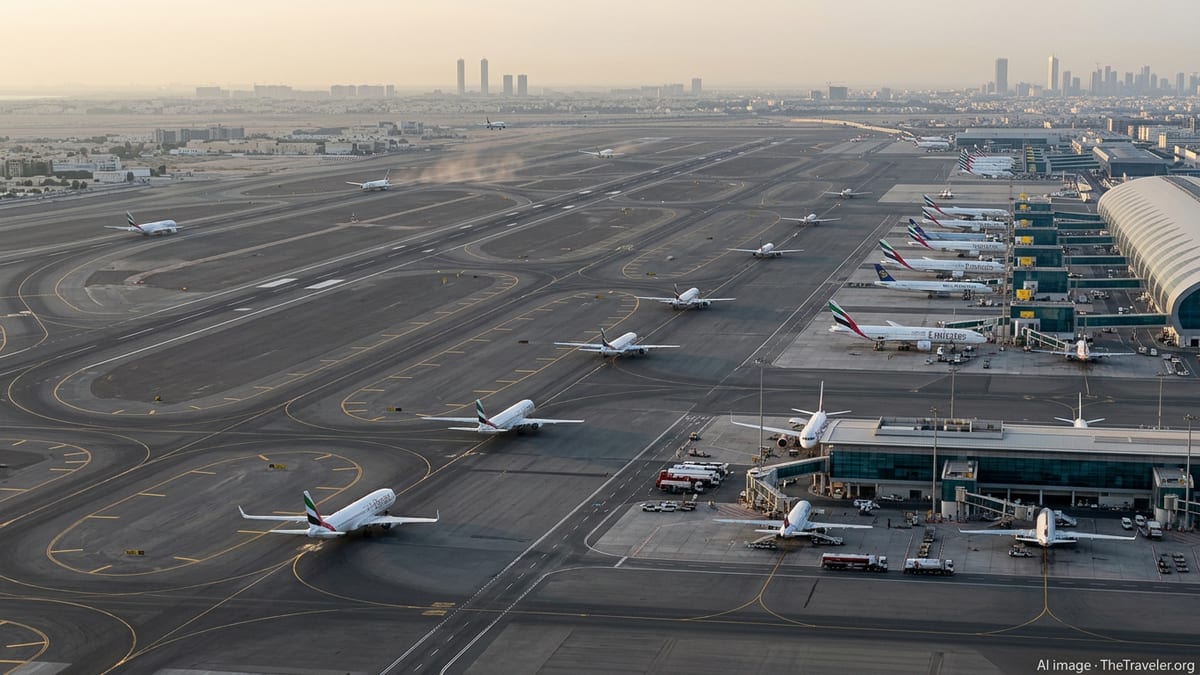
Airports in Dubai and Abu Dhabi, among the world’s busiest hubs linking Europe, Asia and Australasia, have begun operating limited departures and arrivals using the corridors. Most regular schedules remain suspended, but the carefully controlled reopening has already allowed select long-haul flights to resume, providing a much-needed outlet for travelers who had been stranded for days in hotel rooms, cruise ships and terminal buildings across the Gulf.
Aviation regulators stress that the corridors do not signal a return to normal operations. Instead, they form part of a contingency framework that allows essential movements while preserving the flexibility to tighten restrictions again should the security outlook deteriorate.
Evacuation Priority as Thousands Seek a Way Out
With commercial capacity still sharply reduced, the first beneficiaries of the UAE’s safe corridors are evacuation and repatriation flights. Governments from Europe, Asia, North America and Oceania have scrambled to secure seats for their citizens via the UAE’s reopened routes, with authorities in Abu Dhabi and Dubai coordinating closely on passenger manifests and security clearances.
Arabian and international media report that the UAE is planning hundreds of dedicated repatriation services in phases, using the emergency corridors to move stranded tourists, business travelers, migrant workers and religious pilgrims to safer staging hubs or directly back to their home countries. Airlines have been advised to prioritize passengers with urgent medical needs, families with young children and those who have already endured multiple cancellations.
On the ground, the focus has shifted to controlled crowd management rather than open-door operations. National carriers including Emirates, Etihad, flydubai and Air Arabia have urged passengers not to go to airports unless they receive direct notification that their flights are confirmed, a policy intended to avoid chaotic scenes at check-in counters and security lines.
Travelers who do secure seats are encountering a patchwork of emergency procedures. Flights may depart at short notice when new slots open inside the corridors, and routing can change mid-journey as air traffic controllers react to shifting military activity. Airlines are leaning heavily on direct messaging through apps and text alerts, while consular teams work inside UAE terminals to verify identities, assist vulnerable passengers and guard against fraudulent evacuation offers circulating online.
Safeguarding a Critical Global Transit Hub
Beyond immediate humanitarian needs, the safe air corridors are also a lifeline for the broader global aviation system, which relies heavily on Gulf hubs for traffic between Europe, Asia, Africa and Australasia. The closure and partial reopening of UAE airspace has triggered a cascade of diversions and delays as airlines reroute long-haul flights around conflict-affected zones, adding hours to journeys and straining crew and fleet schedules.
Industry analysts say the UAE’s move to carve out secure, internationally coordinated lanes is emerging as a template for crisis-era air traffic management. By concentrating movements into clearly defined corridors, air navigation authorities can maintain tighter surveillance, respond faster to threats and give commercial operators a more predictable framework for planning rotations, even when surrounding skies remain volatile.
Local tourism and business leaders acknowledge the economic stakes. Dubai and Abu Dhabi’s airports handled well over 100 million passengers annually before the crisis, underpinning hotel occupancy, trade fairs and regional headquarters for multinationals. While officials emphasize that safety considerations will always come first, the structured reopening is seen as essential to preventing a prolonged standstill that could ripple through hospitality, logistics and finance far beyond the Middle East.
For now, authorities are framing the corridors as a bridge between lockdown and normality, not a substitute for a wider political de-escalation. Aviation planners caution that any new round of strikes or missile activity could force an immediate reconfiguration of routes or another halt to traffic, underscoring the fragility of the current arrangement.
Regional Coordination and Technical Safeguards
The breakthrough in reopening parts of the sky rests on an unusual level of cooperation among regional rivals and global powers. According to aviation officials, a trilateral understanding between the UAE, Oman and Iran has been central in delineating specific flight paths considered low risk, coupled with assurances that civilian aircraft using agreed corridors will not be targeted.
The International Civil Aviation Organization has been closely involved in vetting the emergency plans and ensuring they align with global safety standards. Gulf civil aviation authorities are exchanging radar data, threat assessments and air traffic forecasts in near real time, allowing controllers to meter flows into and out of the corridors while keeping buffers between civilian and military activity.
Technical safeguards are equally critical. Airlines operating through the UAE corridors are relying on layered navigation systems designed to mitigate the impact of satellite signal interference, which pilots have reported in parts of the region. Enhanced procedures for cockpit communication, diversion planning and in-flight coordination with air traffic control have been mandated, while insurers are reassessing risk profiles route by route.
Special protocols are also in place for medical and humanitarian flights, which often require lower cruising altitudes or different routings for patient care. These operations are being slotted into the corridor system with dedicated handling, reflecting the UAE’s broader role in airlifting vulnerable civilians and patients from conflict zones in recent years.
What the New Corridors Mean for Future Middle East Travel
For travelers and the wider tourism industry, the UAE’s safe air corridors offer a cautious but tangible sign that the Middle East’s aviation arteries can be kept open even amid severe geopolitical shocks. Travel advisers are already urging passengers with flexible plans to maintain bookings through UAE hubs where possible, arguing that the corridors give these airports an operational edge over completely closed gateways elsewhere in the region.
However, the experience of the past week has also exposed the vulnerability of global mobility to regional conflict. Airlines have had to redraw route maps overnight, governments have mounted large-scale evacuations with limited notice, and millions of travelers have discovered how quickly connections can vanish when multiple airspaces shut in rapid succession.
Aviation experts say the current crisis is likely to accelerate investment in contingency planning, diversified routing and cross-border coordination mechanisms. For the UAE, the performance of its safe air corridors in the coming days and weeks will shape not only its reputation as a reliable transit hub, but also broader thinking about how to protect civilian air travel in one of the world’s most strategically sensitive regions.
As flights gradually pick up and terminals in Dubai and Abu Dhabi edge back to life, the sense among passengers and industry insiders is that the region has entered a new era of aviation, where resilience and rapid coordination are as crucial as scale. The success of the UAE’s emergency corridors may determine how confidently the world continues to fly across the Middle East in the months to come.