

More news on this day
United Arab Emirates, Qatari and Omani authorities are working with MSC Cruises and regional airlines to fly thousands of stranded cruise passengers home, after the rapidly escalating Middle East conflict shut down key Gulf airspace and brought the winter sailing season to an abrupt halt.
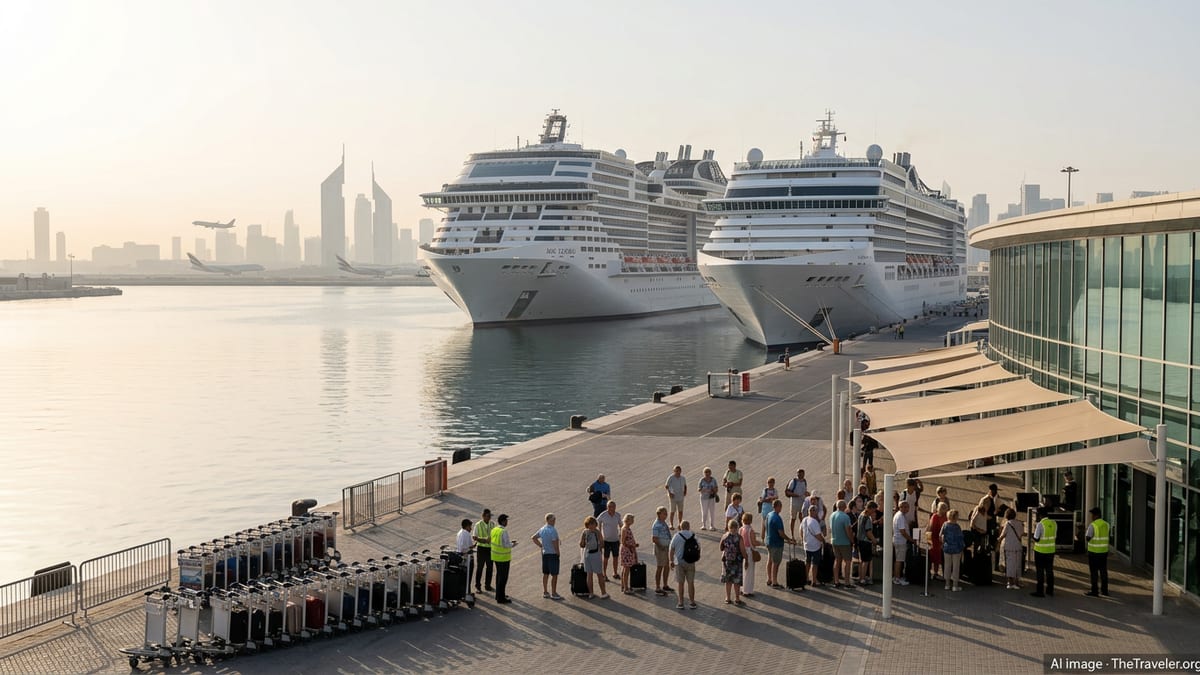
Emergency Airlifts After Gulf Cruise Shutdown
The repatriation effort follows the sudden suspension of most commercial flights across the Arabian Gulf and the effective closure of the Strait of Hormuz, which has left several large cruise ships immobilized in Dubai, Abu Dhabi and Doha. MSC Euribia, the Italian-Swiss line’s flagship in the region, remains docked in Dubai as military authorities keep civilian traffic tightly controlled and cruise operators prioritize passenger safety over planned itineraries.
MSC Cruises has cancelled the remainder of its winter program out of Dubai and Doha and shifted into crisis mode, coordinating dedicated flights and alternative routings for guests who were expecting routine seven-night sailings to ports in the United Arab Emirates, Qatar and Oman. The line says its immediate focus is on arranging seats on limited outbound flights and ensuring that guests can disembark safely as departure windows open at regional airports.
Travel industry analysts estimate that several thousand cruise guests are affected across multiple lines, with MSC among those leading proactive evacuation planning. While some travelers have opted to pay premium rates for private charters or rerouted business-class tickets, most are depending on cruise-organized air bridges and government-approved corridors to exit the region.
UAE Coordinates Flights With Emirates and Etihad
Authorities in the United Arab Emirates are playing a central role in getting cruise passengers out, as Dubai and Abu Dhabi are both major embarkation hubs and aviation gateways. With regular schedules disrupted, evacuation and special commercial services operated by Emirates and Etihad Airways are being used to move priority groups, including cruise guests whose itineraries were cut short when security alerts were raised.
MSC Cruises is working closely with both carriers to identify spare capacity on outbound services from Dubai and Abu Dhabi to key hubs in Europe, Asia and North America. The cruise line has activated round-the-clock operations teams ashore, matching passenger manifests with available seats as airlines adjust schedules in response to shifting military guidance.
For many travelers, the journey home is no longer a simple non-stop flight. Some itineraries now require overnight layovers, circuitous routings and last‑minute rebookings, but the combination of UAE aviation coordination and MSC’s charter-style arrangements is gradually reducing the number of guests still waiting aboard ships. Port officials in Dubai report that the situation at cruise terminals remains calm, with passengers urged to remain onboard until they receive confirmed flight details.
Qatar and Oman Offer Alternative Gateways
With Doha’s airport operating under heavy restrictions and several Gulf airspaces either closed or severely constrained, neighboring Oman has emerged as a critical backup gateway for stranded travelers. Muscat, which normally serves as a regional connection point, is now handling overflow passengers, including some cruise guests who were initially scheduled to fly out of Qatar or the UAE.
Qatari authorities are coordinating with cruise lines and selected carriers to move passengers to Muscat and to other approved airports where commercial departures are still possible. In some cases, guests are being driven across land borders when security conditions allow, then transferred onto onward flights arranged by their cruise operator. The process can take days rather than hours, but it offers a viable exit route while primary hubs operate with reduced capacity.
Omani officials, accustomed to acting as a secondary transit point during previous Gulf disruptions, have again stepped in to support emergency movements. MSC’s air planning teams are now treating Muscat as an auxiliary departure point, securing blocks of seats for passengers whose original tickets out of Doha, Dubai or Abu Dhabi were canceled when the crisis deepened.
Onboard Life While Passengers Wait to Leave
While repatriation flights are organized, thousands of guests remain aboard MSC Euribia and other vessels, effectively turning cruise ships into temporary floating hotels. Cruise lines have extended full board services, entertainment and medical support, assuring passengers that accommodation and meals will be provided at no extra cost until they are able to fly home.
MSC has deployed additional guest relations and shore-side support staff to handle a surge of questions about flight rebookings, insurance claims and future cruise credits. Announcements are being made regularly in multiple languages, and many passengers have praised what they describe as calm, orderly conditions on board despite the uncertainty outside the port perimeter.
However, the strain is evident for some travelers whose original return dates have already passed. Families with school‑age children and workers with limited vacation time are increasingly anxious to secure confirmed departure times. Travel agents in Europe and North America report a flood of calls from relatives seeking updates, as cruise lines relay information in tandem with local port and aviation authorities.
Broader Impact on Gulf Cruise Tourism
The emergency operation between MSC Cruises and authorities in the United Arab Emirates, Qatar and Oman is unfolding at the height of the Gulf’s winter cruise season, traditionally a period of strong demand driven by warm weather and a growing roster of fly‑cruise packages. The sudden shutdown of itineraries has dealt a sharp blow to regional tourism boards that have invested heavily in cruise terminals, shore excursions and marketing campaigns.
Industry experts say the current disruption could accelerate a wider reassessment of deployment plans in politically sensitive waters, even as cruise companies stress that such crises remain rare. Some lines have already announced that ships originally scheduled to operate in the Arabian Gulf later this spring will instead be repositioned earlier than planned to the Mediterranean and Northern Europe.
For the moment, the priority remains firmly on getting everyone home safely. Once the last stranded guests have flown out from Dubai, Abu Dhabi, Doha and Muscat, cruise lines and Gulf governments are expected to review contingency protocols, evacuation planning and passenger communication strategies, drawing lessons from an episode that has tested the resilience of the region’s cruise tourism model.