

More news on this day
Escalating conflict involving Iran and regional powers is rippling through Middle East aviation, with the United Arab Emirates joining Qatar, Kuwait, Iraq and other states in imposing sweeping airspace restrictions that have triggered mass flight cancellations, including a wave of route cuts by Oman Air.
Get the latest news straight to your inbox!
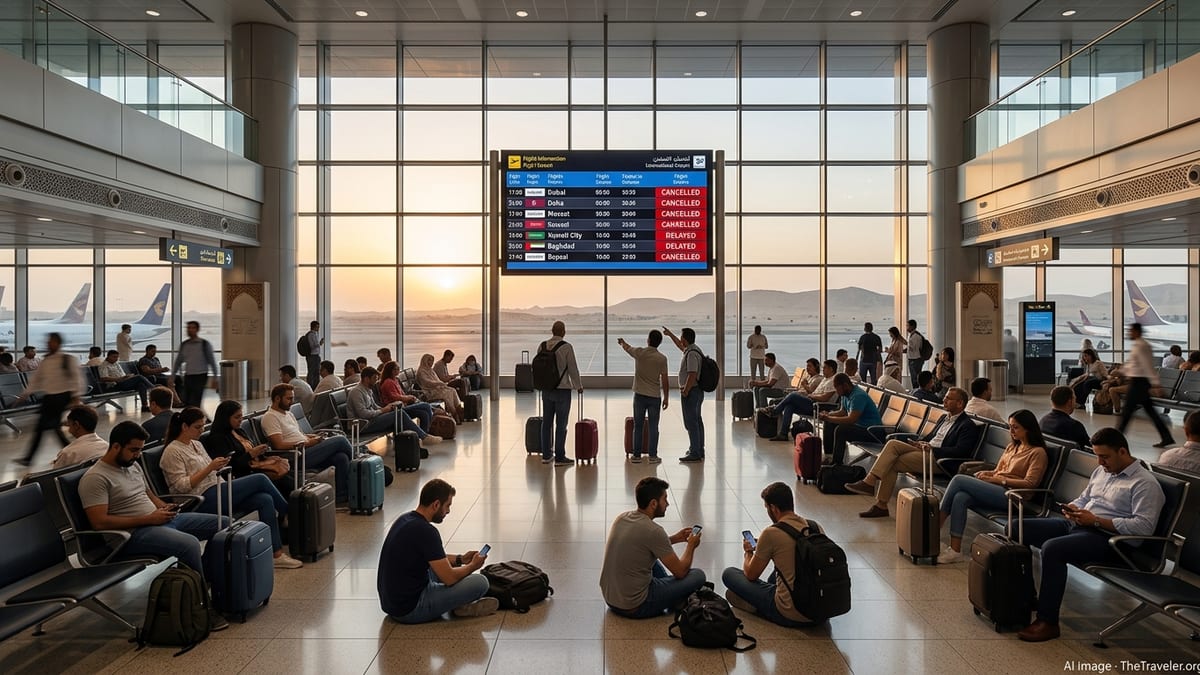
Airspace Closures Ripple Across the Gulf
Since late February 2026, a rapidly intensifying conflict centered on Iran has led multiple Middle Eastern countries to shut or severely restrict their airspace, creating one of the largest aviation disruptions since the pandemic. Publicly available flight data and industry bulletins show that airspace across the UAE, Qatar, Kuwait, Bahrain, Iraq and parts of Iran and Israel has been repeatedly closed or heavily constrained, forcing airlines to ground or reroute thousands of services each day.
Reports from airline analytics firms indicate that closures and missile-related damage at key hubs in Dubai, Abu Dhabi and Doha have at times halted normal operations entirely, cutting off some of the world’s busiest international transit points. Estimates from aviation consultancies suggest more than 4,000 flights a day have been affected at the height of the disruption in early March, stranding hundreds of thousands of passengers worldwide and stretching airline recovery plans.
Advisories issued by travel management and logistics companies in early March described a patchwork of restrictions that changed by the day, warning corporate clients that airspace over large parts of the Gulf remained unpredictable. Many carriers introduced rolling suspensions of Gulf-bound services, extended rebooking windows and relaxed refund policies as they attempted to manage the surge in disrupted itineraries.
These measures have pushed traffic onto longer detours around the Arabian Peninsula, adding hours to Asia–Europe journeys and sharply raising fuel burn. Industry notes highlight that the closure of traditional Middle East corridors comes on top of existing limits over Russia and Ukraine, leaving airlines with far fewer viable options for long-haul routing.
UAE Hubs Struggle With On-Off Closures
The UAE’s major airports in Dubai and Abu Dhabi, normally central to global connectivity, have faced repeated suspensions and partial restarts as security conditions have fluctuated. International news coverage and aviation briefings report that following the initial strikes on Iran on 28 February, both hubs saw waves of cancellations and diversions as the UAE joined neighboring states in restricting airspace.
Passenger-focused outlets tracking airline schedules note that Emirates and Etihad Airways briefly halted virtually all departures from their hubs in late February and early March before cautiously resuming limited operations. These resumptions have remained fragile, with airlines forced to operate reduced schedules, prioritize repatriation and essential travel, and build in additional contingency time for last-minute airspace changes or new security alerts.
Industry advisories emphasize that while the UAE has sought to restore a level of normalcy, underlying risks from missile and drone threats persist, leaving carriers wary of returning to full capacity. The continuing possibility of renewed strikes on infrastructure or near key approach paths has kept insurance costs elevated and forced operators to reassess crew layovers, aircraft parking and maintenance rotations in the country.
For travelers, the result is an unusually volatile environment at airports that typically pride themselves on reliable connectivity. Long queues at rebooking desks, rolling updates on departure boards and a lack of clear timelines for a full schedule restoration have become common scenes reported from Dubai and Abu Dhabi terminals.
Qatar, Kuwait, Iraq and Others Tighten Restrictions
Qatar, Kuwait and Iraq have implemented some of the strictest measures among Gulf states, with publicly available notices and travel advisories pointing to prolonged airspace closures and reduced access to key airports. Qatar’s skies have remained heavily restricted since the conflict escalated, leaving Qatar Airways to operate only a small fraction of its usual network via limited corridors and carefully timed departures when conditions allowed.
In Kuwait, government statements and aviation blogs detail a full closure of national airspace that has left Kuwait International Airport largely at a standstill for passenger services. Airlines based there, including Kuwait Airways and low-cost regional carriers, have cancelled large numbers of flights, while international operators have suspended services to the country until further assessments declare conditions safe for a broader reopening.
Iraq’s airspace, already sensitive due to prior conflicts, has seen further limits as missile trajectories and overflight risks increased. Flight tracking data and regional security briefings indicate that many international carriers have opted to avoid Iraqi skies entirely, forcing long detours to the north over Turkey and the Caucasus or to the south over the Arabian Sea, adding substantial time and cost to long-haul routes.
Other states, including Bahrain and Jordan, have also moved quickly to tighten controls or close airspace at key moments in the crisis, contributing to the wider disruption of point-to-point services and connecting itineraries across the Middle East.
Oman Air Cuts Multiple Routes Amid Heightened Risk
Oman Air, the national carrier of Oman, has faced growing operational pressure as regional air corridors have become congested or unsafe. A mid-March security briefing distributed to corporate clients noted that Oman Air had cancelled flights to nine destinations through 28 March because of security risks, underscoring how even carriers based outside the heaviest strike zones are being forced to pare back.
The affected routes include a mix of regional Gulf services and longer-haul links that typically rely on stable overflight permissions across neighboring states. Industry observers say the cancellations reflect both direct concerns about aircraft exposure to potential missile or drone activity and indirect factors such as crew safety, ground handling constraints and the difficulty of planning rotations when airspace rules can change with little warning.
Oman itself has experienced drone activity linked to the broader conflict, particularly targeting strategic ports and facilities. While commercial passenger operations in Muscat have continued under heightened vigilance, the proximity of military activity has encouraged Oman Air to limit exposure on certain corridors and to rely more heavily on alternative routings that avoid contested skies.
For travelers who once used Muscat as a quieter alternative to Dubai or Doha, the route cancellations have narrowed options and, in some cases, forced rebookings through more crowded hubs that are themselves struggling with reduced capacity.
Global Travelers Face Longer Journeys and Higher Costs
The cascading flight disruptions across the UAE, Qatar, Kuwait, Iraq and neighboring states are reverberating far beyond the region. Analyses of global schedule data show that airlines operating Europe–Asia and Africa–Asia routes have been compelled to redesign flight paths around closed Gulf airspace, bypassing traditional shortcuts through the Middle East.
Logistics and freight specialists report that many carriers have shifted to longer southern routes over the Arabian Sea or to more northerly tracks over Turkey and Central Asia. These detours commonly add four to six hours to flight times, driving up fuel consumption by as much as 20 to 30 percent on some sectors. Rising jet fuel prices tied to the conflict have compounded these costs, with several airlines introducing or increasing fuel surcharges on affected routes.
Travel advisories issued by governments and major corporate travel managers now routinely warn of possible last-minute cancellations, lengthy delays and complex re-routing through secondary hubs. Passengers are being encouraged to allow additional connection time and to monitor flight status closely in the days leading up to departure.
Industry forecasts suggest that even if hostilities ease in the coming weeks, it may take considerably longer for schedules and fares to stabilize. Airlines will need time to reposition aircraft and crew, renegotiate overflight permissions and rebuild passenger confidence in using Gulf hubs that have traditionally anchored global aviation.