

More news on this day
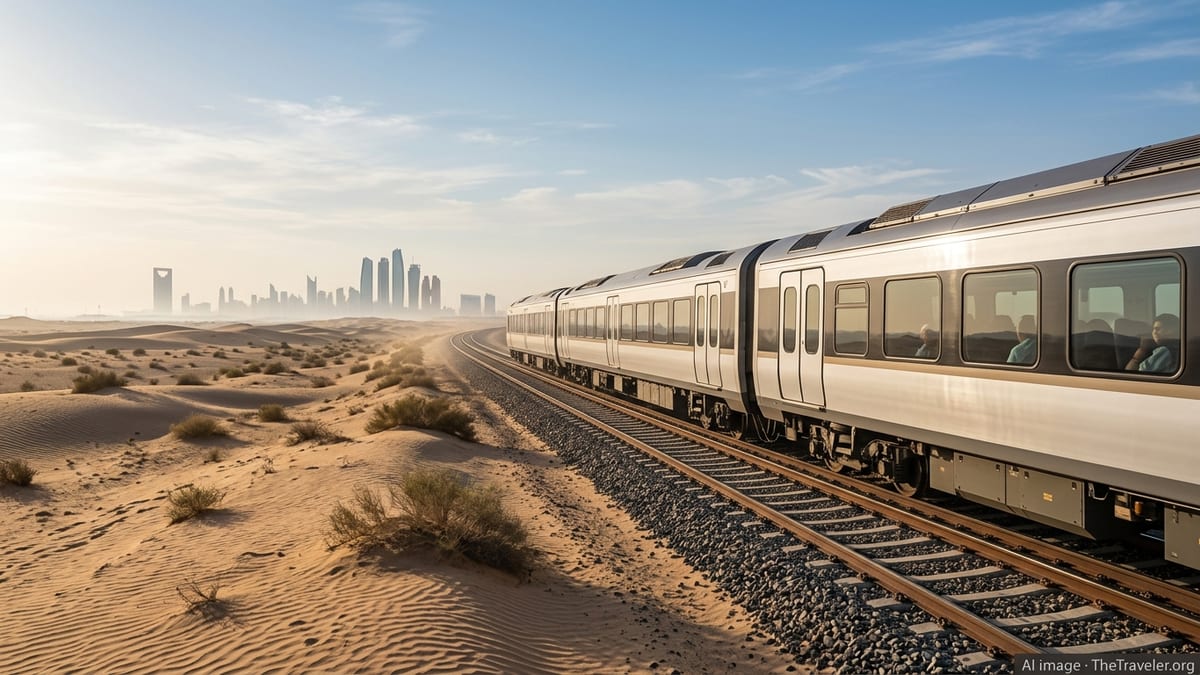
As war-linked airspace closures and missile strikes continue to snarl flight schedules across the Middle East, the United Arab Emirates’ rapidly expanding rail network is drawing fresh attention as a reliable back-up for stranded and risk-averse travelers.
Get the latest news straight to your inbox!
Airspace Closures Expose Vulnerabilities of Hub-and-Spoke Aviation
Regional conflicts have repeatedly forced governments to close or restrict airspace across the Middle East, disrupting a hub-and-spoke model that depends heavily on a handful of mega-airports. Recent attacks and retaliatory strikes linked to the Iran war have triggered temporary suspensions of flights and diversions at key hubs from Dubai and Abu Dhabi to Doha and Kuwait City, according to published coverage by major international outlets. Airlines have been forced to re-route long-haul services around large no-fly zones, increasing flight times, fuel burn and operating costs.
Reports indicate that hundreds of thousands of passengers have been stranded or delayed since late February 2026, when intensified strikes on Iran and subsequent missile launches prompted widespread airspace restrictions. Analysis by aviation data firms cited in global media shows that tens of thousands of flights touching the region have been cancelled, rerouted or heavily delayed since the latest escalation, on top of the lingering disruptions that began with Red Sea and Gulf security incidents in 2024 and 2025.
Travel advisories issued by several governments urge citizens to reassess the need for travel across much of the region, underscoring how quickly aviation links can be constrained by geopolitics. With aircraft now threading narrow corridors over the eastern Mediterranean, the Caucasus or the Arabian Sea, planners are looking more seriously at rail and road as complementary arteries for both residents and visitors.
Industry analysts note that while Gulf carriers have historically excelled at reconfiguring routes during crises, the current pattern of rolling closures and missile risks has raised questions about over-reliance on air travel for regional connectivity, especially for short and medium-haul journeys within the Gulf Cooperation Council.
Etihad Rail Highlights Resilience of Ground Networks
Within the UAE, Etihad Rail’s national network has become a symbol of transport resilience. Publicly available information from the company and recent media coverage show that freight trains have continued to move goods without major interruption, even as airlines suspend routes to conflict-affected destinations and rework their global schedules. The network currently links key industrial zones, ports and logistics hubs, allowing cargo to be shifted inland away from congested or vulnerable coastal chokepoints.
The national rail system was designed with redundancy and reliability in mind, supported by dedicated corridors, grade-separated crossings and integrated logistics terminals. Recent coverage in regional media has emphasized how these design choices are now paying off, allowing trains to maintain predictable timetables despite heightened regional uncertainty. Logistics operators have increasingly cited rail as a stabilizing factor in supply chains that also depend on volatile sea and air corridors.
Although passenger services have yet to launch nationwide, the underlying infrastructure provides a strong foundation for future intercity travel. Completed stretches connecting Abu Dhabi, Dubai and the northern emirates are already being used for freight, and planning documents indicate that stations have been sited with eventual passenger usage in mind. This dual-use approach positions the network to pivot quickly once commercial passenger operations begin.
Transport specialists say the performance of the freight system during the current crisis is offering a real-world stress test of the UAE’s long-term diversification strategy. The ability to keep trains running as aircraft divert around conflict zones is reinforcing arguments that rail can provide a steady backbone to complement the UAE’s aviation-driven connectivity.
Passenger Rail Plans Gain New Strategic Urgency
The UAE has signalled that national passenger services are on track to launch in the near term, with local outlets reporting preparations for intercity trains between Abu Dhabi, Dubai, Sharjah and other urban centres. Time Out Dubai and other regional publications have highlighted official indications that the first phase of passenger operations could begin as early as next year, transforming how residents and tourists move between major cities.
While earlier rail planning was framed largely around economic diversification, lower-carbon mobility and domestic tourism, the recent air travel turmoil is adding a security and resilience dimension. Analysts suggest that a fully operational passenger rail system would give travellers a robust alternative when flights are cancelled, connections are missed or airlines temporarily withdraw from particular routes.
For visitors who continue to arrive via the UAE’s airports, the prospect of stepping onto high-quality intercity trains rather than short-haul flights or congested highways is increasingly attractive. Rail can offer predictable schedules unaffected by shifting overflight bans and missile risk assessments, especially for journeys of a few hundred kilometres within the federation.
Travel industry observers note that even a modest initial timetable would create new options for tour operators and conference organizers seeking contingency plans. As rail timetables grow denser over time, they could help sustain tourism flows during geopolitical shocks and encourage travellers to spend more time exploring multiple emirates by land.
GCC Railway Vision: A Regional Safety Valve for Travelers
Beyond the UAE’s borders, the wider Gulf Cooperation Council Railway Project is being framed as a long-term hedge against repeated aviation disruptions. Studies and policy speeches cited across regional business media describe a 2,000-kilometre-plus network that would eventually link Kuwait, Saudi Arabia, Bahrain, Qatar, the UAE and Oman with cross-border passenger and freight services.
Recent coverage of the project notes steady progress on key segments, such as the UAE’s completed line toward the Saudi border and the planned Hafeet Rail corridor connecting Abu Dhabi with Sohar in Oman. Outlets tracking the scheme report expectations of phased completion toward the end of this decade, although timelines vary by country and funding approvals.
In normal times, such a network is promoted as a driver of intra-GCC tourism, trade and labour mobility. In periods of crisis, however, it could also serve as a vital safety valve when airlines pare routes, embassies organize evacuations and travellers seek surface alternatives to conflict-affected skies. Cross-border trains could, for example, offer additional capacity to move passengers from one hub to another when specific airports or airspace segments are closed.
Experts in regional integration argue that the current wave of airspace closures is underscoring the value of having multiple, interoperable modes of transport. If ticketing, security screening and customs procedures are made seamless, rail could support a more flexible, resilient mobility ecosystem in which passengers can be shifted between air and land corridors as conditions evolve.
What Travelers Should Expect in the Near Term
For now, travellers heading to or through the UAE still rely predominantly on air transport, with Dubai and Abu Dhabi continuing to function as major global hubs despite periodic disruptions. Reports in international and regional outlets show that Gulf airlines are constantly recalibrating flight paths to avoid high-risk areas, which can translate into longer journeys and tighter connection windows.
Rail’s role in passenger movement remains largely prospective, but the direction of travel is clear. As infrastructure projects advance and operators move closer to launching commercial services, visitors may soon find that itineraries combining flights with intercity trains become a realistic and even preferable option within the UAE and, eventually, across the wider Gulf.
Travel planners are beginning to factor rail into risk assessments and contingency planning, especially for corporate travel, large events and high-season tourism flows. Industry briefings suggest that organizations with significant regional exposure are increasingly interested in multimodal strategies that combine air, rail and road to maintain operational continuity.
For individual tourists, the practical advice remains to monitor airline notifications closely, allow extra time for connections and remain flexible about routings. Yet the experience of the current crisis is shifting perceptions about what a connected Middle East might look like. As the UAE’s rail ambitions move from blueprint to reality, the region’s travellers may soon enjoy a more balanced network in which the rails beneath the desert play almost as important a role as the skies above it.